
Mirren Bodanis
Editor-in-Chief
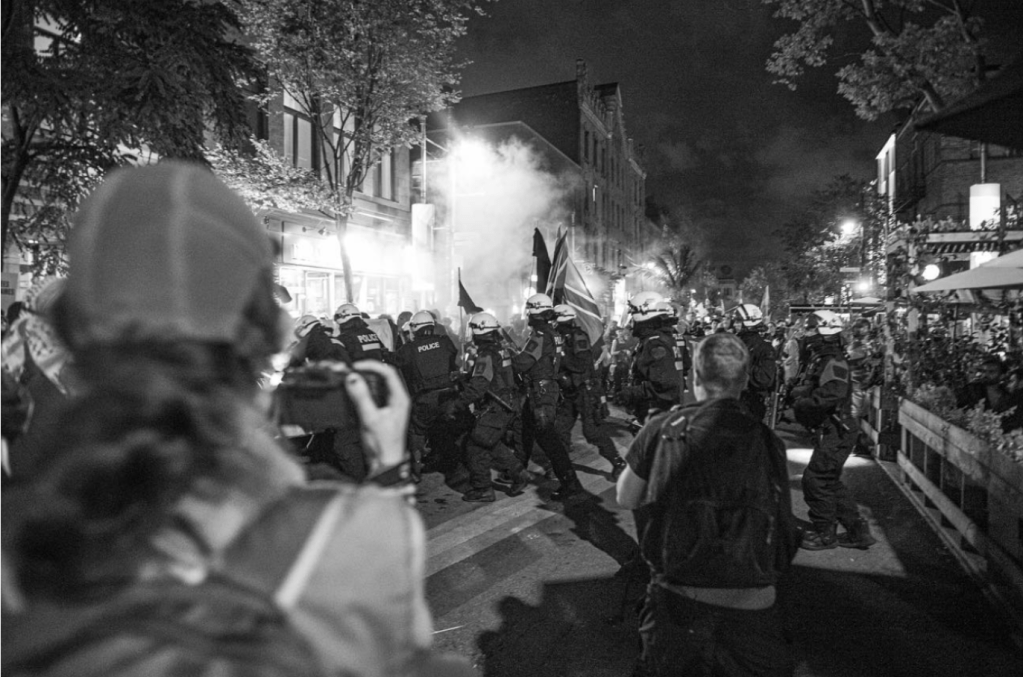
Photo by Alex (@the_purple_line)
The Wikipedia entry for “Pinkwashing” describes it as “the promotion of the gay-friendliness of a corporate or political entity in an attempt to downplay or soften aspects of it considered negative.”
Pride celebrations are a relatively recent phenomenon. To find their origins, we have to go back less than 70 years. In the 1960s, homosexuality was still generally criminalised across the globe. Decriminalisation on a national level in Canada only happened in 1969, while in the States it remained illegal throughout the 60s in every state except Illinois. CrashCourse summarises that, in 1960s America, there was “a massive effort [against queer people] by the US government and law enforcement agencies like the FBI which resulted in arrests, harassment, and sometimes the threat of public exposure.” In New York, the state refused to give licences to bars that served the queer community, and then the police would use the lack of state liquor licences as an excuse to frequently conduct brutal raids on queer bars.
Journalist Eric Markus, creator of the show “Making Gay History,” explains in an episode of NPR’s Throughline that “[In the 50s and 60s] the people who challenged police oppression were those who had the least to lose and those were often street kids. Those were teenagers thrown out of their homes who were making their living on the street as best they could. They were people who would call themselves today gender nonconforming who also had no place in the world.”
In New York City, this all culminated in the Stonewall Riots. On June 28th, 1969, police raided the Stonewall Inn, a popular queer bar; again, with the liquor licence excuse. Employees and customers alike were searched, assaulted, and dragged out of the bar by police, but both those in the bar and in the surrounding queer community fought back. The resulting protests lasted for 6 days as a series of marches and clashes with the police throughout Greenwich Village. The NYPD attempted to suppress the activists using tear gas, water hoses, beatings, and arrests, while the activists fought back with bricks and bottles in response to the police’s brutality.
One of the activists at the centre of the movement was Marsha P. Johnson, a black and trans drag queen who entered the NYC queer community as an unhoused sex worker. Among others, she founded a coalition of several radical queer liberation groups known as the Gay Liberation Front (GLF) immediately after the Stonewall Riots. GLF helped organise Christopher Street Liberation Day, a march attended by thousands on the 1-year anniversary of the Riots. The event triggered a movement of similar protests held in June around the globe, eventually becoming the pride we’ve come to know today.
Presently, Montréal’s Pride parade is organised by Fierté Montréal, who states their mission as being to “[amplify] the voices of 2SLGBTQIA+ communities to assure their representation, their inclusion and the recognition of their rights in society.” Fierté allows for-profit corporations to register with them as “Allied Members.” Amongst these is McKinsey & Company, a global management firm who generated over 15 billion dollars in revenue in 2021, and is often said to have heavily contributed to the 2008 financial crisis. The Royal Bank of Canada, who, according to CBC is the largest financier of fossil fuels, also holds an Allied Membership along with IBM, an IT multinational who provides (among other products) “National Security and Defense Solutions.” Another main sponsor of Fierté Montréal includes TD Bank, who, according to The Globe and Mail, holds an 1.8 million dollar investment in Elbit Systems and 16 million dollars invested in General Dynamics, both of which are arms suppliers for Israel – where they have been used to commit genocide on Palestinians, including, of course, queer Palestinians, as reported by UN Human Rights experts.
In response to this corporate infiltration, Montréal’s Pride parade was blocked by what CBC described as “pro-Palestinian” protestors. According to an article posted on CBC.ca “the protesters wrapped themselves in an orange banner that read ‘no justice no peace’ and chanted ‘free Palestine!,’” as well as “pride is a protest!” while surrounded by police officers. The CBC article recounts how the protests took the moment of silence as an opportunity to “blast the sound of fighter planes through loudspeakers and lie on the ground, some with red paint on their chests.”
These activists who took part in this demonstration are more than just “pro-Palestinian” protestors; they comprised mainly of two groups: the P!nk Bloc, a “Queer Revolutionary collective” who states their mission to be a “revolutionary organising force against all forms of oppression and domination.” and F.A.G.S. (a french backronym which, translated, stands for “United Anti-Genocide Faction”).
The night before Fierté Montréal’s pride parade, P!nk Bloc and F.A.G.S. served as main organisers for a “Rad Pride” held in Montréal’s gay village. An invitation to the event posted on the P!nk Bloc’s instagram reads “Let’s show that the Fierté festival doesn’t have a monopoly on our pride and our communities, let’s show that we can come together without the institutions that are complicit in genocide and exploitation.” A correspondent from The Plant attended the event, recording that the march began at the Papineau metro station and followed a course down St. Catherine through the Gay Village. Attendees wore festive costumes and makeup, and danced to music while chanting slogans such as “No Pride in Genocide!,” “Fuck your wealth, Fuck your Pinkwashing money,” “Le Village est à nous” (the Village belongs to us!) and “Bottoms, tops, we all hate cops!”
At around 9pm, before the march even began, approximately a dozen SPVM police officers surrounded the meeting point at the Papineau metro station on foot, with bikes, and in cruisers. As the march began, several dozen police officers in riot gear with shields, rifles, and gas canister launchers flanked the march. At one point a protester with a hammer struck the window of a TD Bank office, causing the riot police to immediately begin forming a line to block the entire protest by kettling with shields across St Catherine street. As the protest diverged up a street around Beaudry metro station, more police officers formed lines blocking the way, pushing the march back towards St Catherine, where riot police began launching tear gas into the crowd. The police’s escalation led to an atmosphere of panic and fear, the crowd chaos leading to damage to restaurant terraces that extended out onto the street. Although some activists attempted to resist the police’s attempts to stop the protest, by 11pm most of the crowd had fled. The very next day, SPVM officers marched alongside floats in the Fierté parade, and had their own booth at Fierté’s community day.
These more radical incarnations of pride have garnered criticism from more centrist bodies of the queer community. Fugues, a french-language queer publication in Montréal, published an article about Rad Pride, who’s translated title reads “Radicalised Fringe Group Violently Breaks Windows on St. Catherine street,” echoing the tone of the articles in the first paragraph. The article claims that only “a few tens of protestors” attended the march, when photos of the event and The Plant’s correspondent attest that at least a few hundred were there. On the protest that blocked the Fierté parade, cbc.ca quotes a drag queen who participated in the parade saying “No matter how they think, what they want to do with the politics, we’ll still be there and they cannot erase us,” while The Gazette began their coverage by writing that the parade-protestors “halted” “a joyous event on a Sunday afternoon.”
In the weeks after Pride, The Plant spoke with “B,” a Dawson student and queer activist of 5 years who attended Rad Pride and the Fierté parade-protest and has worked with the P!nk Bloc and F.A.G.S, to hear their perspective on why they felt the need to contribute towards a more radical pride: “I was seeing how a lot of liberals were like, ‘oh, well, everything’s good now. People are getting represented, there’s rainbows everywhere and Netflix shows about queer romance. They equate that with things being okay. […] I feel like a lot of people don’t see these corporations and these big systems like the police. […] It’s absolutely absurd to have them [in pride], to have banks that are funding multiple genocides, it’s just not what pride is.” They stressed the desperation with which they feel this pinkwashing needs to be fought. “We have to show them that we’re willing to take action. Nobody dies from windows being broken, but there’s bombs in Gaza killing people every day, and there’s police brutality against queer and unhoused people.” “And I understand where there’s the concern of families with queer parents who want to bring their kids to pride or queer youth that want to go to pride. […] they tend to misconstrue it as ‘oh, well, they don’t want pride at all’. They just want to block it, They just want to break things in the gay village. People would say that the protesters were homophobic, which is actually the opposite. Pride is a protest and we need it now more than ever with the rollback of everyone’s rights that we’re seeing and the rise of the far right.”
It’s absolutely absurd to have them [in pride], to have banks that are funding multiple genocides, it’s just not what pride is.
“B”, Activist
Demonstrations against Pride Parades this summer weren’t exclusive to Montréal. In Toronto, the parade was stopped an hour early by the Coalition Against Pinkwashing, who decided to interrupt the parade after Toronto Pride refused to meet to discuss demands to divest from corporations with ties to Israel. Similar disruptions occurred during Halifax and Victoria pride as well.
As genocide-complicit corporations capture pride and queer rights are being rolled back accross the country, Montréal’s queer community is re-examining how their rights were won in the first place.
 The Plant
Leave a comment