

Ezra Bucur
Creative Writing Editor
Photo via Sartorial Geek
In the world of character creation and fiction, the use of tropes is inescapable. One does not have to look too deep to see this in some of the world’s oldest literary works. Common examples from the “damsel in distress” and the “heroic knight” of childhood fairytales, to the “blonde bombshells” and “rugged cowboys” of Old Hollywood come to mind when thinking of these stereotypes. Each character type has a specific, unchanging set of characteristics and a designated part that they must always play. As times changed and evolved,artists from marginalised communities dissected the many problems behind all these tropes. These critics pointed out that behind the seemingly innocent and sometimes comedic veneer of these characters, there often exists a racist, sexist or homophobic message being peddled to audiences. For example, the damsel in distress trope became more and more critiqued by women, namely due to the popularity of the New Woman movement of the 1920s. Ultimately, what could be downplayed as being “just a work of fiction” can impact the way that real people would be perceived. As a result, these archaic tropes slowly disappeared from modern productions, following the trend of various activist and artistic movements of the latter 20th century that sought to question and deconstruct the world around them. If old character archetypes were to be utilised in movies, it would serve as a vessel to dismantle and critique these old ideologies. Despite this push to modernise fictional characters, they remain derived from the very same tropes that created and influenced them, a reflection of the society their authors exist in. This means that modern tropes, even when they are trying to distance themselves from old stereotypes, can lead to peddling these same outdated ideas. One of such tropes is the Manic Pixie Dream Girl, a reimagined “modern” woman that nevertheless falls into the same pitfalls as many older female character archetypes.
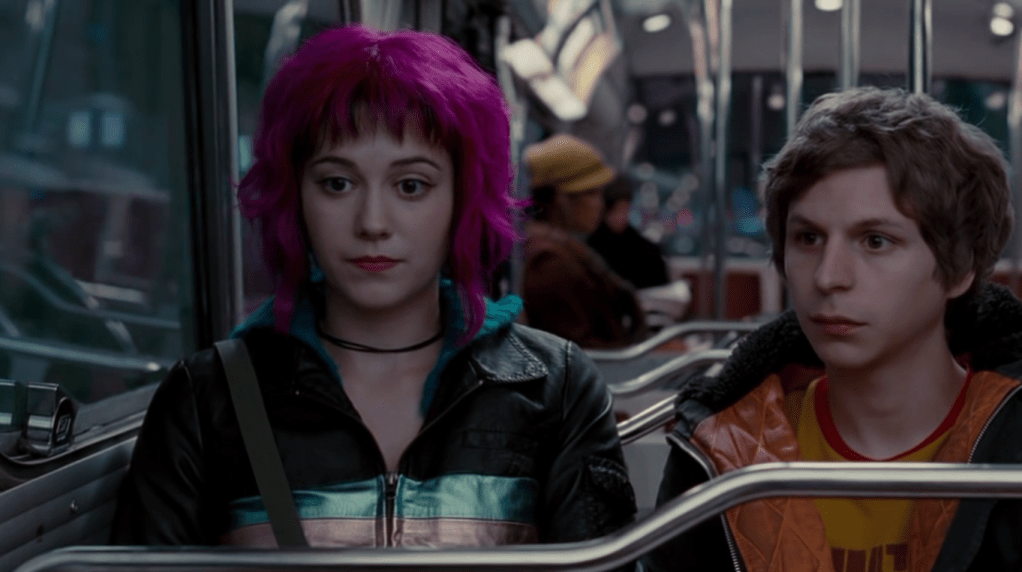
The term Manic Pixie Dream Girl was first coined by film critic Nathan Rabin in 2007, in his review of the film Elizabethtown (2005). In his review, he described Kristen Dunst’s character as such, writing that her character only sought “to teach broodingly soulful young men to embrace life and its infinite mysteries and adventures”. Whilst he is the originator of the term itself, the trope had existed for years prior to that, with Rabin listing out the embodiment of these tropes in a 2008 article in The A.V Club. However, who comes to mind most vividly when this trope is brought up are Clementine from Eternal Sunshine of the Spotless Mind (2004), Ramona Flowers from Scott Pilgrim V.S The World (2010) and Summer from 500 Days of Summer (2009).
The Manic Pixie Dream Girl is a girl unlike any that the viewer has ever seen on screen. She’s different. Her hair is dyed in bright colours, her fashion sense leans on alternative styles. Her music taste is obscure and underground. All of these character traits exist in perfect correspondence with how she presents herself. She is mysterious, quirky, staying away from all those other girls, as she incarnates otherness. Most importantly, however, is that no matter how much she stands out, she remains a conventionally attractive (and usually always white) young woman. Indeed, the Manic Pixie Dream Girl does not serve herself, but rather the relatable male protagonist and the male viewer’s fantasy. Throughout the runtime of the movie, she assists the main, male character, giving him a sense of purpose he was unable to find within itself. All that could make a Manic Pixie Dream Girl grow and develop as her own person is instead thrusted upon the male character. For him, she is a life lesson, a goal to attain, a reason to grow and exist as a better man. On the flipside, his female counterpart rarely gets any of that development herself. Ironically, despite these women being depicted as more “deep” and “interesting” than the fellow women within their own universe, they become a flat, one-dimensional character in the real world. The Manic Pixie Dream Girl is less of a character in her own right, acting instead as a plot device, a tool to advance the male character’s soul-searching journey. In this way, she does not differ from other older female tropes. Notably, the damsel in distress also serves to build courage within the male character, so that he can one day hope to “save her”. The only difference this time is that the onus of “saving” is on the man, using the woman as a proxy for his character growth throughout the movie, ignoring any struggles she might face.
Most importantly, however, is that no matter how much she stands out, she remains a conventionally attractive (and usually always white) young woman.
However, whilst the idea of the Manic Pixie Dream Girl is flawed in the way in which it portrays women on the silver screen, this trope does not exist within a vacuum. “Unconventional” interests, traits or personality types are worshipped and venerated granted the woman who possesses them is seen as attractive, but only on a surface level. Women who dress themselves in alternative ways or have tastes that “differ” from what women are supposed to like to get fetishized and harassed. This behaviour is even more flagrant online, with many men feeling emboldened to post degrading and sexual comments under any girl who fits their preconceived notions of a “life changing experience”. Neurodivergent women are especially vulnerable to this mischaracterization, as their quirks and differences in presentation are seen as commodities by romantic prospects. Some men are drawn in by the enthralling Manic Pixie Dream Girl from their favourite movies, expecting real women to behave the same way. On the flipside, women feel pressured to “help” the men they care about, as they are once again told that they serve no purpose besides aiding the men that see them as nothing but a prospect. They also feel the need to adopt this persona of otherness and difference in order to even feel seen, even if they will be perceived in all the wrong ways. Through attempting to create a girl that stood out, that was different, male writers and directors have instead reinforced the patriarchal narrative that a woman can only exist to be a companion to a man, but never her own person.
Neurodivergent women are especially vulnerable to this mischaracterization, as their quirks and differences in presentation are seen as commodities by romantic prospects.
Despite this, art is experienced by all, not just the initial target audience. This means that many women, especially those who are neurodivergent or otherwise just considered “unconventional” find solace in characters who fit the Manic Pixie Dream Girl archetype. This may be due to a similar musical taste presented by these characters, or a similar style of dress. Many girls also feel inspired by the way these women present themselves and aspire to look and act like them. For example, many girls enjoy “The Smiths”, much like Summer from 500 Days of Summer, or dress in a similar fashion as Ramona Flowers from Scott Pilgrim v.s the World. This can be an inspiring result of these movies and can even serve as representation for many women out there. Unfortunately, this comes at the cost of being put into another box. Neurodivergent women are fetishized and infantilised for their neurodivergent traits. From an early age to further into adulthood, they are othered, deemed “quirky” and “awkward” by men and women alike. However, these same traits are fetishized when displayed on a Manic Pixie Dream Girl, as she is a fantasy that cannot respond, argue or fight back against those who project an image onto her. Neurodivergent women are thus coveted and fetishized for traits that are a product of a neurological condition, and not treated as fully fledged human beings by predatory men. Whilst toxic relationships and mistreatment of women has existed long before the Manic Pixie Dream Girl, these tropes still misrepresent the reality of being a neurodivergent woman, or even just a woman who has never truly fit in.
Ultimately, art reflects the society in which it is created, and vice versa. This means that whilst there are definitely works of fiction that challenge the idea of The Manic Pixie Dream Girl written by women of all kinds, these works are not reaching the audience they deserve due to the grip patriarchy has on commercialized artwork. However, this does not mean that the viewer cannot make a choice to seek these works out and break their bubble of what female characters can look like in various artistic projects. For example, Fleabag (2016) by Phoebe Waller-Bridge deconstructs what hides behind quirky and wild Fleabag, exploring her past and struggles. Ultimately, The Manic Pixie Dream Girl is a trope that stems not from hate, but from ignorance and dismissal of women’s unique struggles and personal autonomy. This does not mean it is exempt from critique and improvement. Like many other archetypes before it, art will evolve and change, hopefully highlighting the perspectives of these “strange” and “unconventional” women rather than the men who treat them as a developmental chapter of their lives. ⟡
 The Plant
Leave a comment