

Sanad Hamdouna
Co-Editor-in-Chief & Visual Arts Editor
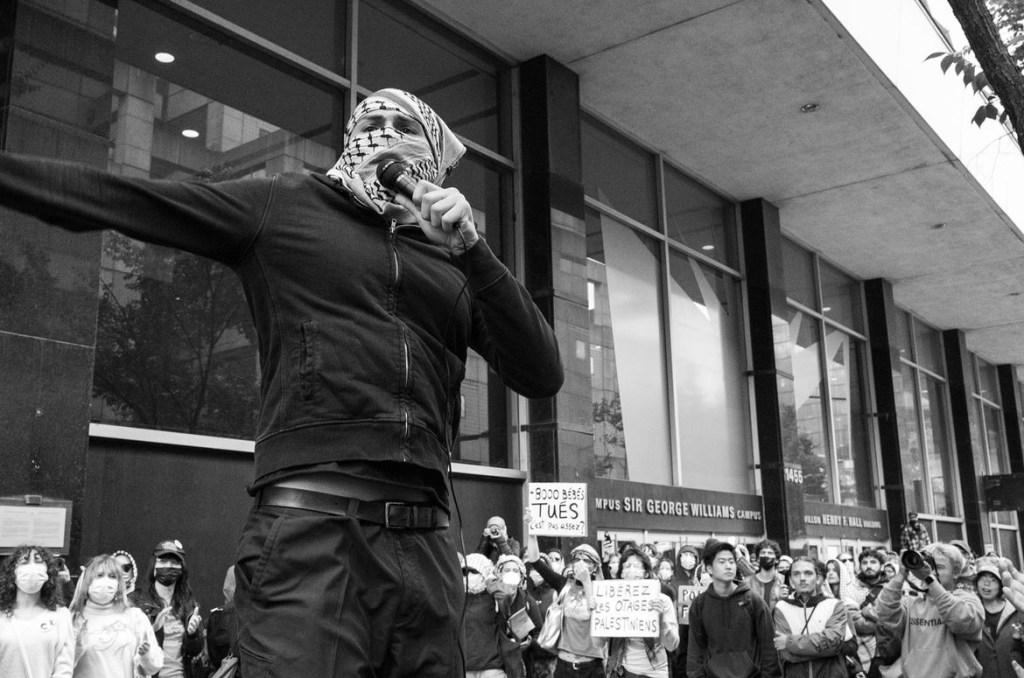
Photo by William Wilson @williamwilsonphotography, 7/10/2024
On October 7th 2024, hundreds of students from Universities and Cegeps across Montreal staged a walkout to mark a year since Hamas fighters breached the wall surrounding the beseiged Gaza Strip and attacked Israel, as well as to respond to one year of genocide in Gaza. They once again demanded their universities divest their finances and academics away from Israel, weapons manufacturers, and other war profiteers.
Yet among the usual chants of “free Palestine”, new chants also emerged, this time focusing on Lebanon, which had suffered a number of savage Israeli assaults in the previous weeks.
Hezbollah, a Lebanese faction with a significant armed wing, has been exchanging fire at a low intensity with Israel since October 8th 2023 in solidarity with the people of Gaza. But things escalated dramatically on the 17th of September, when thousands of pagers simultaneously exploded in Lebanon. The next day, walkie-talkies and other small devices reportedly exploded too. These explosions injured nearly 3500 people and killed 42 according to the Lebanese Ministry of Health.
This act of terror was allegedly part of an Israeli plot targeting Hezbollah operatives, yet according to Amnesty International: “Evidence indicates that those who planned and carried out these attacks could not verify who would be harmed when the devices exploded.” Videos of the attack quickly circulated online depicting pagers exploding in grocery stores, residential streets, and other busy public places, giving further evidence to the indiscriminate and careless fashion of the attacks, which led to the maiming of hundreds and killing of dozens of Lebanese civilians, including children. Additionally, Amnesty indicates in their report that these pagers were not only distributed to Hezbollah fighters, but also to employees of civil institutions, such as healthcare workers.
These consequences are precisely why booby traps are largely prohibited under international law; indeed, this entire operation may violate the UN 1996 “Protocol on Prohibitions or Restrictions on the Use of Mines, Booby-Traps and Other Devices”.
Like with any act of terror, the psychological impact of this attack on the civilian population is intense, creating profound anxiety around the use of everyday technological items, such as phones and tvs, in fear they may also be booby trapped. One Lebanese civilian told Amnesty: “I left my phone at home, I didn’t open a laptop, I became paranoid. […] I don’t want people next to me. Because if they have a device, I am gone with them.”
If the pager terror attack wasn’t already considered a declaration of war, Israel then launched an intense bombing campaign starting on the 23rd of September. On the very first day of this bombing campaign, Israel killed 558 Lebanese people, including 94 women and 50 children, and injured at least 1835 others according to the Lebanese Ministry of Health. Israel also started the day by attacking ambulances, health centers, and hospitals, killing 4 medics and injuring at least 16 others. A chilling reminder of Israel’s recent willful destruction of the Palestinian healthcare system in Gaza, leading to tens of thousands of excess deaths.
On the 27th of September, Israel killed Hassan Nasrallah, who had led Hezbollah for the last 32 years, in a wave of explosions that also leveled six apartment buildings, according to Al Jazeera The Lebanese Foreign Minister, Abdallah Bou Habib, later revealed in a CNN interview that Nasrallah had agreed to a 21 day ceasefire shortly before he was assassinated by Israel. Rumours of a similar deal had been in circulation shortly before Israel assassinated Hamas’ chief negotiator, Ismail Haniyeh, in July.
Despite decapitating Hezbollah, Israel said that it will keep bombing Lebanon. According to Al Jazeera, Israeli attacks across Lebanon have killed at least 2071 people as of October 7th 2024, many of whom were civilians, and—according to the UN refugee agency—displaced as many as 1.2 Million civilians, nearly a quarter of the country’s population.
Israel’s attacks have long been criticized as disproportionate and inflicting too much damage on civilians and civilian infrastructure, but according to the Institute for Middle East Understanding (IMEU), that’s intentional.
The Dahiya Doctrine, is an Israeli military doctrine that calls for “the deliberate targeting of civilians and civilian infrastructure” with overwhelming and disproportionate military force
The Dahiya Doctrine, is an Israeli military doctrine that calls for “the deliberate targeting of civilians and civilian infrastructure” with overwhelming and disproportionate military force, seemingly to punish civilians and push them to become hostile to enemies of Israel operating in their country. There is no evidence suggesting the doctrine has been successful. According to IMEU, it was made official in 2006 and was named after the southern Beirut suburb of Dahiya, where Hezbollah held its headquarters. The suburb was leveled in Israel’s 2006 attacks, which killed around 1000 civilians, a third of them children.
Evidence suggests Israel is once again applying the Dahiya Doctrine to the suburb and across Lebanon. Like with Gaza, Israel is deliberately killing civilians in Lebanon, and Canadian universities like McGill and Concordia still seem unbothered by their role in facilitating these atrocities.
 The Plant
Leave a comment