

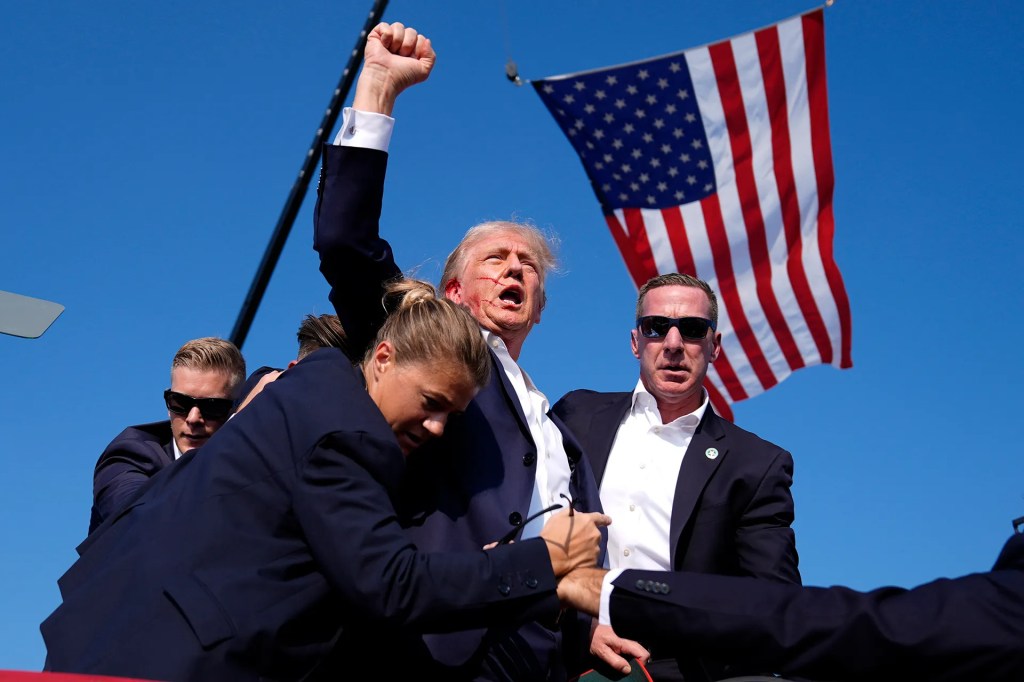
Abigail Oyewole
Staff Writer
Photo via The New Yorker
If you were told a few years ago that a man facing multiple criminal charges would have a real chance of winning the American presidential election, you would have laughed – but here we are today. As reported by BBC News, on May 30, 2024, the Presidential nominee for the Republican party became the first former president to be criminally convicted in American history. Why does Donald John Trump, despite being a controversial figure with radical ideologies and provocative strategies, have a large base of supporters in the Presidential race? How do Trump’s campaign strategies, such as populism and appealing to a target demographic, work to garner a large base of loyalists?
The race’s two main contenders are Trump and Harris. New York Times data shows that, as of October 5th 2024, Trump has a 47% chance on the national polling average, taking the lead in North Carolina, Georgia, and Arizona. No presidential candidate has taken a significant lead towards the 270 electoral votes that are required to win. This race is said to be the first election since 2004 where candidates are so deadlocked in the seven “pivotal” states. Although Harris is slightly ahead of Trump, the polls have a reputation for underestimating Trump. After the presidential debate, the poll averages in Pennsylvania and Arizona slightly shifted in favour of Trump. This is advantageous for him as Arizona is one of the key states. The republican nominee currently has 219 electoral votes and can come out triumphant if he manages to emerge in the lead in the key states, or at least in most of them.
“Trump’s escalating threats to pervert the criminal justice system need to be taken seriously,”
Michael Bromwich, former Justice Department Inspector General
In spite of his strong national polling average, Trump is not exactly known for being agreeable. Considering his numerous ongoing criminal cases, he is arguably the most controversial figure to ever run for president. ABC News details a summary of his charges related to the 2020 election and January 6th insurrection: “Trump was charged with four counts: conspiracy to defraud the United States, conspiracy to obstruct an official proceeding, obstruction of and attempt to obstruct an official proceeding and conspiracy against rights”. Trump allegedly attempted to coerce election officials to alter the results, spread false narratives about the results, and instigated the January 6th capitol riot to delay Biden’s ascension to presidency. The supreme court ruled that Trump, being a president at the time, has immunity for any official actions taken. While he vehemently denies the charges, stating that it is a plot by the Biden Administration and democrats, Trump still faces four criminal counts as a private citizen and political candidate. He is unrepentant about all charges and refers to them as “fake”. He vows to retaliate against his opponents whom he claims “lie and steal and cheat on elections” to “destroy America”. Based on his words, it is not hard to deduce that Trump plans to utilise the US justice department to go after those he deems his enemies, the most notable being Joe Biden. “Trump’s escalating threats to pervert the criminal justice system need to be taken seriously,” said the former justice department inspector general Michael Bromwich. “We have never had a presidential candidate state as one of his central goals mobilizing the levers of justice to punish enemies and reward friends. No one has ever been brazen enough to campaign on an agenda of retribution and retaliation”.
“We have never had a presidential candidate state as one of his central goals mobilizing the levers of justice to punish enemies and reward friends. No one has ever been brazen enough to campaign on an agenda of retribution and retaliation”.
Michael Bromwich, former Justice Department Inspector General
In addition to his ongoing criminal cases, Trump’s policies and opinions have also gained traction for being controversial. Agenda 47 is a list of planned policies and proposals Trump intends to implement if he is re-elected into office. A few of those include ending gender-affirming care, eliminating the United States’s accountability to climate change, massive deportation, ban on birthright citizenship as part of an effort to curb US immigration, and stronger police protection, which will be detrimental for those on the receiving end of police brutality. Agenda 47 further proposes increasing the reach of the president over the executive branch. It also features similar proposals to Project 2025. This is a set of conservative political initiatives created by Heritage Foundation, a conservative think tank based in Washington, D.C. Project 2025 is headed by two former Trump administration officials, Paul Dans and Spencer Chretien, former special assistants to Trump. According to BBC News, Project 2025 proposes that the entire federal bureaucracy, including independent agencies such as the Department of Justice, be placed under direct presidential control, a controversial idea known as “unitary executive theory”. Key proposals in Agenda 47 that mirror Project 2025’s are the ban on transgender people from serving in the military and an increase in presidential power. Despite glaring similarities in proposal and officials, Trump denies his involvement in Project 2025. On July 5th, he wrote to his social media platform on Truth Social, a property of Trump Media, “I know nothing about Project 2025. I have no idea who is behind it. I disagree with some of the things they’re saying and some of the things they’re saying are absolutely ridiculous and abysmal. Anything they do, I wish them luck, but I have nothing to do with them”.
Taking all this into account, many wonder why and how it is possible for Donald Trump, a twice impeached former president facing 91 criminal counts, to stand a reasonable chance of returning to office. He has a blatant disregard for the rule of law and for the justice system of the country he seeks to serve. Given his words, actions, and policies, it seems absurd to have such a large base in the presidential race. However, it is not, considering the effect of populism on the people.
Populism, according to the Oxford dictionary, is a political approach that strives to appeal to ordinary people who feel that their concerns are disregarded by established elite groups. It is an approach that exploits the disgruntled, presents someone like Trump as a saviour, and designates the opposing side as enemies working to keep them oppressed (the Democrats in this case). It seeks to provoke the feeling of suppression to convince the disgruntled that they are victims and are doing nothing wrong except defending traditional values. Trump has turned to populism because it is a tool that has proven effective since the times of George Wallace and Ronald Reagan. Trump’s brand of populism can be characterised as one that reflects nativist, nationalist, and authoritarian ideologies, while presenting himself as the only one capable of saving America. As reported by New Lines Magazine, last spring at a rally in Waco, Texas, Trump told his loyalists: “I am your warrior. I am your justice. And for those who have been wronged and betrayed, I am your retribution!”. Trump’s populism is emotional in the sense that it aims to provoke anger against political institutions, ethnic minorities, women, and migrants. He makes false claims and induces fear to frame them as a threat to America and its traditional values. Trump presents himself as a saviour to the “forgotten men and women of America”. A successful factor in his brand of populism is the fear of status loss. “They [working-class white Americans] fear a loss of attention. A loss of validation. These are people who have always had racial privilege but never had much else. Many feel passed over, ignored. Trump listened to them and spoke their language when few other politicians did,” says Andrew Cherlin, a sociologist at John Hopkins University. The effect of Trump’s use of populism can be seen in his cult personality. It consists of extreme loyalists that exhibit unwavering support to their leader whom they view as a hero capable of protecting America from “threats”. Trump declared at the Republican convention “I am your voice” and “I alone can fix it”. His ability to commandeer and identify with followers in a personality cult has proved to be a useful skill and strategy. Such followers do not necessarily base their support on political views, but on psychological needs such as assurance in a situation where they feel threatened, in a society that is quickly evolving and giving more voice to marginalised people.
In spite of legitimate criticism and controversy, Trump has a large base in the ongoing presidential race. This is largely due to his primary strategies namely, populism, identifying with the common people and appealing to a target demographic. Trump’s base remains resolute because his supporters mainly consist of staunch loyalists that believe that he can do no wrong, and that even if he does, it is a necessary act to protect the nation and “make America great again”. With Trump rapidly gaining on Kamala Harris, America should think about what will happen to democracy should Trump ascend to power. God Bless America!
 The Plant
Leave a comment