

Sanad Hamdouna
Visual Arts Editor & Co-E.i.C
Photo Via CNN Photo by Mahmud Hams @mahmudhams
“It’s Bissan from Gaza—and I’m still alive” is the title of the AJ+ documentary that won the 2024 Emmy award in the Outstanding Hard News Feature Story category, but also the opening phrase in every video from the ground in Gaza by Palestinian Journalist Bissan Owda.
In her 8 minute documentary short film — a compilation of her shorter daily videos originally published on her Instagram account @wizard_bisan1 – Owda walks the viewer through her day in the camp set up inside the courtyard of Northern Gaza’s Al-Shifa hospital. She documents the long lines to use the bathrooms, the squalid living conditions of Palestinian civilians forcefully displaced by israeli bombing, the young boys volunteering to clean up hospital grounds, the long lines for meagre food and water, the orphaned children with no time to mourn, the overwhelmed hospital staff, and—of course—the chilling sound of Israeli war planes and bombs surrounding the hospital.
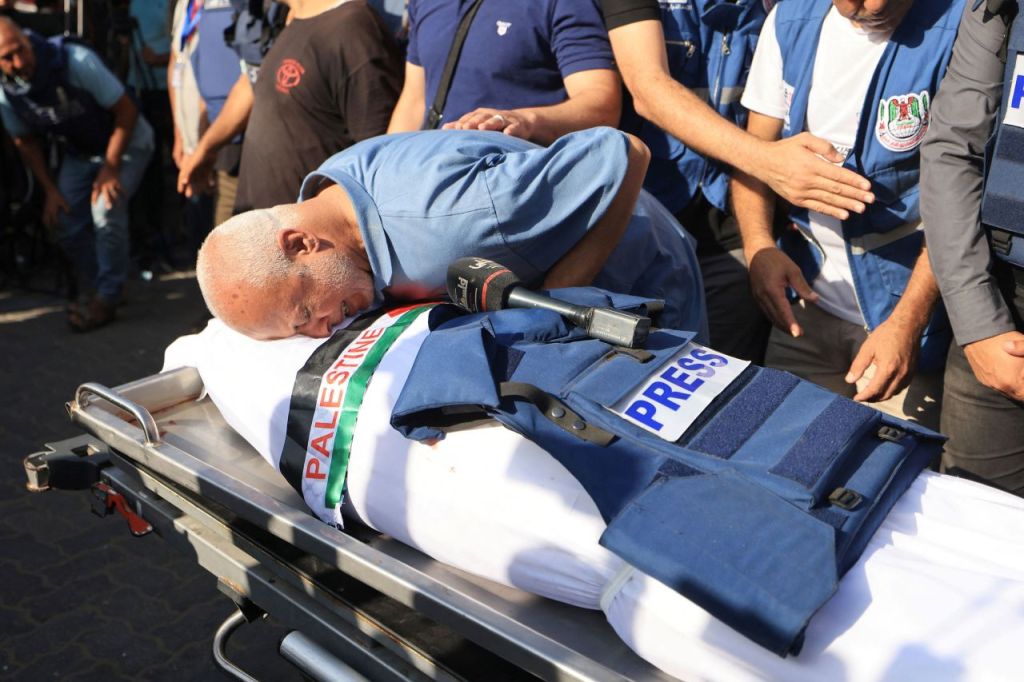
Her work and the work of other Palestinian journalists documenting the reality on the ground in Gaza has been instrumental in bringing awareness to the situation, humanising Palestinians, countering Israeli propaganda, and dispelling the fog of war. Yet this critical work comes at a heavy price: a target on their back. Indeed, Reporters Without Borders counted over 140 journalists killed by Israel in Gaza since October 7th 2023, and the Government Media Office in Gaza reported 180 journalists and other media workers killed in the same timeframe.
Both Reporters Without Borders and the Committee to Protect Journalists (CPJ) have declared Gaza the most dangerous place for reporters, and Israel’s ‘war on Gaza’ as the deadliest in modern history for journalists. Yet due to Israel’s ban on foreign journalists entering the Gaza Strip, Palestinian reporters are the ones facing the brunt of Israel’s brutality.
Ismail Al Ghoul was a 27 year old Palestinian broadcast reporter for Al Jazeera and one of the few journalists remaining in the north of Gaza, where Israel’s siege is particularly brutal. He was also the father of Zeina, a toddler who was displaced to the south along with his wife and the majority of his family. According to the Al Jazeera report, he was assassinated along with his cameraman Rami Al Rifi by an Israeli strike on their car as they were leaving the Shati refugee camp, west of Gaza City. The car was clearly marked with “TV” and both of them were wearing blue press vests and helmets, clearly demarcating them as journalists. Witnesses and reporters nearby told CPJ there were no clashes taking place in the area. Al Jazeera aired footage of the moments after the strike and of Al Ghoul and Al Rifi’s bodies being removed from the car. Al Ghoul’s head had been severed from his body by the blow.
Shortly after his assasination, Ismail Al Ghoul’s brother, Jihad, who used to accompany him as he went out for press coverage, said in an interview with The New Arab: “Ismail told me that [he] was not afraid of death, but he was afraid of leaving his daughter alone in this terrifying world.”
On August 1st the IDF admitted they had assassinated Al Ghoul in a statement on X (formerly known as Twitter) and accused him of allegedly being part of Hamas’ military wing by teaching them “to record operations”, without presenting any evidence. Al Jazeera immediately issued their own statement, calling the IDF’s accusations fabricated and baseless. Their statement also points out that “the Israeli occupation forces had previously abducted Ismail on March 18, 2024, during their raid on Al-Shifa Hospital, detaining him for a period of time before his release, which debunks and refutes their fake claim of his affiliation with any organisation.” Yet the IDF did not give up on trying to justify their actions.
On August 3rd they published a screenshot of a document allegedly found on “Hamas computers”. The document listed Al Ghoul as an engineer in Hamas’ military wing and showed that he had received a Hamas military ranking in 2007–when he would have been 10 years old, yet it also indicated that he had only joined Hamas in 2014, at the age of 17. Al Jazeera put the document’s authenticity into further question by pointing out that the photo of Al Ghoul used in the document was of a basic Palestinian ID card and that anyone could alter the information on it using a simple photo editing software.
Al Ghoul’s story is only one of Israel’s many targeted murders of journalists, who—under international law—are meant to be protected in times of war. Yet Israel attempted to sideline the law and justify their actions by smearing those they’d already killed, when their victims no longer had a voice to defend themselves.
Israel has now accused six surviving (as of October 29th) Palestinian journalists working for Al Jazeera of being members of armed militant groups. The six journalists are: Anas Al Sharif, Talal Aruki, Alaa Salama, Hossam Shabat, Ismail Farid, and Ashraf Saraj. Yet Reporters Without Borders stated that “the mere publication of these documents does not constitute sufficient proof of affiliation, nor a licence to kill.” Additionally, the Committee to Protect Journalists published a statement on X saying that they were aware of the accusations, and that “Israel has repeatedly made similar unproven claims without producing any credible evidence.”
Al Jazeera issued their own statement online, condemning Israel’s accusations and warning them not to use allegations as justification to target their journalists. The statement also calls the allegations unfounded and fabricated in “a blatant attempt to silence the few remaining journalists in the region, thereby obscuring the harsh realities of the war from audiences worldwide.” Indeed, the six journalists named are some of the last few remaining in northern Gaza, where Al Jazeera is the only international media outlet documenting Israel’s siege and bombardment of Palestinian civilians and the resulting humanitarian catastrophe.
Journalism from the frontlines, like that of Al Jazeera’s journalists, is critical to capturing the devastation of war and informing the public on the realities on the ground. This information can influence public opinion, policy decisions, and slowly bring about necessary change. In fact, in 2015 the UN Security Council passed a resolution strengthening the protection of journalists, stating that “the work of a free, independent and impartial media constitutes one of the essential foundations of a democratic society”. Additionally, the 2020 UN Chief stated that “the fundamental role of journalists in ensuring access to reliable information is essential to achieving durable peace, sustainable development and human rights”, he included civilian journalists in his statement, saying that they must all “be respected and protected under international humanitarian law.”
Despite journalism’s critical importance, Israel still imposes a ban on any independent international journalists trying to report from Gaza. Indeed, international journalists are only permitted to report from Gaza if they are embedded with the IDF and submit “any material they intend to broadcast” to the media censor before publication, according to Anadolu Agency, a news outlet based in Türkiye. The Foreign Press Association, a nonprofit representing hundreds of foreign journalists from 32 countries working for international news organisations, has published a series of statements expressing shock at Israel’s refusal to allow foreign press independent access to Gaza. Saying: “Never before has Israel enforced such a long and strict information blackout. […] It raises questions about what Israel doesn’t want international journalists to see.”
Never before has Israel enforced such a long and strict information blackout. […] It raises questions about what Israel doesn’t want international journalists to see.
Foreign Press Association
Israel’s killing of over 180 journalists and media workers, its smearing of the only international media outlet reporting from Gaza, and its ban on uncensored international media coverage forms a deeply concerning pattern. A pattern that suggests Israel is deliberately trying to hide its actions in Gaza, as it is on trial for the crime of Genocide.
Israel has also attempted to hide its actions in Lebanon. On the 25th of October 2024, Israel killed three journalists in an air strike in the southern Lebanese city of Hasbaiyya, which was under no evacuation order. The building where the 3 media workers were sleeping was known to house journalists and cars marked “press” were parked outside when it was directly targeted according to reporters on the scene. The attack is considered a war crime by Lebanon’s Information Minister, Ziad Makary, who wrote: “This is an assassination, after monitoring and tracking, with premeditation and planning, as there were 18 journalists present at the location representing seven media institutions.” These 3 journalists were not the first reporters killed in Lebanon. According to Al Jazeera, Israel has targeted and killed at least 3 others in the past year, wounding many more.
Yet unlike Gaza, Lebanon’s borders aren’t controlled by Israel and the country is accessible to foreign press. On October 21st, when Israel claimed Hezbollah, an armed Lebanese faction, was hiding cash and gold in a Beirut hospital, reporters from the Associated Press, Sky News, and other international news agencies were quickly given an unrestricted tour of the hospital. They were able to show their audiences that Israel’s claims were untrue. If Israel were to strike the hospital, like they did with the ones in Gaza, there would be no doubt that it was unjustified.
When it comes to Gaza, claims made by the IDF are often unable to be independently verified by international observers and regular Palestinians who argue against these claims are rarely believed, but journalists can provide a picture of the truth and dispel the fog of rumour, allegations, and war. The protection of free and independent journalism is crucial, especially in times of war or organised violence. Palestinian journalism is an essential service to the entire civilised world and Palestinian journalists must be protected, regardless of inflammatory allegations levelled against them. In the words of Jon Laurence, executive producer at AJ+, in his speech accepting the Emmy Award on behalf of Bisan Owda: “Journalism is not a crime.”
 The Plant
Leave a comment