

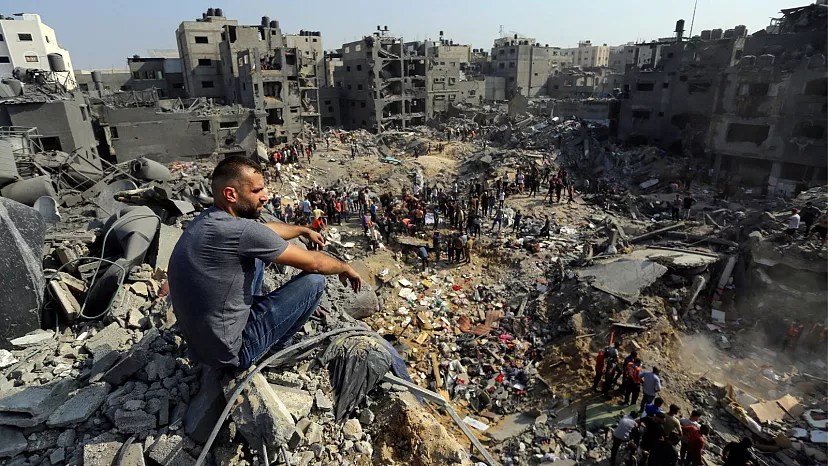
Photo Via AP/Abed Khaled
Ciaran Williams, Science and Environment Editor
The invasion of Gaza will cost much more than the lives of civilians. As bombs continue falling, Gaza sustains more and more ecological damage, which compromises the future well-being of the territory and its inhabitants.
In December 2023, The United Nations Environment Programme (UNEP) received a request from the State of Palestine to conduct a survey of the environmental damage caused by the conflict. The UNEP commenced their work shortly after, and, in June 2024, released their findings in a report titled Environmental impact of the conflict in Gaza: preliminary assessment of environmental impacts. The assessment’s goal was to address specific factors that have led to environmental degradation in Gaza, as well as produce suggestions for minimising the long-term impact of the war. As of writing, UNEP’s report acts as the most thorough and comprehensive review of the environmental situation in Palestine. For this reason, all information in this article is sourced from UNEP’s report.
UNEP’s work, however does have its limitations. First, its findings are preliminary, as the name implies, as the situation is ongoing, and UNEP was also limited in its investigation due to security barriers and safety concerns imposed on them by the Israeli Government. A totally comprehensive report will not be possible until a ceasefire is declared, UN investigators are no longer at risk, and the assault on the environment is over.
Outlining environmental challenges already faced by Gazans prior to October 7th is important before proceeding with the current state of affairs. Potable water in the Gaza strip has long been hard to come by, as rapid population growth in recent years, weak rainfall, and over extraction of water resources have decreased supply, and increased demand. Also, Gaza has had issues managing solid waste due to infrastructure damage from prior shelling by the Israeli Defence Force. This has resulted in heavy contamination to Gaza’s environment. Gaza is also arid, with only ~10% of its land being arable and suited to farming. This forces local farmers to increase crop productivity through the use of pesticides, which are notorious for their negative environmental impact. All of these factors mean that even before the war’s start, Gaza’s environment was already fragile.
Since October 7, one of the largest hits to Gaza’s environment was the destruction of many of Gaza’s wastewater treatment and management facilities by Israeli shelling. This has led to sewage contaminating and polluting local environments, as well as putting civilians at risk of short and long term health complications as a result. The destruction of water purification facilities has strangled Gaza so hard that humanitarian officials have been forced to start rationing water. The report outlines that there is not a single water-purification system in Gaza that is operating at full-capacity as of the time of its publication.
Solid waste management has also been limited since October 7th. A lack of fuel caused by an Israeli blockade on Gaza and damage to critical infrastructure have limited authorities’ abilities to collect and dispose of waste properly. This has led to a build up of hazardous waste, especially medical waste around hospitals and refugee camps. The presence of medical waste poses a threat of disease outbreaks, which could put a strain on the already scarce supply of medical resources in Gaza. The buildup of waste also poses the threat of toxins potentially leaching into the ground and into water supplies, weakening Gaza’s ability to self-sustain in the future.
The extensive use of munitions throughout the Gaza Strip has also left chemical waste residue, which is known to have detrimental impacts on the environment and human health. Explosives used by Israeli forces, such as DNT, RDX, and TNT, leave heavy metal and chemical residues that seep into the local environment – most commonly water supplies – and threaten its health. The presence of some of these heavy metals, such as arsenic, cadmium, chromium, and mercury, is concerning. This is because they have been attributed to numerous health complications, such as organ failure, cancer, and developmental issues in children. In addition, these heavy metals bioaccumulate in local fauna and flora, contaminating local food supplies.
Air pollution has also increased. As Gazans have been cut off from access to fuel for almost a year, many have been forced to find alternative sources of energy to stay warm, which has prompted some to turn to burning plastic. Burning of plastics and other substances for heat and cooking has released hazardous chemicals into the air. These, combined with fires started during combat that are still burning in many regions, have severely deteriorated the air quality in Gaza to dangerous lows, threatening the health of the Gazan population.
All of these factors have contributed to environmental pollution that seriously threatens the livability of Gaza for future generations. Without healthy water, soil and air, the territory will never be able to provide a safe place for the Palestinians that call Gaza home. Efforts to tackle the environmental catastrophe in Gaza have been proposed, with some already having been implemented before the war, but regardless of this, making Gaza a truly safe and liveable environment is likely to be a decades-long process.
 The Plant
Leave a comment