

Via Cult MTL
Emma Caspi
Voices Editor
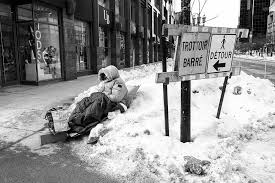
As winter creeps closer and the temperature steadily drops, we retreat into our heated homes, taking comfort and warmth for granted. But what about those forced to face the brunt of winter without shelter, condemned to the cold weather and ignored by cold hearted individuals? There must be some sort of solution, right? As the term ‘solution’ is derived from the Latin solvere, meaning to loosen the knot of a problem, ‘solutions to homelessness’ must be a misnomer; the convoluted knot of homelessness is only getting tighter. That is, unless Montreal has been disguising its motives of consolidating the financially stable population and helping those unhoused. As a result, the rest of society scorns the unhoused population, not because they necessarily deserve it, but because they are trapped in a perpetual cycle of contempt.
Stereotypes, biases, and misunderstandings only feed into this general disdain, making it hard to understand why the unhoused population has steadily increased while showing no signs of decline. For starters, the word “homelessness” stratifies four distinct groups under one common, and often misconstrued term. The four types are the following: 1) transitional homelessness resulting from a major life change or catastrophic event, 2) episodic homelessness categorised as a minimum of three periods of homelessness within the last 12 months, 3) chronic homelessness defined as “an unaccompanied homeless individual with a disabling condition” having been homeless for more than one year, and 4) hidden homelessness, defining those temporarily living in others’ homes without a permanent place of their own. The unhoused population is far more diverse than its generic definition, “the state of having no home” would suggest.
The quick assumption that all homeless people’s circumstances result from mental illness, substance abuse, laziness, and criminal activity (or freedom of choice) perpetuates harmful stereotypes, further generalising homelessness. According to a 2022 study conducted by Centraide, Montreal’s 4,690 unhoused persons, not including the invisible unhoused, also experienced familial problems, marginalisation, low income, difficult immigration experiences, violent relationships, and most prevalently, the consequences of high rent and housing shortages. Such nuances matter when it comes down to proper intervention and course of action.
Sam Watts, CEO and Executive Director of the Welcome Hall Mission, explains to The Rover that Montréal is experiencing an unprecedented “systemic problem”, “producing more people experiencing homelessness” because “ it’s getting harder and harder to find affordable housing.” Resources like homeless shelters are ideal, but Watt reveals such resources “are stretched so thin that we’re consigning [individuals] to a merry-go-round that takes them in and out of homelessness.” Unhoused persons subjected to high rent and housing shortages attempt to create solutions, such as the encampment on Atwater Hill. While Quebec’s transport ministry fought to remove the encampment to renovate the overpass, those relying on it for survival fought back on humanitarian grounds. Police raids dismantling encampments condemn those dependent on that safe space to more dangerous and exposed environments, such as near railways and abandoned buildings. Facing this dehumanisation, unhoused persons shrink themselves down to make room for those whom the government cares about.
CBC explains how Montreal seeks the “public’s input on how to live ‘harmoniously’ with the unhoused population” and relinquish the rising tensions between “Montreal’s residents and unhoused people.” Although Montreal’s population deserves to feel safe in public spaces, they should ask themselves how unsafe and vulnerable the unhoused population must feel, outcasted from society and stigmatised. Serge Lareault, Montreal’s commissioner for people experiencing homelessness, proudly shares that resources for the unhoused population have doubled since the COVID-19 pandemic. Nonetheless, the resources were created to comfort and appease the rest of society, answering complacently to their “influx of complaints”. It almost makes you think nothing would have been done for the suffering unhoused persons had the rest of society not been made uncomfortable.
It would be unfair to claim that nothing is being done to abate this growing crisis. For instance, The Gazette reports Mayor Valérie Plante committed to constructing 120,000 affordable social housing units over 10 years. However, up until this point, Quebec and Montreal officials have communicated poorly, making the presented solutions fragmented and incohesive. Pierre Lessard-Blais, mayor of the Mercier borough, requested the encampments remain untouched, while Plante enforced a policy to break up encampments systematically. Pledging to construct housing for the unhoused is the first step in the right direction. However, no change will be made unless all parties involved view the unhoused population as human beings and not as a nuisance hindering “more important” people from executing “more important” matters.
 The Plant
Leave a comment