

Karina Hasselbo
Contributor
Courtesy of NOAA Fisheries
For us, a honking car or a jackhammer might only be a slight disturbance in our everyday lives. However, imagine if that jackhammer or car horn was almost always on and so loud that it could damage your hearing. What if it woke you from sleep or prevented you from going to the grocery store? For many marine animals, this isn’t just a thought experiment – it’s reality. It should also be noted that noise pollution affects land animals as well, but this article focuses on marine life.
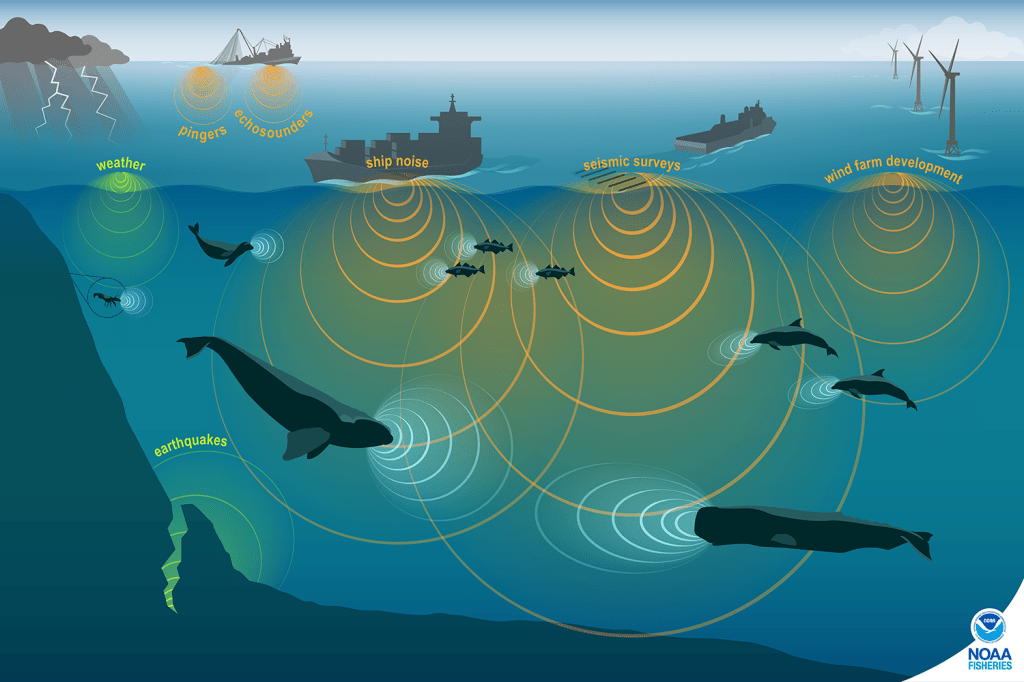
Noise pollution causes a variety of problems for different species. While the issues it causes for whales and dolphins are the most well-known, noise pollution seriously affects others as well, from fish to squids. This is because much of ocean life uses sound for crucial parts of their lives. Sound travels faster in water than it does in air, and the natural seascape is filled with the chirps and hums of fish, whales, crustaceans, and more. These sounds are used for basic functions such as finding a mate, locating food, avoiding predators, and communicating with each other. Even species like coral larvae use sound to communicate! When they’re released into the water, they listen for the sounds of a reef to find a suitable place to grow.
For millions of years, the ocean listened only to the natural sounds of marine life. Now humans with boats, oil drilling, and sonar, have added to this soundscape; this additional noise has proven to be detrimental in numerous ways. Noise pollution not only impairs the ability of whales to communicate and find food, but it can also panic them into surfacing too quickly,
potentially causing decompression sickness. It damages the statocysts of squids, an organ they
need for balance. When boats pass over damselfish, they are at greater risk of being eaten, as
they cannot hear predators approaching. Worse yet, noise pollution is only set to increase as ship traffic increases. For example, southern resident orcas, an endangered population of orca, are expected to see more boats in their area.
Fortunately, there are ways to reduce noise pollution. New technologies, such as quieter
propellers and bubble curtains, can decrease the amount of noise pollution in our oceans. Even
slowing down boats can make a difference. If boat speed was globally reduced by 10%, noise
pollution could drop by roughly 40%. Moreover, the effects of reducing noise pollution would be
nearly instantaneous, with animals being able to return to communicating with each other, and
resume listening for both prey and predators as soon as the noise is lessened. If adopted, many of these methods of reducing noise pollution could seriously benefit marine life. Therefore, regulations that slow vessels down must be taken seriously. In its natural state, the ocean is a bustling world filled with the clicks of fish and the whistles of dolphins whose sounds are important for the maintenance of a healthy biosphere, so let’s give back the ocean its natural symphony!
 The Plant
Leave a comment