

Thalia Ruiz Ramirez
News Editor
Photo Via Articulo 14
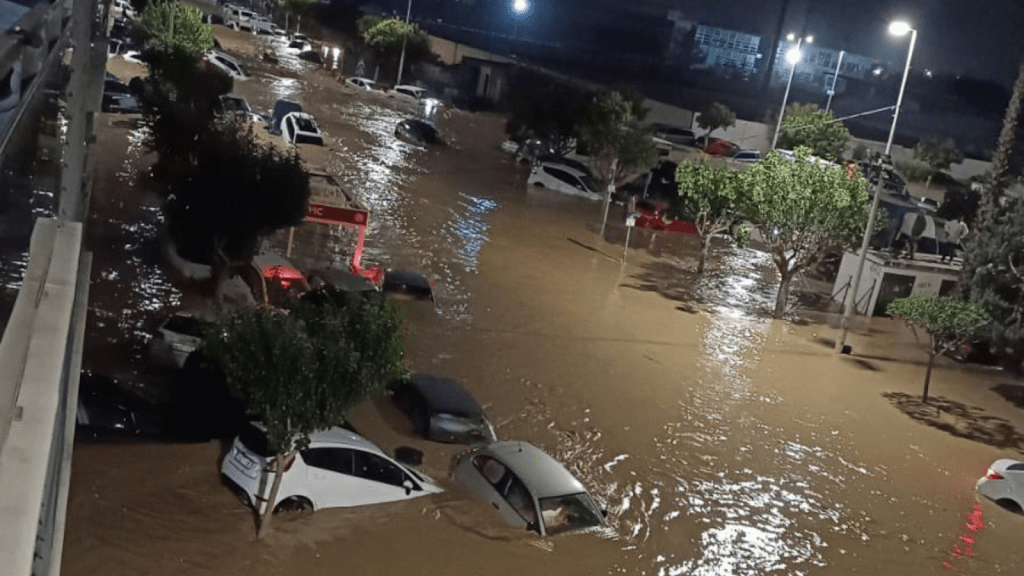
The recent Depresión Aislada en Niveles Altos (DANA; Spanish acronym for high-altitude isolated depression) devastated Valencia and surrounding regions in Spain, forcing them to recover from one of the deadliest natural disasters in the country’s recent history. Torrential rains fueled by this atmospheric phenomenon caused flash floods that killed at least 220 people and left dozens missing. Nearly a million people face significant challenges, according to France 24. As the death toll climbs, both the government and the public confront growing scrutiny over their responses.
On October 29th, the DANA unleashed unprecedented rainfall across eastern Spain. The BBC reported that in Valencia, over 500 litres of water per square metre fell in a matter of hours, surpassing the region’s annual average rainfall. The BBC explained that this phenomenon occurs when cold polar air collides with warm, moist Mediterranean air, creating violent storms with strong winds and tornadoes.
El Español described how rivers burst their banks, submerging entire towns and forcing thousands of people onto rooftops or into vehicles for safety. By November 1st, reports from the BBC revealed that authorities had identified 214 fatalities, including 211 in Valencia alone. Additionally, France 24 reported that the disaster affected over 950,000 people, with families grieving lost loved ones while searching for missing members. Survivors shared heartbreaking accounts, such as Sarai from Paiporta. She told À Punt Television that her father died while saving her children from the floodwaters. According to France 24, rescue teams recovered bodies from submerged vehicles and garages days after the initial floods.
Material destruction also adds to the suffering. Floodwaters destroyed thousands of homes, vehicles, and public infrastructure, according to France 24. The BBC noted that over 75,000 households remain without power, while several areas face contaminated water supplies. Financial losses, reported by El País, could reach billions of euros.
The government’s response has drawn widespread criticism for delays and inefficiencies. El Periódico de España reported that the Agencia Estatal de Meteorología (AEMET; Spanish acronym for State Meteorological Agency) issued a red alert early on October 29th, warning of severe flooding. However, regional authorities waited eight hours before declaring an emergency in Valencia, and officials delayed sending mobile alerts until 8:12 PM. By then, France 24 described how many residents were already clinging to trees or trapped on rooftops.
Interior Minister Fernando Grande-Marlaska faced backlash for rejecting international aid offers from France and El Salvador. Regional leaders, including Carlos Mazón, insisted their resources sufficed despite visible shortcomings, as reported by Tele Madrid and La Sexta.
Amid the institutional shortcomings, the public demonstrated remarkable solidarity. France 24 described how volunteers from across Spain arrived in Valencia with cleaning supplies and food, organising grassroots relief efforts under the motto “Solo el pueblo salva al pueblo” (“Only the people save the people”). Volunteers cleaned streets, assisted evacuees, and distributed essential goods, stepping in where official responses fell short.
Public anger towards officials erupted during visits by Prime Minister Sánchez, King Felipe VI, and Queen Letizia to the affected areas. France 24 recounted how residents in Paiporta protested, accusing the government of negligence. One resident shouted, “We have lost everything… and nobody did anything to prevent it.” Others hurled mud and insults, voicing their frustration. CNN highlighted the escalating tension, noting that some citizens even attempted to confront officials directly.
Eventually, rescue teams expanded their operations with 1,200 military personnel, followed by another 500 troops, as reported by the BBC. Prime Minister Pedro Sánchez pledged €14.37 billion in emergency relief, according to El País. The package includes direct compensation for affected families, housing reconstruction funds, and a moratorium on utility bills until 2025. Sánchez also announced that families who lost members would receive up to €72,000 per deceased relative, while homeowners whose properties were destroyed could qualify for up to €60,480 in aid.
The DANA revealed significant weaknesses in Spain’s disaster preparedness and response systems. Climatologist Jorge Olcina told the BBC that evacuation orders and proactive measures could have saved many lives. Olcina emphasised that authorities left too many people exposed, going about their normal lives when they should have evacuated.
As Spain embarks on the long road to recovery, the tragedy underscores both the resilience of its people and the systemic failures that exacerbated the disaster. This event serves as a powerful reminder of the urgent need for more effective disaster management strategies in the face of increasingly severe weather events.
 The Plant
Leave a comment