

Ella Dubé
Contributor
Photo Via Dawson College
Did you know there is more to your R-Score than meets the eye? Every Science student in CÉGEP obsesses over that five-digit number that appears in their transcripts at the end of each semester. The general purpose of the R-Score, as per the Bureau de Coopération Interuniversitaire (BCI), is to “correct for observed differences in college grading systems and to adjust the resulting values so as to take into account the relative strength and dispersion of each group of students.”. Simply put, it aims to level the playing field across the province, so everyone has a fair chance during university admissions. Yet, at Dawson, quite the opposite is true in the pre-university science programs. Instead, the administration applies something called R-Score groupings in a way that appears to benefit the highest-performing students while potentially disadvantageing the others.
For starters, what is the R-Score grouping? When calculating the R-Score, a student’s average is typically compared to those of their classmates. However, according to the BCI, this comparison does not have to be limited to a single classroom. If multiple sections of a course are evaluated in the same manner, all the grades from those sections can be grouped together for the R-Score calculation. The BCI gives the example of a justifiable R-Score grouping in the circumstances where a teacher gives three sections of the same course. In this context, it would be reasonable to regroup those 3 sections into a single group.
Nevertheless, the college furthers that example by grouping all the sections for a single core science course into one R-Score grouping, even if they were taught by different teachers. This practice is justified on the premise that everyone takes a common final at the end of the semester, thus fulfilling the BCI’s criteria of being “evaluated in the same way.”. This grouping does not account for previous evaluations, the differences in grading methods, or the variation in teaching methods from class to class. Hence, the R-Score calculation is no longer accurate at depicting a student’s success compared to their peers.
To understand the issue, one must understand the principles of the calculations. The R-Score utilises three primary classification methods: The average grade, the Z-score and the College R-Score. The average grade is simply one’s grade in a class. The Z-Score standardises this by comparing it to the class average and the standard deviation, which measures how spread out the grades are from the class average. Therefore, a better R-Score is achieved if classmates have very similar grades, and a student manages to stand out significantly above them.
However, this method is flawed when a group average is very high, as in the case of enriched classes, making it nearly impossible to distinguish oneself. The college originally developed the course-wide R-Score grouping to counter this issue. However, the larger collective of grades skews the group averages and increases the standard deviation, making it harder to achieve a high R-Score, especially for the lower-performing students.
In 2017, the BCI implemented the college R-score in an attempt to correct the issue of enriched classes. This method corrects the Z-score by implementing two correction factors that estimate the strength of students: the indicator of the relative strength of the group (ISGZ) and the indicator of the dispersion of the group (IDGZ). The results from high school ministry exams from secondary 4 and 5 are used to determine these factors.
The implementation of these indicators was influenced by the Comité de Gestion des Bulletins d’Études Collegial, which determined this method to be “more equitable for all students, regardless of the characteristics of the group to which they belong.” This signifies that, in the case of groups with abnormally high averages, the overall strength of the students in the group will increase their R-Score.
As of seven years ago, the inconsistencies seen in enriched classes were resolved. Nonetheless, Dawson College never readjusted the R-Score groupings, opting to maintain the previous ones. The effects, mostly felt amongst regular Science students, are evident not only in the Z-Score calculation, as previously mentioned, but also in variations in the ISGZ and IDGZ factors, caused by the wider range of high school results when a larger number of students are grouped together.
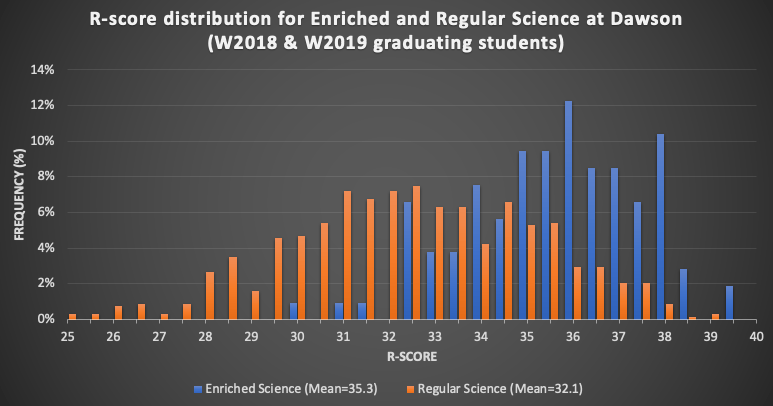
Ironically, the administration provides a graph on their website’s Science R-Score page, demonstrating the inequities between regular and enriched science students’ results. Despite that, it would be incorrect to assume that enriched students are exempt from the negative impacts, seeing as they no longer obtain a boost from the correction variables that reflect their true strength as a group. In essence, these R-Score groupings are hindering student success across the board and the need for change is long overdue.
 The Plant
Leave a comment