

Emma Caspi
Voices Editor
Photo Via Poem Analysis
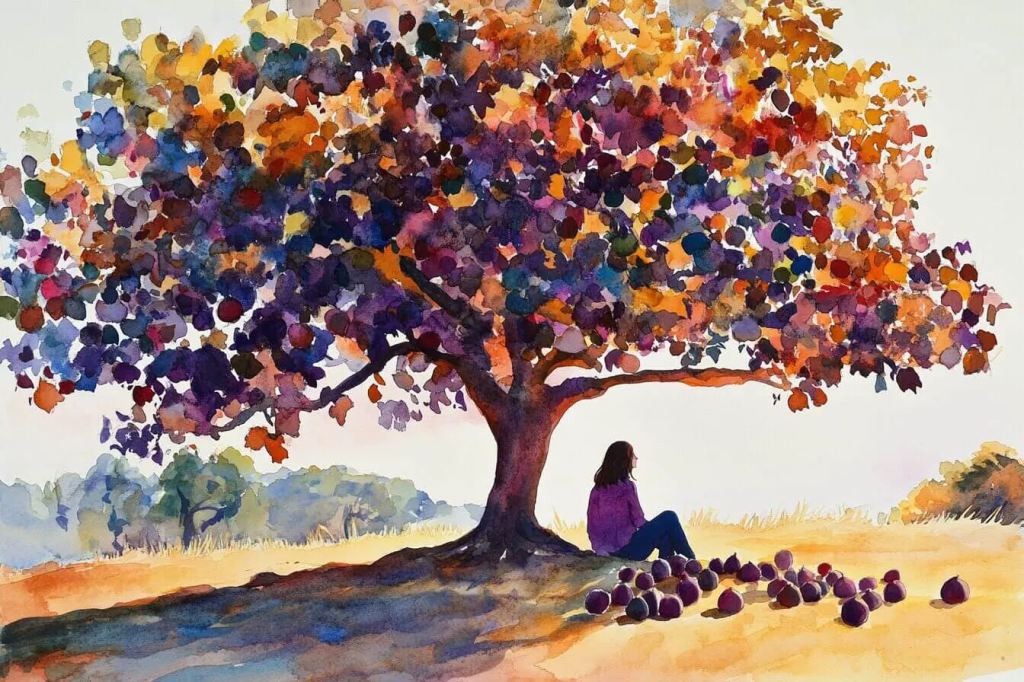
American poet and author Sylvia Plath confessed her anguish about the inadequacy of pursuing one career through the main character Ester in her novel The Bell Jar. She did so by creating an analogy about a fig tree. Each fig represents “a wonderful future [that] beckoned and winked,” such as becoming a successful poet, professor, editor, etc. Because Ester wanted them all, she “starv[ed] to death” since “choosing one meant losing all the rest.” Unable to decide, her “figs wrinkle[d] and [turned] black.” Why am I telling you this? Well, after what feels like an eternity of lengthy metro rides, endless lectures, and nerve-racking exams, I have made it to my last semester at Dawson College. I pictured this moment as relieving and reassuring: I have finally completed my program and could move on to larger aspirations. However, I never stopped to think; out of the heaping basket of fruit I am destined to choose from, which one is my fig?
Undoubtedly, most university applicants feel immense pressure to know themselves well enough to choose their life-long career and amass enough experience and skills to be sensational in their field. Realistically, how am I expected to know exactly who I want to be when I have barely lived? Like a helpless child pretending to be an adult, I still feel like I am wearing my mother’s too-big high heels and bright red lipstick to interviews and though I am babbling senselessly in university applications. I shamelessly confess that I am clueless as to who I am or who I want to be, and I know I am not alone in this struggle.
A 2022 Dejardins study reveals 60% of 14 to 30-year-olds are anxious about choosing a career. Additionally, the Public Health Agency of Canada reports that 40% of students indicated anxiety and/or depression, and 60% of students reported substance use. Even if we do manage to succeed in our academic goals, many of us suffer from what psychologist Pauline Clance calls the “imposter phenomenon.” Clance categorizes the strong feelings of fraudulence students may feel among their peers – as if they were imposters, who somehow managed to convince others of their academic legitimacy – into this phenomenon. It is no wonder why academia is riddled with anxiety– it is a lose-lose situation.
The number of university enrollments has substantially increased since the 2000s, which only worsens the pressure on college students to distinguish themselves from a large pool of competing students. According to Statistics Canada, McGill University recorded 34,245 enrollments and Concordia University recorded 33,402 enrollments in 2009-2010. As of 2022-2023, McGill’s enrollment rose to 38,694, while Concordia’s rose to 38,265. One could argue that the narrative of attending university as an imperative for a “good” life is more dominant than it was in the 2000s, pressuring individuals to attend grandiose institutions or societally conventional programs.
So, what can we do to alleviate the stress of imminent career choices? Antonina Nobile and Diane Wong, the Dawson College Co-coordinators of Academic Advising, recommend that graduating Dawson students “start [their] research early, go to the websites of universities that interest [them], review their program offerings and admission guides [and] attend university Open Houses or virtual admissions webinars.” Dawson’s Career Resource Centre also has services and resources that help assess the program or career path that best suits your interests, values, abilities, motivations, etc.
I think we all need to be told that it is okay if you do not have your future perfectly and intricately planned, are not applying to university, are not doing as well as you wished in your current program, are taking longer to graduate, apply to a certain university or program against others’ opinions, or get rejected from your desired school. It is okay! There is nowhere we are supposed to be, and no one we must be.
If you were to read the page after the fig tree withers, Ester consumes a meal and consequently realizes the rotting fruit was a vision that arose from “the profound void of an empty stomach.” In other words, Ester became consumed by her indecision in the face of such vast possibility because she ignored her need for sustenance, her need to live! Thinking about your career is indeed inevitable and important. However, we must resist getting lost in the turbulent and uncertain ideas of the future. Although easier said than done, we must prioritize living in the present and caring for our well-being to be the best future versions of ourselves.
I cannot tell you what career you should choose. I can, however, advise you to begin with what you like, are passionate about and genuinely enjoy. Remember that this is your life and that there is no one right or wrong way to live it.
 The Plant
Leave a comment