

Julia Azzouz
Creative Writing Editor
Photo Via The Hollywood Reporter
“He will continue to stir up war in order that the people may continue to need a leader.”
-Plato The Republic
In our fear of awakening an old evil, we look to shadows and forget that the real thing is looming right behind us. We witness politicians slink out of imprisonment, bluff tariffs, and flirt with the prospect of nuclear war. At the same time, multi-billionaires mimic genocidal dictators in their gestures, attend far-right conferences, and receive ovations from white supremacists. By perverting democratic tools to serve undemocratic ends, these new authoritarian “strongmen” are not merely anomalies—they are clear agents guiding us down the slippery slope toward fascism.
First, what is fascism? It may be easier to define it by its characteristics rather than define it as an isolated term. In A History of Fascism 1914-1945, the Wisconsin University professor Stanley G. Payne lists generally accepted cultural, political, social, and economic factors of early twentieth-century European fascism: strong currents of nationalism, a perceived crisis in cultural values, a threat from the left, the challenge of secularization, a polarized party system, effective leadership, a large sector of workers that are underrepresented, and a general discontent with the existing party system. Sounds familiar, doesn’t it?
Fascism builds on a democratic system; it doesn’t immediately annihilate it. It starts when many people, frustrated with the current political setup, rally behind a strong, charismatic leader who promises to fix all the problems and restore national pride. This leader uses the public’s anger and anxiety to gain more power, gradually manipulating the democratic system to serve one rigid way of thinking. Over time, lively debates and different opinions—which are essential for a healthy democracy—are shut down to promote an exclusionary ideology. In the end, what begins as a democratic outcry against the old system evolves into an authoritarian regime which suppresses individuals and opposition.
New authoritarians like Trump and Musk use tactics similar to those of past authoritarian leaders: they simplify complex issues by scapegoating a clearly defined bogeyman—be it the “woke” left, the Democratic Party, or immigrants—to divert attention from their own corruption to present themselves as heroic defenders against evil. As Hannah Arendt explains in The Origins of Totalitarianism, the success of authoritarian leaders lies in their ability to destroy two misconceptions about the masses: first, that the majority is naturally politically active, and second, the idea that they are entirely indifferent and immune to persuasion. By appealing to deep-seated religious beliefs, nationalist sentiments, and fears of losing freedom, these charismatic figures transform widespread indifference into passionate support, effectively mobilizing a vast, previously unengaged population into a force backing their authoritarian agendas.
A broader shift from democracy to authoritarianism is exemplified on the smaller scale of Elon Musk’s digital empire, X. In 2022, after having bought out Twitter, kicked out the CEO, and appointed himself CEO of the new social media platform X, Musk completely removed all content restrictions designed to eliminate hate speech and restored all banned accounts (many of them being neo-Nazi or white supremacist accounts). Despite his original promise of total freedom of speech, he has since then threatened to ban the words “cis” and “cisgender” from the platform, considering them to be slurs, restricted multiple journalists’ accounts after they criticized him, and has recently been accused of reconfiguring X’s algorithm to promote far-right content. Following July 13th, 2024, the day of the assassination attempt on Donald Trump, reliable news outlets reporting the event got significantly less attention than right-wing conspiracy blogs with smaller followings, which raised suspicions about the algorithm’s bias. According to NBC News, right-wing news accounts collected 1.2 million reposts, whereas nine traditional news outlets amassed 98,064. This points to an alarming trend where the rhetoric of free expression is used to justify controls that ultimately narrow the scope of public debate.
Initially, Elon Musk and Donald Trump were far from allies. In November 2016, Musk publicly expressed that Trump was “not the right guy” for the presidency in an interview with CNBC, stating that “he doesn’t seem to have the sort of character that reflects well on the United States”. Despite these comments, Trump appointed Musk to an economic advisory council composed of business leaders called Trump’s Strategic and Policy Forum in December 2016 from which Musk resigned in June 2017 over disagreements on climate policies. Their relationship remained strained until July 2024, when Musk endorsed Trump following an assassination attempt on the former president. This endorsement marked a significant shift, leading to Musk’s appointment as head of the Department of Government Efficiency (DOGE) in January 2025. This newfound alliance suggests a strategic partnership and a recognition that their combined influence could more effectively advance their agendas.
On January 20th, 2025, Musk dramatically reentered the domain of politics, having been appointed head of DOGE by Trump himself. Despite its misleading name, DOGE is not an actual government department, but something closer to an advisory body with Musk being a volunteer, not a government official or employee. Their overarching goal is to save money–lots of it. They plan to cut down about 2 trillion dollars of government expenses by overseeing mass layoffs and cutting funding from government agencies or shutting some of them down entirely. Among these agencies are the National Oceanic and Atmospheric Administration (NOAA) which is responsible for weather forecasts, the United States Agency for International Development (USAID) responsible for providing foreign aid and development assistance around the world, and the Department of Education. This aggressive restructuring isn’t just about fiscal austerity—it’s a clear signal that DOGE is being used as a tool to undermine independent institutions and consolidate power.
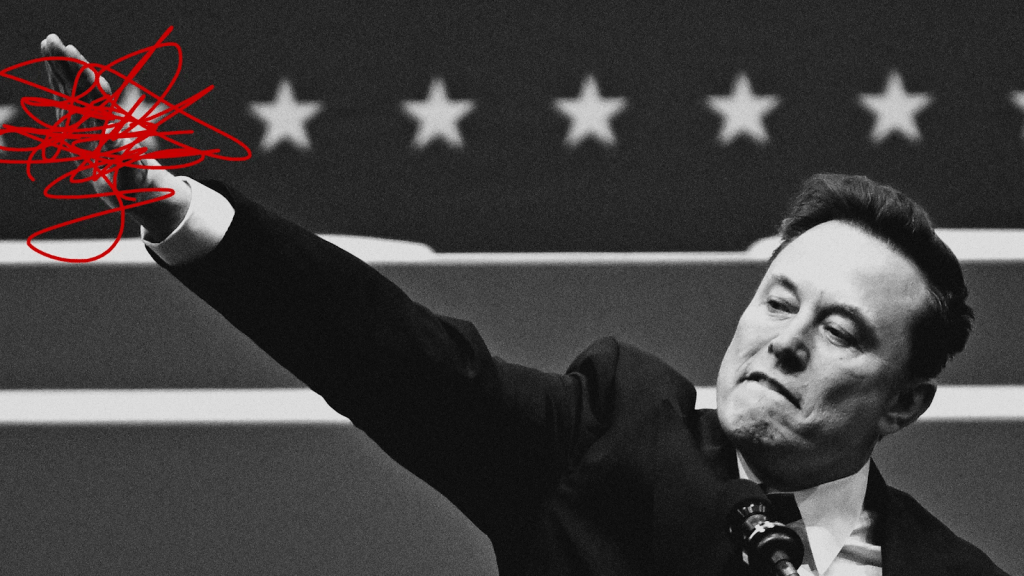
That same day, on stage in Washington’s Capital One Arena for Trump’s post-inauguration rally, Musk exclaimed “My heart goes out to you” and repeatedly extended his arm into a Nazi salute. Though many people are referring to this incident as an unfortunate coincidence, the gesture is a classic example of dog whistling– a political tactic that uses coded language or gestures which seem harmless to most but are designed to signal extremist ideas to a targeted audience. His phrase was meant to disguise an obvious political statement in order to maintain plausible deniability while still appealing to a far-right audience. Considering Musk’s long-standing right-wing affiliations, his implicit support for antisemitic conspiracy theories, and his participation in fascist political rallies, it is unlikely that his gesture was a mere accident. Intentional or not, this effectively garnered massive support from neo-Nazis. The right-wing political commentator and Holocaust denier Evan Kilgore responded “Holy crap … Did Elon Musk just Heil Hitler at the Trump Inauguration Rally in Washington DC … This is incredible”, and Christopher Pohlhaus, the leader of the American neo-Nazi group Blood Tribe wrote “I don’t care if this was a mistake, I’m going to enjoy the tears over it.” Elon Musk himself did not apologize or deny any accusations of Nazism but instead retaliated on X, “The ‘everyone is Hitler’ attack is sooo tired”. Way to make a big joke out of a genocide.
On February 1st, the USAID website went dark, and its employees were abruptly placed on administrative leave—an act that effectively dismantled an agency devoted to global health, disaster relief, socio-economic development, environmental protection, democratic governance, and education. In a move unprecedented in modern American politics, the wealthiest man on the planet has systematically targeted an organization built to serve the public good. As Jon Rogowski, a political science professor at the University of Chicago, noted in a BBC interview, “I cannot think of any precedent where a presidential administration has essentially handed over the reins to a private citizen”. This aggressive restructuring is not merely about slashing budgets or streamlining bureaucracy—it’s a calculated effort to weaken independent institutions. Such tactics are alarmingly reminiscent of fascist regimes, which have historically undermined the pillars of democracy by subverting institutions that promote transparency, accountability, and collective welfare. By stripping away the autonomy of organizations like USAID, this maneuver not only curtails critical social services and global cooperation but also signals a broader shift toward a governance model where authority is centralized, dissent is quashed, and power is concentrated in the hands of a few.
The dismantling of democratic institutions and the strategic deployment of extremist signals by figures like Trump and Musk are not isolated missteps—they are the calculated maneuvers of a modern authoritarian playbook. By repurposing democratic tools and co-opting the language of free speech, these leaders are slowly but surely transforming our political landscape into one that mirrors the early, insidious stages of fascism. The creation of quasi-governmental bodies like DOGE, the selective suppression of dissent on platforms like X, and the blatant use of dog whistling to mobilize extremist support all serve as stark warnings of a regime where power is consolidated at the expense of pluralism and debate. The cat is out of the bag, now let’s make sure it doesn’t swallow us whole.
 The Plant
Leave a comment