

Ciaran Williams

Science and Environment Editor
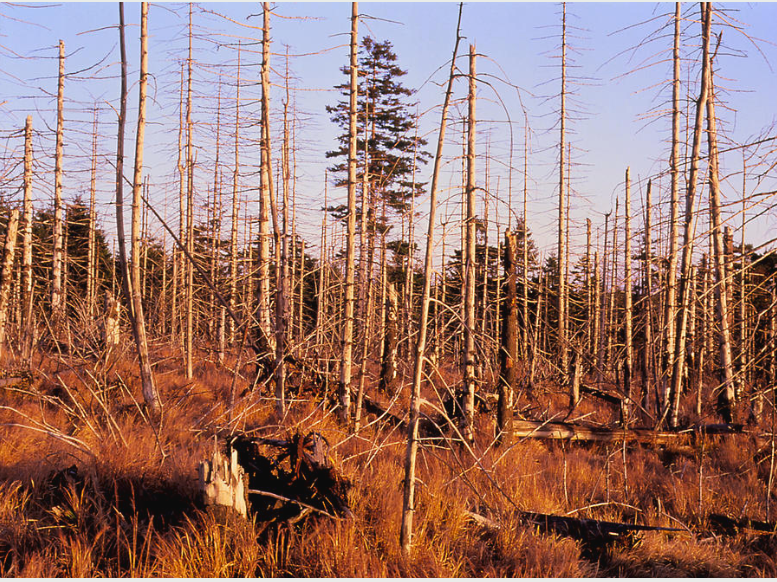
Photo Via Simon Fraser. A forest devastated by a downpour of acid rain.
If you know someone who grew up in the 1980s, they would be able to tell you about the threat acid rain posed. During that period, all throughout parts of Canada and the United States, toxic precipitation tore ecosystems apart, devastating forests and aquatic ecosystems. Lake beds sat visible from as far as 10m below the surface of the water, as any microorganism normally responsible for capturing light had been killed. Headlines like High Country News’ Acid Rain: A Corrosive Issue Across the Nation captured the magnitude of the threat, communicating its dangers to the public. So, how did this dangerous phenomenon occur? How did it work? And what did scientists do, so that now, some 40 odd years later, we no longer face constant threats of acid rain?
There are actually two different types of acid rain: wet deposition and dry deposition. Wet deposition is sleet, hail, or rain that has a pH (the measure of how acidic something is) lower than 5.6, the standard acidity of rainwater. The acidification of these types of precipitation occurs when sulfur dioxide and nitrogen oxides are emitted into the atmosphere, where these two compounds react with water, oxygen, and other various chemicals present, to create sulfuric and nitric acids. These then mix with water and fall to the earth during regular precipitation. Dry deposition, however, is when these collected acids precipitated in the absence of rain. This still poses the same risks as wet deposition, as it still accumulated in ecosystems. If dry deposition is followed by rain, the water can wash the acid deposits off of surfaces and into soil.
The environmental effects of acid rain are considerable. Aside from damaging crops, vegetation, ecosystems, and sometimes even buildings, to a severe extent, acid rain’s most adverse effects are those it has on aquatic ecosystems, especially inland lakes. The ecosystems of lakes require a carefully balanced pH to function. Below a pH of 5.5, zooplankton and vegetation begin to die. This negatively affects the food chain, as larger fish feed on the small fish that feed primarily on these two. Many of these zooplankton also absorb light, so, when they die, their absence creates the aforementioned eerie clearness that allows observers to see the lake bed from the water’s surface.
In large part, emissions of sulfur dioxide and nitrogen oxides were from coal-burning energy production plants, factories, and non-ferrous metal smelters. A lack of regulation on air quality, and perhaps a lack of knowledge of the effects of these emissions enabled companies to spew dangerous quantities of pollutants into the atmosphere. Unfortunately, the link between industrial emissions and acid rain wasn’t made until the 1970s and 80s, after years of experimentation on the biospheres of lakes located in Ontario’s Experimental Lakes Area, that the connection was made. This came over a century after acid rain’s first discovery by Robert Smith in 1852.
After drawing the connection between industrial pollution and acid rain, groups like the Canadian Coalition on Acid Rain formed, and began awareness campaigns to sway public opinion in favour of regulations on air pollution to force policy makers to act. At every corner they turned, groups working to raise awareness of the effect of acid rain faced skepticism. However, their efforts found success in 1990 when the Clean Air Act was passed, and again in 1991 when the US and Canada bilaterally passed the Canada-United States Air Quality Agreement. These pieces of legislation addressed many of the causal factors of acid rain, paving the path for its reduction.
Since then, rates of acid rain have been steadily dropping in the developed world. This story serves as an example of what is possible when scientists and government collaborate properly, which is why it is important to continue to encourage collaboration and communication between these two disparate groups. Without this collaboration, it will only become more difficult to take necessary action against climate change as time passes.
 The Plant
Leave a comment