

Maya Jabbari
Managing Editor
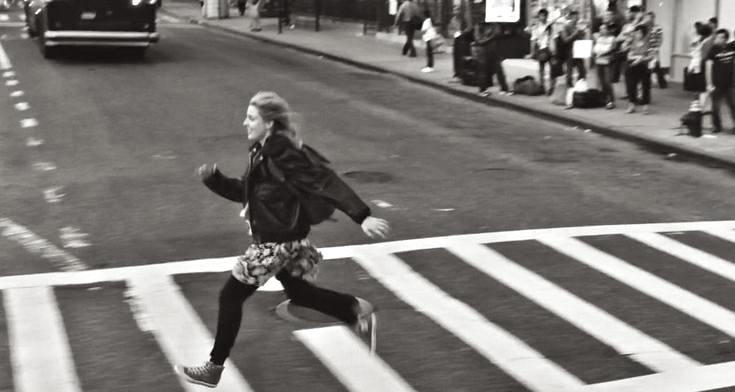
Photo Via Frances Ha, dir. Noah Baumbach
“…when you give yourself to places, they give you yourself back; the more one comes to know them, the more one seeds them with the invisible crop of memories and associations that will be waiting for you when you come back, while new places offer up new thoughts, new possibilities. Exploring the world is one of the best ways of exploring the mind and walking travels both terrains.”
― Rebecca Solnit, Wanderlust: A History of Walking
Walking. It’s an act so fundamental to our existence that we often take it for granted. Yet, within this mundane action, there is a history of our evolution, societal changes, and the core of what it means to be human. From the primal need for survival to the modern pursuit of wanderlust, the story of walking is a journey in itself, and one that continues to develop with every step we take.
Our earliest ancestors were nomadic walkers, driven by the need to find food and shelter. Their survival depended on their ability to travel vast distances. Without knowing it, their footsteps etched the first chapters in the long narrative of human movement. Walking wasn’t a leisure activity; it was the engine of their lives and made for a constant negotiation with the landscape. This inherent connection to the earth and the intimate knowledge of the land they actively walked on shaped their understanding of the world. Historian Joseph A. Amato, the author of On Foot: A History of Walking, discusses how, as bipedal locomotion evolved, so did societies and the purpose of walking. The development of agriculture and settled communities lessened the need for constant migration. The paths walked by our ancestors transformed into well-worn routes and from then on, the development of early civilizations. Walking became rooted in the rhythm of daily life, a natural extension of community and belonging.
This brings us to the very well-known advancement of industrialization. The rise of factories and urban centres encouraged people to leave rural areas, which transformed walking from a necessity into a way to navigate an urbanized city. Cities, with their rapidly rising populations resulting in an active environment, became a stage for a new kind of walking. Sidewalks, a direct result of city planning, emerged as designated pathways for organized and controlled people-flow. No longer were we simply walking through the environment; we were walking within it, with a crowd of other people, each with their own destination and purpose.
Along with Industrialization, came the rise of consumerism and capitalism. An article from Georgetown Law by writer Ian Stubbs, goes into how city streets became showcases for goods and services, attracting everyday people with the want and need to buy products that might’ve not been necessary. Not only that, but the Industrial Revolution made shoe manufacturing dramatically different when machinery enabled mass production, making items more accessible. During this time, footwear became more specialized with the making of boots for industrial workers or even more comfortable shoes for the everyday person. An emphasis on efficiency and lower costs blossomed since the once labour intensive job was replaced by a machineThis made walking in the city easier and formed a connection to shopping, window-shopping, and the general experience of navigating a marketplace. The city itself became a commodity with the potential for consumption; a wonder to be experienced and consumed through the act of walking.
With this comes the modern phenomenon of wanderlust. In many ways, wanderlust is a reaction to urban environments. It’s a yearning for a deeper connection with the world, a desire to escape the confines of a routine and rediscover the primal joy of movement. It’s a conscious choice to walk; not just to get from point A to point B.
The evolution of walking has continuously been turned into different forms. First, a story of survival, then one of connection through civilization, and ultimately, one of self-discovery. Another quote from Rebecca Solnit encapsulates the wanderlust of today perfectly; “Walkers are ‘practitioners of the city,’ for the city is made to be walked. A city is a language, a repository of possibilities, and walking is the act of speaking that language, of selecting from those possibilities. Just as language limits what can be said, architecture limits where one can walk, but the walker invents other ways to go.” To wander and to invent other ways to go, as Solnit suggests, is a form of thinking, a way of engaging with the world through our senses. It is a way to reclaim the streets, to move beyond the role of consumer and become an explorer, an observer, and a participant in the ongoing narrative of the city.
 The Plant
Leave a comment