

Minola Grent
News Editor
The Société de Transport de Montréal, better known as the STM, has been innovating in public transport since the beginning of the 20th century. With buses replacing tramways in the 1920s and the metro opening in 1966, the STM improved everyday transportation for Montrealers. Yet, in recent years, complaints have piled up: installations are failing like never before and accessibility seems but an afterthought.
The months of January and February 2025 have been challenging for citizens in all of Québec. The back-to-back snow storms that hit the province made transportation an absolute nightmare for workers and students alike. The roads were in poor condition, making driving a hazard. “The city is asking people to favour public transit,” says a CTV News article from February 16th 2025. But this is easier said than done. How are commuters supposed to trust public transit when cancellations and delays from Exo and the Réseau Express Métropolitain (REM) rendered multiple operations paralyzed?
A City News article from February 18th 2025 mentions the cancellation of 3 Exo trains from Vaudreuil, Saint-Jérôme, and Candiac during afternoon rush hours. Public transit already lacks development in many areas outside of the city’s centre. What are people meant to do when their only option of transportation is ripped away? Similarly, South Shore residents have dealt with constant problems from the REM. The light rail has been in construction since 2018 and is set to reach downtown Montreal, the YUL airport, and the Greater Montreal area through a web of 26 stations spread across 67 kilometres. The first 4 stations opened in July of 2023 and now connect the South Shore to the Bonaventure metro station. According to the Caisse de dépôts et placements du Québec that owns Alstom, the company that is building the REM, the entire project is expected to cost $8.34 billion.
This new addition was supposed to make commuting easier for residents of the South Shore but it only complicated it. Worst of all, “there is a non-competition clause that prevents buses from other transit networks from crossing the Champlain Bridge” says CBC News. Doreen Assad, Brossard’s mayor, begs for this clause to be renegotiated in light of the numerous stoppages in an interview with CBC News: “I’m asking for them to […] not force this exclusivity because they’re holding everybody hostage.” Despite the frustration, Alstom still plans to see the entirety of the REM in working order by the end of 2025. If 4 stations are already a nightmare to navigate, what will it be like with all 26?
On top of constant stoppages, accessibility to public transit has been nothing short of appalling. The REM prides itself on being fully accessible, however, the 9 elevators the REM counts across its 4 stations are rarely in service. “In REM’s 73 days of operation, there have been only 30 days when all 9 elevators were working,” says CBC News in October 2023. Francis Labbé, spokesperson for the REM administration, insists that these issues will be resolved with time as the light rail system matures. Until then, annoyance will persist among REM users.
Not only is the REM inaccessible, but so are multiple other transportation facilities such as bus stops. According to a study done by the Institut National de la Recherche Scientifique, out of the 22,000 bus and metro stops in Montreal, only about 25% are safe, accessible, and walkable. Hugo Bourgoin, spokesperson for the city of Montreal, told CBC News that “the safety of pedestrians and those with reduced mobility is a priority for the city.” However, after the February 2025 snow storms, the sidewalks were unusable for days.
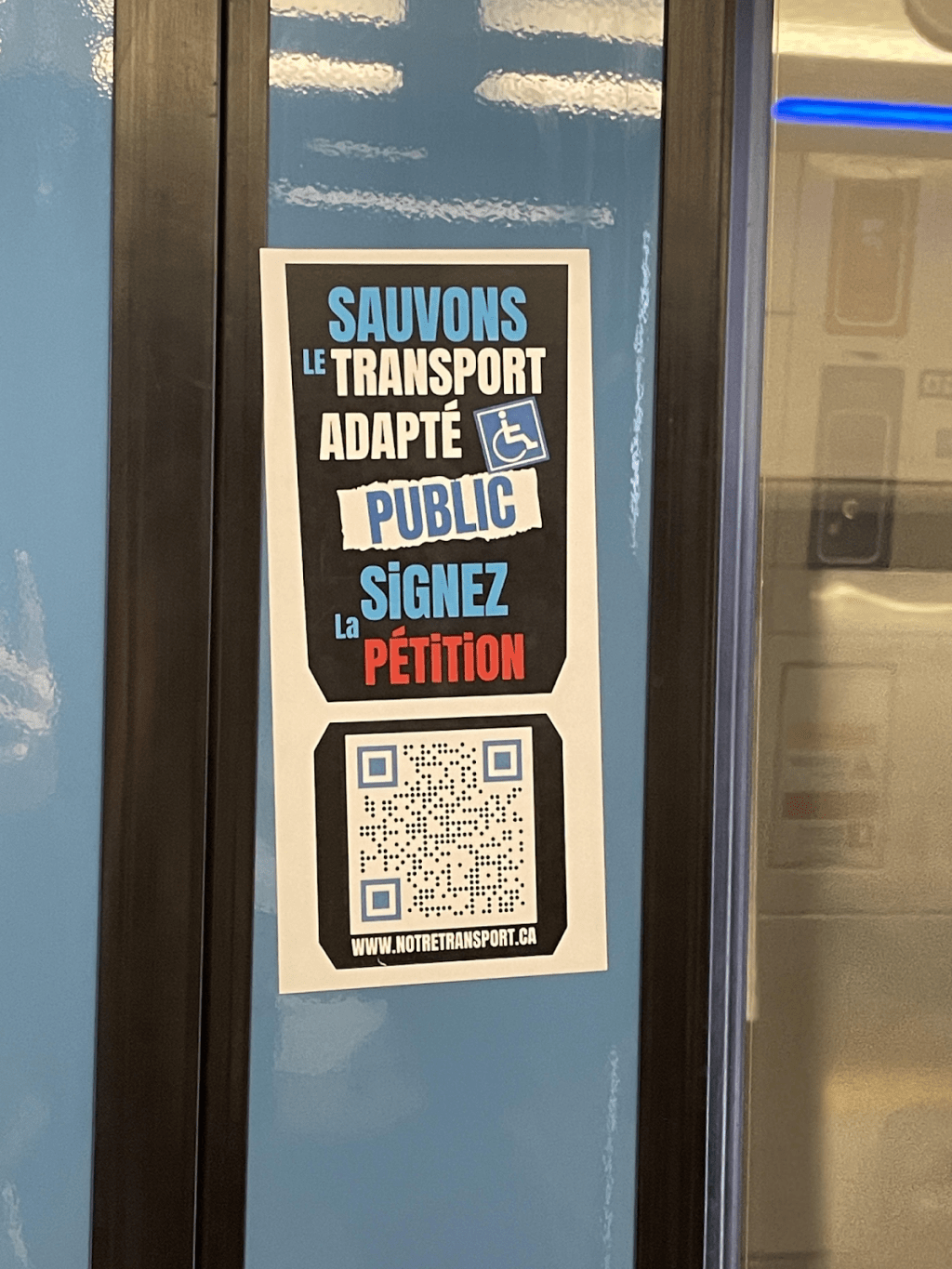
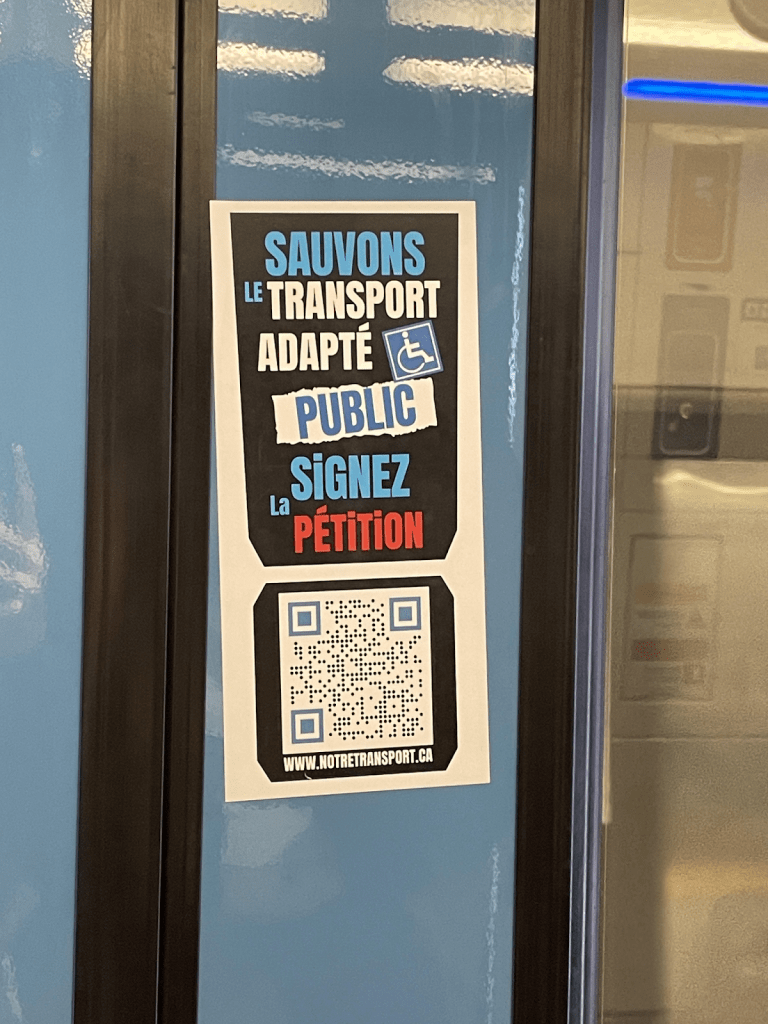
A year ago, in January 2024, the STM proudly proclaimed in a statement to CBC News that “the issue of universal access has been a priority for several years and that every possible limitation of transit users is taken into consideration.” This pretty promise has recently been shown to be nothing but hypocrisy when the STM announced the discontinuation of one of its most essential accessibility services: the public adapted transport service. This service allows people with disabilities to set up appointments with the STM and be picked up directly from their house. It ensures ease of access to transport as well as the users’ safety. The Montreal metro has been flooded by stickers with QR codes calling for users to sign a petition in hopes of saving this necessary part of the STM. While the STM justifies this decision because of an $85 million budget cut from the government, the repercussions are too important to be ignored when they imply giving up on an entire part of the population.
The city of Montreal and transport companies keep offering subpar service and taking away accessibility while claiming the contrary. In times like these, it is crucial to remember the power that lies within the community’s hand. Holding our representatives accountable is the best way to hope for change. Sign the petition to save public adapted transport and help the ones the STM has decided to cast aside.
 The Plant
Leave a comment