

Jacqueline Graif
Arts and Culture Correspondent
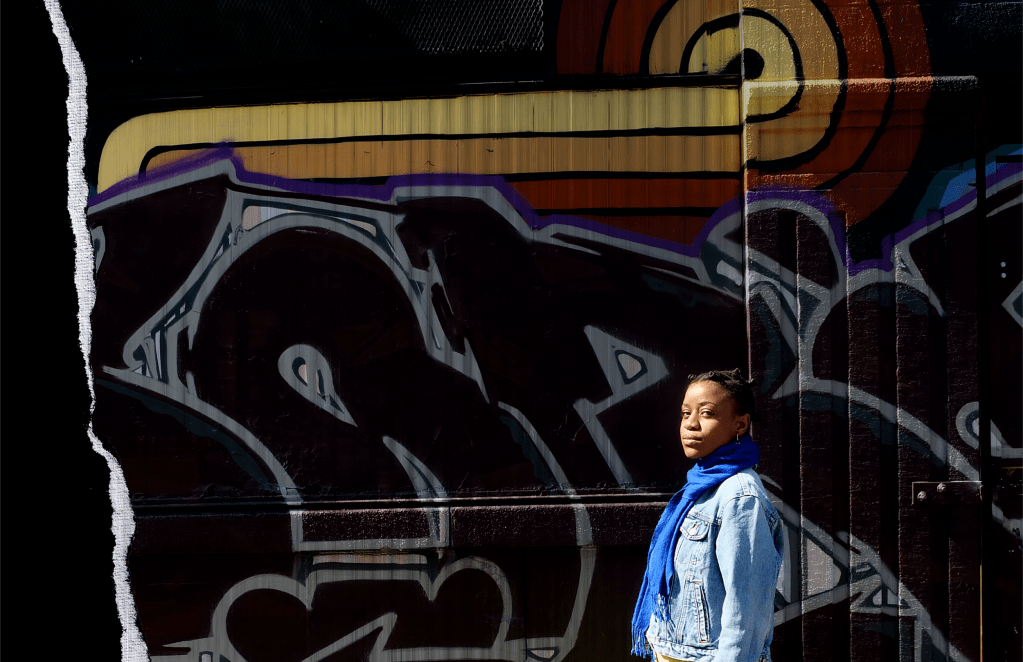
via Imago Theatre
“What happens to a dream deferred?” – Harlem, Langston Hughes
As one enters Studio Mile-Ex, a wave of curiosity overcomes them while they observe their surroundings. Rocks, dirt, caution tape, old crates, empty shopping carts, and pieces of broken canvas and insulation hanging from the ceiling fill the space. For what used to be an abandoned train workshop, has now been transformed into a theatrical experience.
The immersiveness of Scorpio Moon (running with Imago Theatre from March 27th to April 6th) begins as you walk into the building, immediately encapsulating you in the story of Koa (Cameron Grant) and Lily (Bénédicte Bélizaire). The play begins with Lily alone onstage, anxiously awaiting the arrival of her old friend, Koa. As the play progresses, the audience is taken through a friendship that has been ripped apart, and sewn back together again, over and over. A reflection of Adjani’s own life, the story does an incredible job at resonating with its audience. Tying in themes of economic disparity, the struggles of creating art, and the Queer and Black experience, the story is complicated and ever-changing. Adjani had a “desire for people to feel reflected in the story and the themes.”
In an interview with playwright Adjani Poirier, I asked about her intentional message when writing Scorpio Moon, to which she replied “There is no singular message.” I was then curious to see what the play had in store for its impending audience. Once the play took place, I finally understood what Poirier had meant. Scorpio Moon explores not one specific message, but manages to incorporate many different messages while portraying the human experience.
The lack of a central plot or singular message feels truly like an homage to the complexities of the human experience. The focus lies on the relationship of the two characters, Lily and Koa, and how they connect on a deep level. Koa is a struggling studio artist, with a distant personality, and tendency to correct others. Meanwhile, Lily, is a former artist with a vexatious victim complex, leaving her dreams behind to make a living in a corporate job. The two characters ravage from intense emotional fights to love and support, reflecting any long and living friendship. The story is very engaging, and we quickly learn that Lily had slept with Koa’s boyfriend previously, leaving the friendship to reach an intense halt for over two months. When they meet at the warehouse, it is their first reunion.
With the hardship the pair have endured, Lily and Koa both are eradicated in their own pools of guilt. Lily emotionally rips apart the friendship, after she slept with Koa’s ex-boyfriend, Michael, betraying his trust and creating a deep space between them. Koa had then asked Lily not to reach out, even if he had not meant it, to which she obeyed. On the other hand, Koa felt guilty for not supporting Lily when she lost her grandmother, of which he had not known, since he had never initiated any conversation. Lily makes a great comment that truly resonated with the audience “Death is inevitable, but I can’t understand she’s not here,” pulling in themes of loss and grief simultaneously. Their mutual guilt only brings them closer together, understanding that they have made mistakes, and can persevere through them together.
The characters speak of their struggles within the friendship, and their own personal ones. Koa’s issues with money, as he later reveals, have rendered him homeless. Lily’s struggles with her mental health, and attempting to overcome her past mistakes that have left her in a pit of regret. They reminisce on their days at art school (where they met), when they were learning about their sexualities and identities, young and free. Soon enough, Koa criticizes Lily leaving the art world almost entirely, to take a well-paying corporate job. However, the double-edged sword between art and capitalism becomes evident. Koa is a wonderful artist, but is homeless, while Lily makes a decent living, but had to leave her dreams behind. Koa mentions “Capitalism and art are like oil and water.” The audience is soon faced with the reality of being an artist in the modern world.
“Everything interesting always gets destroyed.”
“Everything interesting always gets destroyed.”
-Lily, in Scorpio Moon by Adjani Poirier
At a later point, Lily says “Everything interesting always gets destroyed.” This quote is meant to describe the quirky warehouse the pair had been using to hangout in for the last decade, and its impending death, but also inspires the idea of capitalistic priority in the art world.
The love the duo hold for each other is a constant message. Between their intense fights, and uplifting praise, they always progress with love. That is the mission of Scorpio Moon, to portray the complexities of being a human, and loving someone else unconditionally, when it is easy or when it is difficult.
 The Plant
Leave a comment