

Minola Grent
News Editor
Photo Via NPR
In 1948, the National Party in South Africa implemented a measure that, on paper, aimed to develop the white and Black populations separately but equally. Despite what it initially claimed to bring, the apartheid actually caused 46 years of segregation in South Africa that was anchored in the law. This was the beginning of the apartheid. The African National Congress (ANC) political party played an important part in the resistance against these laws. More than 8000 people were sent to jail for their participation in a peaceful resistance campaign called the Defiance Campaign that was started by the ANC in 1952. Among these stood Nelson Mandela, a member of the ANC who would not be freed until the end of the apartheid in 1994. That date is ingrained in the minds of all South Africans as a pivotal moment of political, cultural, and social reform. However, 2024 and 2025 surprised everyone by bringing back-to-back events that spread and shocked the nation in a similar way.
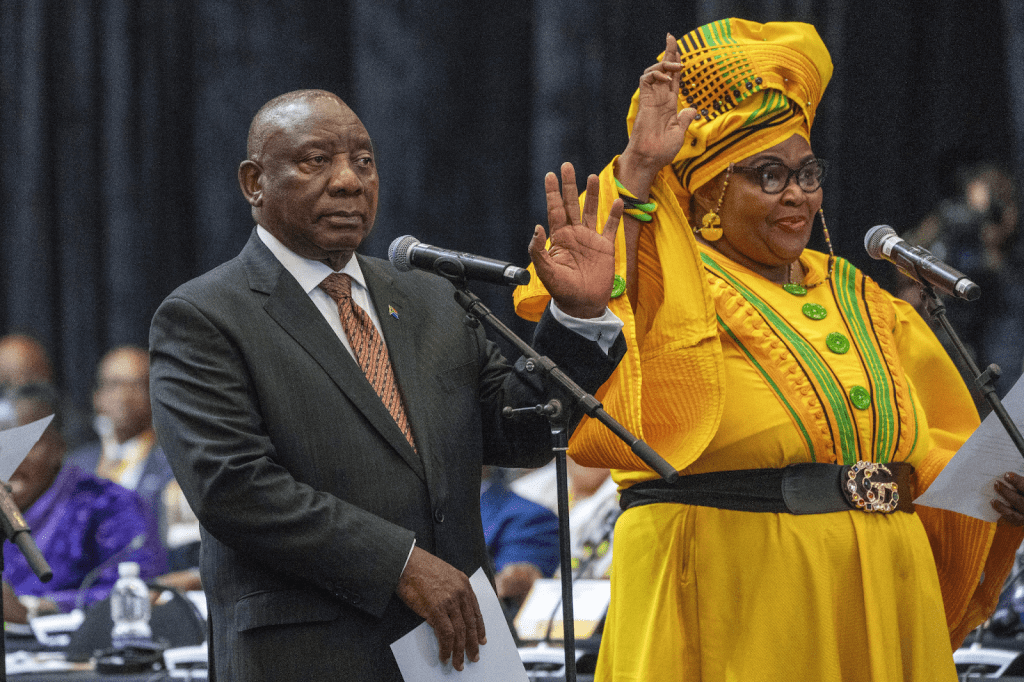
Last year saw South Africa’s 7th general election since the end of the apartheid in 1994. President Cyril Ramaphosa and his party, the ANC, had been in power since and expected to be reelected. However, he failed to secure a majority of seats in parliament as he had garnered only 40% of votes. This placed the country in a similar position to that of Canada’s minority liberal government elected in 2021. In response, the government’s website, State of the Nation, stated that “the Government of National Unity (GNU) was formed after the elections, when 10 political parties from across the spectrum came together to chart a new path forward for [the] country.”
South Africa brought a genocide case against Israel in front of the World Court rendering its relations with the US tense in light of Trump’s “staunchly pro-Israel stance,” reports Reuters. The United States has cut all previously agreed-upon investments to help alleviate South Africa’s dependency on coal and support its transition to renewable energy. These investments were also of great use in vaccine production and in the treatment of HIV and AIDS. Without U.S. support moving forward, South Africa would have found itself in a worse situation than it currently is—if not for the EU stepping in.
On March 13th, 2025, EU chief Ursula von der Leyen and South African president Cyril Ramaphosa met at the Cape Town summit. The EU jumped at the opportunity to fund South Africa and announced that about €4.7 billion would be given to the country. According to a DW article, von der Leyen said that the EU, unlike other countries, was not interested in exploiting South Africa for their raw materials, but that they wanted “to support local jobs, local added value, and high environmental and labor standards.”
The U.S. removing its funding has affected the country on more than one front. In fact, South Africa had already been struggling with a massive problem within the government. At the beginning of the year, the government has to present its budget and have it approved. The original version of the budget was quickly voted down by the president’s own party, the ANC, and their biggest coalition partner and historical enemies, the Democratic Alliance (DA). The proposed budget suggested raising the value-added tax (VAT), which is applied to various products, by 2%. It would bring the current VAT to 17% instead of 15%. This change would worsen many families’ situations as it would increase the cost-of-living. Finance Minister Enoch Godongwana had no choice but to postpone the budget presentation to write a new proposition that would appease more parties in the coalition government. This type of situation hadn’t occurred in South Africa since the end of the apartheid in 1994, says the BBC. Godongwana came back with a revised version of the budget that barely improved the situation. It suggested increasing the VAT by 1% and spreading it out across two years to alleviate the stress on households.
This time around, it garnered the support of the ANC and one other small party in the coalition, the Patriotic Alliance. The 8 other parties did not approve of the budget. The revolutionary coalition that was meant to promote a new era of cooperation for the country now puts it at a great political risk. According to the BBC, because the second main partner in the coalition, the DA, rejected the budget, the ANC is forced to “strike a deal with other parties or risk seeing the budget being voted down—something that could result in the collapse of the coalition government.”
Regardless of the people and politicians’ upset with this route, the South African government is in dire need of money for multiple reasons. First, the retraction of U.S. funding may be an indicator of the bleak trade future between the two countries. According to the World Integrated Trade Solution (WITS), the US is South Africa’s second biggest trade partner and according to the Office of the United States Trade Representative, the trade balance between two countries totaled $20.5 billion for the year 2024. If trade between the U.S. and South Africa were to decrease or, even worse, cease completely, it would be a catastrophic turn of events for South Africa.
Second, the government is in tremendous debt to various countries from which South Africa borrowed money or from which it has received financial help. According to BusinessTech, “for every rand spent by the South African government, 22 cents goes to paying off debt”. The government needs the money to attempt to reduce debt and there seems to unfortunately be few other options than what is currently proposed in the budget.
Moneyweb conducted an interview with Dawie Roodt, chief economist at the Efficient Group, to shed some light on the current economic impasse South Africa has found itself in. Roodt explains that “there’s something that economists call the Laffer curve, which means that if you keep on increasing taxes, then eventually your tax rates, then eventually you will start collecting less taxes”. That is the current situation in South Africa.
The government could not increase other taxes like the personal income tax (PIT) or the corporate income tax (CIT) as they had already been pushed past the Laffer curve. Counterintuitively, raising these taxes further would actually result in less revenue. He also explains that 4% of South Africa’s population, its high-earners, make up almost 50% of the total revenue for the PIT and only 1000 companies make up 70% of the CIT. These high-earners feel as though, even though they give the biggest contributions, they aren’t the ones reaping the most benefits from government spending. Roodt says there is already a rising trend in attempts at emigration and tax evasion from this part of the population. Therefore, raising the PIT and CIT would only make matters worse, which is why this is not an option for the South African government.
The only tax the Roodt says is not past the Laffer curve yet is the VAT. This explains why the budget proposes an increase in that sector. However, Roodt also warns that while the Vat may not be over the Laffer curve yet, it very well may be after the raise. The most important thing is to wonder whether too much money is being taken out of the economy with these types of policies, says Roodt.
President Cyril Ramaphosa promises that this budget is what’s best for the economy and that it will create jobs. However, these are the same promises he made during his last mandate and the current unemployment rate in South Africa is about 30%. According to Moneyweb, the South African government is expecting a rise in Gross Domestic Product (GDP) of 1.9% over the next few years, but Roodt explains that a more realistic expectation is 1%. He says that in the best case scenario, GDP will grow 1.5%.
As of the end of March 2025, no compromise was found. The country is in a political impasse with none of the 10 parties that form the coalition government finding common ground. The economic state of South Africa is just as deplorable. Despite the EU’s investments to counter Trump’s retraction of funds, the Government of National Unity’s inability to settle on a budget because of political disagreements and because of what increasing taxes may mean to the people may bring a crisis. Though it is a situation no one wishes to see South Africa end up in, a collapse of both its economy and government seems on the horizon. All people can do is hope the GNU will come to an agreement before it is too late.
 The Plant
Leave a comment