

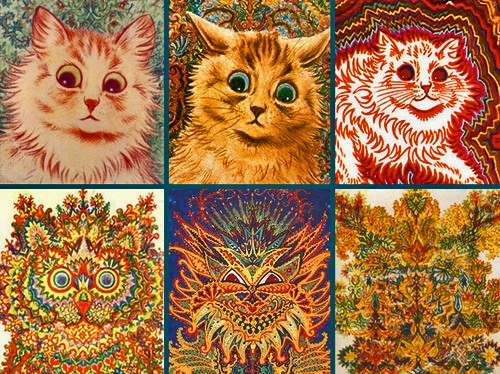
Camylla Joseph
Staff Writer
Photo Via Louis Wain
Schizophrenia is a very serious mental illness that has unfortunately been bastardized and misinterpreted all throughout history. The general idea the public has on Schizophrenia is based on false assumptions that couldn’t be more wrong.
It is stated by the Schizophrenia Society of Canada that approximately 300,000 Canadians are currently diagnosed and living with schizophrenia. Despite schizophrenics being 0.75 percent of the population, the stigma surrounding this mental illness still scares many, sometimes even people who have never been around a schizophrenic. The proof lies in how the word “schizophrenic” is casually thrown around and used as a derogatory term. Western media and film industry have played a major role in this misinterpretation and “boogeymanification” of schizophrenia. Movie such as The Joker (2008), have portrayed the illness as an aggressive and dangerous disorder, while this couldn’t be further from the truth.
Schizophrenics aren’t the scary, multiple personalities, hot-blooded citizens that they’re depicted to be. Those stereotypes have led to the isolation of them, even though it is a fact that a schizophrenic is more likely to get assaulted by a non-schizophrenic than the opposite, as stated by the National Library of Medicine. It is ironic, considering many non-schizophrenics seem to think schizophrenics are real threats that need to be dealt with utmost carefulness. In an interview for the YouTube channel Special Books by Special Kids, Cecilia, a diagnosed schizophrenic, discusses the challenges she faces. She admits that her true fears are not the voices she hears, but rather “the fear of real people, like what real voices have to say..” and that those are “the one that matters” to her. The stigmatization she faces has made it nearly impossible for her to fully trust another person.
Visual and auditory symptoms are the most widely known symptoms in western media. While those are actual symptoms of schizophrenia, it shows limited representation of schizophrenic symptoms. The symptoms can be divided into three main categories. There are the positive symptoms, which are commonly known as psychotic symptoms. Those are the “well-known” symptoms of schizophrenia, such as hallucinations and delusions. Negative symptoms are symptoms that impact the daily life of the individual and their behavior, including a hard time expressing emotions, difficulties socializing, speech issues, lack of motivation, lack of interest in activities and a reduced experience of pleasure. Lastly, there are cognitive symptoms, which affect thought processes, difficulties with attention and memory issues, making it harder for the average schizophrenic to perform daily tasks.
Schizophrenia symptoms not only vary from one individual to another, but it has been found that geolocation has an impact on how the person with schizophrenia experiences the illness.
In a Stanford study led by professor Dr. Laurence Kirmayer, researchers found that, while schizophrenics from Ghana and India tend to hear calmer voices, people from the United States tend to hear harsher and violent voices. Ghanaian and Indian patients suffering from schizophrenia have said to maintain good relations with their voices, which for the most part are seen as elders exhibiting a caring, playful attitude, nurturing them and giving them advice. On the opposite side, voices heard in the USA are hostile, frequently telling the patient to harm themselves or others.
It is theorized by Dr. Laurence Kirmayer that the reasons for this phenomenon are the typical individualistic views of the West, which pushes citizens to put themselves and their individual needs on a pedestal while neglecting their communities. This might be the cause of those harmful thoughts against others, compared to South Asian and African cultures, which often prioritize a sense of community rather than individualism.
Another study, led by Tateyam Masato and Asai Masahiro, published on Karger, an academic publisher of scientific and medical journals, conducted on 575 patients from Germany, Austria, and Japan, has found that Germans and Austrians tend to have strong false beliefs which are also known as delusional thoughts about religion, guilt, and death, compared to the Japanese, who are more likely to have delusional thoughts about coworkers wanting to harm them.
The stigmatization of schizophrenics has a huge impact on Schizophrenics, it is stated by the Schizophrenia Society of Canada that approximately 96 percent of Schizophrenics experience discrimination due to the negative image that schizophrenia has. By attempting to learn and understand them, we create a safer environment for schizophrenics, making them feel safer, less ashamed and isolated.
 The Plant
Leave a comment