

Photo Via UDiscoverMusic
Charlotte Renaud
Arts & Culture Editor
With practice, a person can probably memorize a poem in Chinese without knowing what any of the words mean. They could even learn multiple poems if they put their mind to it. Yet, no matter how well they may know how to recite those poems, they still wouldn’t master the language. To know how to speak a language, one must be able to improvise in it—to express oneself freely without a script. The same can be said about the language of music.
Music is born from the spontaneous creation and organization of sounds. Before anything is written down or practiced, it must be felt; it must be created. When improvising in music, the notes are in their purest and truest form, the direct product of a person’s stream of consciousness. They are not refined and they are not perfect, but they are real. Philip Alperson’s article “On Musical Improvisation” puts it perfectly, “In this regard, we attend to a musical improvisation much in the way that we attend to another’s talk: we listen past the “mistakes” and attend to the actual development of a work. More broadly still, we might say that musical improvisation brings to light a feature of human action in general in a world recalcitrant to human will.” Just like how rehearsed words are less sincere, rehearsed music loses its original touch of authenticity, no longer tending to matters of the heart but to musical technicalities instead.
Improvisation in music has a long history dating back to prehistoric times before notation. Long before Taylor Swift released her first song, before Beethoven composed “Moonlight Sonata” and even before the oldest artist that you can think of existed, a caveman banged rocks together while yelling “Ooh! Ah!” Music has always been a part of the human experience, which is why it is impossible to pinpoint when it was first “invented” and by whom. Before the existence of notation —and more recently recording— music could only be transmitted orally. Music that wasn’t played would simply be forgotten. To prevent that, there was great importance placed on sharing music with one’s community.
The element of community in music is still very present today in all genres. For example, an article published by Ableton explains how the tribal music of the Massai people in Kenya and Tanzania are defined by their signature fixed rhythms which they cannot deviate too much from. To stay loyal to their people, they must abide by their ways; however, they are still encouraged to express themselves as much as possible within those confines through improvisation.
Now, especially with the development of recording, importance has been placed on music that is rehearsed. People go to concerts expecting to hear songs that they know and artists practice their songs with the intention of performing them for their audience. Rehearsed music is wonderful, but it lacks a fundamental quality of music: stream of consciousness. Music is a language; why have we limited ourselves to using it solely when it is rehearsed? While not as popular today, the concept of improvisation still exists – especially in African-influenced genres like jazz and freestyle rap.
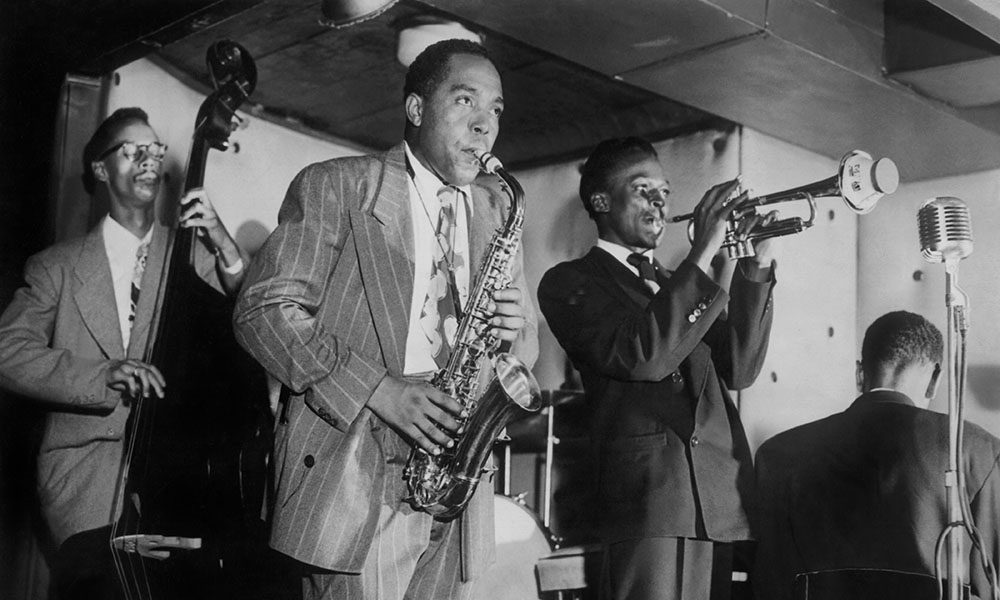
Jazz, and more specifically bebop, is known for its emphasis on improvisation. The bebop movement emerged during the 1940s as a protest against the restrictions of swing bands. It had an experimental approach that encouraged unconventionality in music such as quicker tempos and chords that were considered odd at the time. According to Carnegie Hall’s timeline on African American music, the great Charlie Parker paved the way for the bebop movement. John Coltrane, Miles Davis, Pat Metheny, and Thelonious Monk also played an important role in shaping bebop. Monk once said, “Everything I play is different. Different melody, different harmony, different structure. Each piece is different from the other one. I have a standard, and when the song tells a story, when it gets a certain sound, then it’s thorough…completed,” making a direct reference to the crucial element of storytelling in music.
In addition to those incredible musicians, vocalists such as American jazz singer and pianist, Sarah Vaughan, also mastered the bebop genre with improvisation. Similarly to how abstract painters and sculptors seek to “dissociate their art from the world of the ordinary,” Carnegie Hall explains that “[Vaughan] created abstractions of popular melodies and elaborated on the score by extending the harmonic content and melodically improvising upon standard show tunes like “Shulie a Bop” (1954).”
At first glance, jazz may not resemble rap at all… yet, they both share an improvisatory nature. Rap originated as ‘freestyle’ performances by DJs who would interact with the crowd between sets of funk music. Jake Hall’s article “A Brief Hip-Hop History of Rap Battles” recalls how DJ Kool Herc would rap lines to the crowd who would then rap them back to him. Over time, these lyrics grew more complex and became the rap that we know today. These DJ sets became a space where rappers could engage in competition with one another over who could appeal more to the crowd. Displaying the original form of rap, DJ Kool Herc’s song “Let Me Clear My Throat” is an interaction between himself as a DJ and the crowd.
According to Brent Wood’s article “Understanding Rap as Rhetorical Folk-Poetry,” “the rap culture that grew in New York in the 1970s was not specifically about the exchange of insults, boasting, toasting, documenting social ills or creating poetry. It was about the power of the word, especially its rhyme and its rhythm, and these long-standing oral traditions naturally became a part of rappers’ explorations.” From rap battles between students in schoolyards to professional ones between known artists such as Big L, Eminem, and Kendrick Lamar, freestyle rap is one of the few remaining genres of music that keeps improvisation at its core.
While rap focuses on the improvisation of lyrics, many of the best guitarists valued improvisation above anything else. Prince’s unforgettable “While My Guitar Gently Weeps” and Jimi Hendrix’s legendary Woodstock performance of “Star-Spangled Banner” could be considered one of the best live solos… and, guess what? They were both improvised on the spot. It is evident that Prince and Hendrix both mastered the language of music.
Allan Holdsworth, the British jazz guitarist known for his role in the progressive rock scene, also mastered the language of music by prioritizing improvisation in his work. Graham Tippett, in his article “The Improvisational Genius of Allan Holdsworth,” writes, “Allan didn’t have any pre-fabricated licks or runs, and certainly didn’t script or rehearse what he was going to improvise on any given night. When you see him improvising, it’s from the heart; he’s not stringing a bunch of licks together like most other players.”
Holdsworth influenced many musicians to come, including Frank Zappa, the American guitarist who is best known for his jazz-inspired progressive rock. Zappa’s work also places improvisation as one of its core tenets. In an 1984 interview with MTV, he says that “most of the other guitar solos that you hear performed on stage have been practiced over and over again, they go out there and they play the same one every night and it’s really just spotless. My theory is this: I have the basic mechanical knowledge of the operation of the instrument and an imagination. When the time comes up in the song to play a solo, it’s me against the laws of nature. I don’t know what I’m gonna play, I don’t know what I’m gonna do, I just know roughly how long I have to do it.” Isn’t the ability to express emotion the power of music? When rehearsing songs and replicating them time and time again, music is strictly being used to refer to emotions felt in the past. Shouldn’t it—as a language—be used to communicate the musicians’ thoughts and feelings in the present? In the same interview Zappa adds, “I don’t like any of the guitar solos that have ever been released on a record. I think that the real fun of playing the guitar is doing it live, not freezing it or saving it on a piece of plastic someplace or putting it on video.”
Performing and sharing music with others is scary even when those songs are rehearsed. For an artist to display their work in front of an audience, they are bravely putting themself at risk of judgement. There is an additional layer of vulnerability when performing an improvisation because not only is the artist performing something that they did not practice beforehand, but the product of their playing is also directly from their heart’s instincts. Zappa addresses the risks that accompany improvisation when he boldly says, “I will take that chance of going out there and making a mistake for the privilege of doing something unique – one time only – live in front of an audience.” In contrast, many artists meticulously and intentionally perfect their work before performances. Instead of offering the audience a one-time-only experience, they offer them the most accurate performance of their songs.
While improvisation requires taking risks and being incredibly vulnerable, it has that special touch of authenticity that rehearsed music lacks. Just like we do not prepare everything we want to say for the day and recite it when the time comes, we should encourage music to stay true to its instinctual roots. The current music scene may be placing much less emphasis on improvisation; however, jazz, rap, progressive rock, as well as other genres still advocate it. Music will always be a stream of consciousness for some and a rehearsed language for others; but even when it is perfected, it is initially created through improvisation.
To all the musicians out there, grab your instrument and let yourself play what you feel. To all the non-musicians out there, go to open jam sessions at local bars and let yourself experience music in its candid state where it is much more than a performance; it is real life.
 The Plant
Leave a comment