


Photo Via Internet Archive
Julia Azzouz
Creative Writing Editor
We look back at 1940s and 1950s posters—those with big, burly men encouraging military enrollment, or quaint, apron-clad housewives setting a meal before their suited-up husbands—and we think, “Wow! How we’ve evolved!” These illustrations of hypermasculinity, female submission, and nuclear family ideals seem overwhelmingly obvious to the modern eye, but they are still present in our contemporary media landscape. Despite our self-congratulatory distance, these themes haven’t disappeared; they’ve simply evolved. Our contemporary media landscape is still saturated with similar messages, though now they arrive through subtler, more personalized channels. With social media, everyone has the power to disseminate images, videos, and texts thick with biases. Often unconsciously, individuals perpetuate the very same ideas we so easily point to and criticize in those old-timey propagandist posters.
To understand how these patterns have endured, we can turn to Edward Bernays, who is considered the “father of public relations.” In his 1928 book Propaganda, he defines modern propaganda as “a consistent, enduring effort to create or shape events to influence the relations of the public to an enterprise, idea or group.” He establishes that “conscious direction is given to events,” not as sinister manipulation, but as a fundamental feature of any enterprise. Whether it is to build a skyscraper, launch a military campaign, or sell a new face cream, someone in the background always crafts a narrative to serve an end. Bernays recognized, however, that the term “propaganda” carried negative connotations, particularly after WWI, so he rebranded the practice as “public relations.” This rebranding itself is telling of the power of language to veil intentionality. Propaganda is not explicitly labelled as such, so as not to arouse fear or suspicion, with the term “public relations” projecting an image of benevolent reciprocity to create trust.
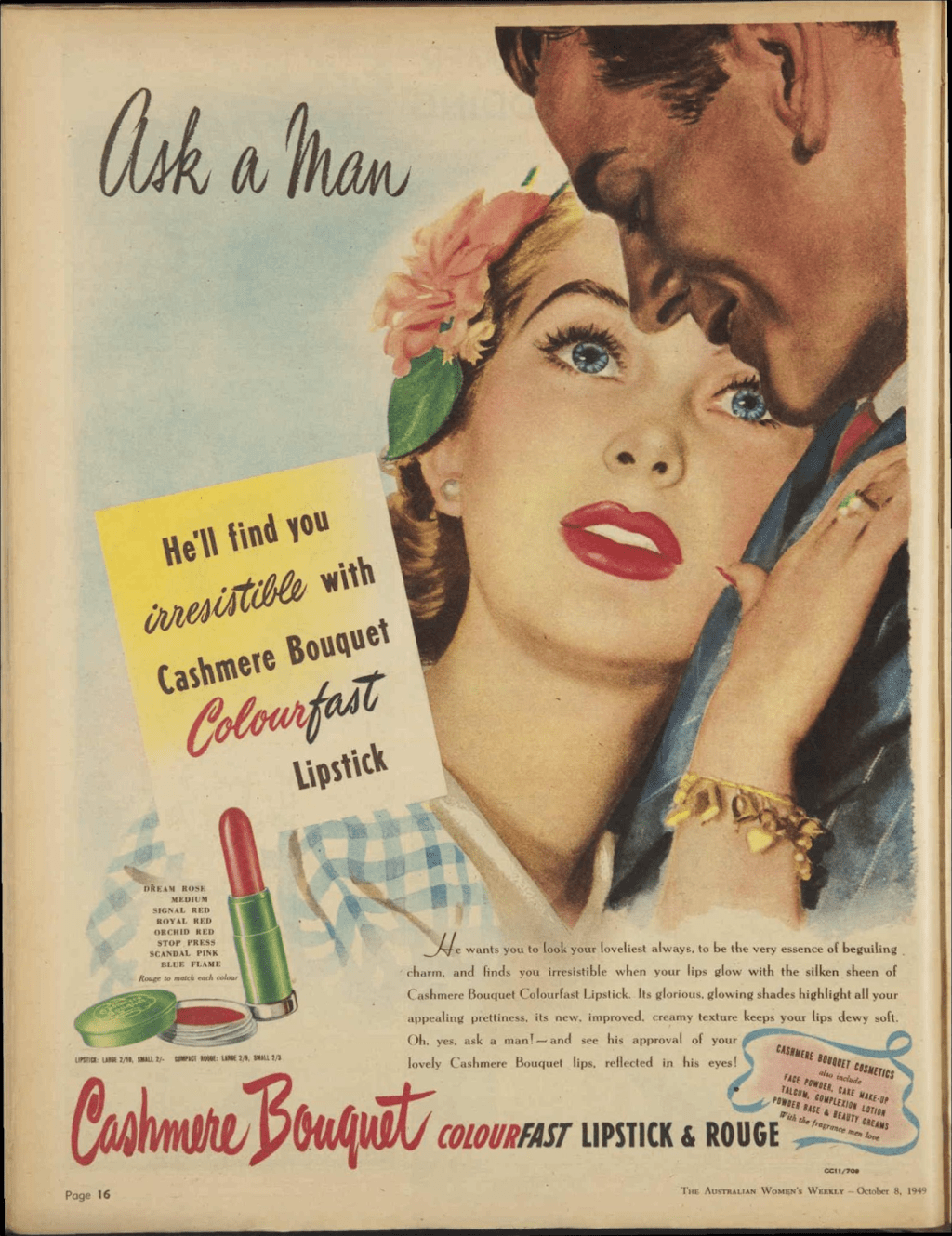
That trust is exploited on the internet, where businesses market products and aptly named “influencers” promote these sales. In these cases, the aim is overt (“buy this product”), but the way it’s pursued has changed. Makeup ads in the 1950s were adamant about making the consumer “prettier” and more desirable to men. This rhetoric is now evidently outdated, so modern cosmetics ads have adapted to a female audience that believes it has evolved past the need for male validation. Instead of promoting the beautifying powers of concealer, blush, or mascara, marketers and influencers propose these items as tools for “self-care,” “self-love,” and “self-expression.” The implication here, as well as in vintage commercials, is that if you do not buy and wear makeup, you do not care about your image. It’s still a performance, just for a different audience: the self. Makeup influencers on social media often do not know how they are playing into these existing ideals, yet they are key actors in maintaining them.
The consumer’s role is clear, but in many other cases, it is more difficult to determine one’s role. In the “I’m just a girl” trend on TikTok and Instagram, women lament their relational, professional, and academic responsibilities by symbolically regressing into a caricature of teenage helplessness. Though unconsciously perpetuated, these biased claims are markers of socially cemented misogynistic ideas that identify women as passive, infantile, and intellectually inferior to men. Though satirically playful on the surface, this trend places the blame on one’s “girlhood” rather than on one’s agency for irresponsibility– not the autonomous self as whole, but its contingent feminine quality. It’s nowhere near as overt as an image of a housewife in a kitchen, but it contributes just as much to the dominant patriarchal narrative, if not more.
As these claims come from individuals and not from organizations or institutions, the audience receives them as authentic. Personal experiences secure trust, as we have seen countless times in ads using testimonials from “real people” to validate the efficiency or quality of a product. It’s the same reason why we look at reviews before purchasing an item. When a person willingly affirms a statement and participates in its circulation, it’s like they are stamping their mark of approval on it, thus obscuring the distinction between opinion and persuasion. Influencers and individual women participate in their own oppression using social media, unknowingly legitimizing systemic oppression.
Bernays understood propaganda to be a conscious tool, used by those in positions of authority to steer public opinion. In his time, access to mass communication was limited to a select few—radio hosts, journalists, and publishers. The messages were top-down, and their narratives easier to identify. But with the rise of social media, that control has dissolved. Now, anyone can be a mouthpiece. The line between conscious and unconscious messaging is increasingly blurred. Propaganda, once orchestrated from above, now emerges from within the crowd. Not through intention, but repetition. Not from strategy, but from habit.
 The Plant
Leave a comment