
Photo Via PBS
Emma Caspi
Voices Editor
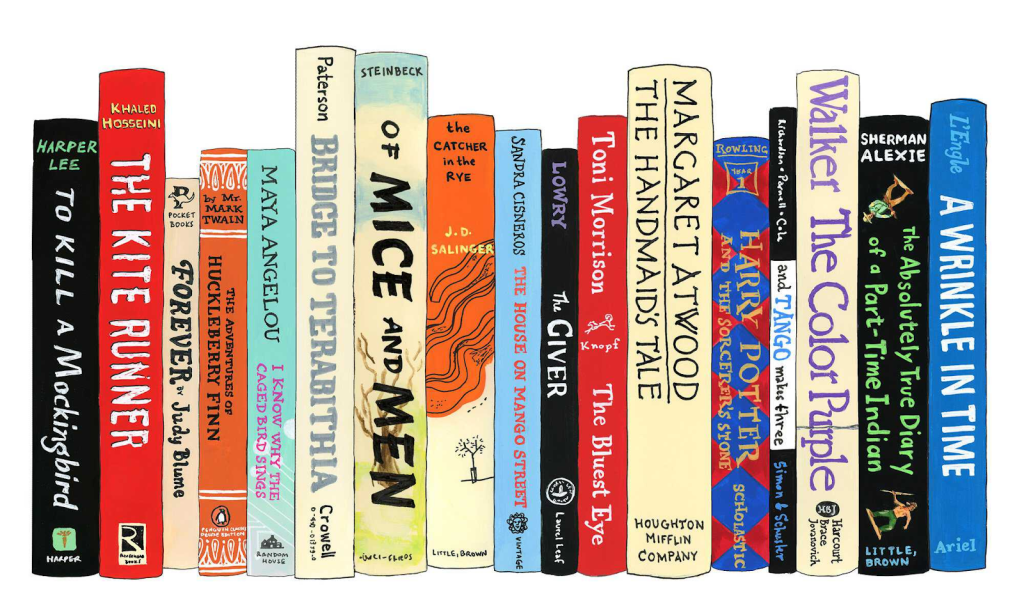
Reading The Handmaid’s Tale, Beloved, The Perks of Being a Wallflower, To Kill a Mockingbird, and I Know Why the Caged Bird Sings as a teenager profoundly influenced my worldly perception; these kinds of novels are extraordinarily raw and real, forcing you to go beyond the boundaries of your own experiences and grapple with an alternate reality. My love for literature served me well by landing me in enriched English high school courses and influencing me to choose the Liberal Arts program at Dawson. I suppose you could say that these classic novels changed my life. The feeling is however not universal, considering that all these books are banned across various American states and schools. Book bans have never made sense to me and seem rather paradoxical, for they rarely work at restricting a book’s content and fail at protecting the youth from “harmful” content.
What does it even mean to ban books? What qualifies a book to be banned? PEN America, an organization protecting freedom of expression, classifies a book ban as restricting, diminishing or completely removing a book’s access from schools, either because of inappropriate content, parent or community complaints, administrative decision, or threatened action by lawmakers and government officials. PEN America’s Index of School Book Bans recorded 10,046 book ban instances across 220 public school districts and 29 states in the 2023-2024 school year. With every passing year, the U.S.A. resembles more and more George Orwell’s 1984, which is, ironically, a banned book about a manipulative and invasive totalitarian regime.
Books have long threatened government officials and those in authoritarian positions. Consequently, literature censorship is nothing new either: Freedom To Read traces censorship back to 259–210 B.C., where the Chinese emperor Shih Huang Ti allegedly buried alive 460 Confucian scholars and burned all the books in his kingdom. However, you would think that book bans would be effective, considering they have existed for centuries.
For instance, banning books does not deter people, but adversely attracts them. It is a clear case of the “forbidden fruit effect,” the psychological theory that links increased desirability to increased restriction or unavailability. Book ban lists become ineffective if, in an act of protest, they are used to determine which books should be read instead of avoided. For instance, the American Library Association and PEN America host a “Banned Books Week,” and the bookstore Indigo dedicates a page on their website to their reading challenge to read the banned books they carry. Regardless of the attention books receive after they are banned, they do not hold the same kind of attraction before they are deemed illicit.
According to The Walrus, contemporary book bans assign too much power to physical literature in an age of literary decline: fewer books are being read in high school, enrolments in English Literature programs are lessening, and more people rely on summaries or key passages of a text rather than analyzing it themselves. So, if we are in an age of rapid technological development where physical literature is becoming obsolete, why should anyone feel the need to create school book bans? This introduces the issue of whether the motive behind book bans is for the student’s benefit or for political or personal agendas. Constantly pushing to restrict certain “harmful” content in the same genre of books, predominantly those with narratives including anything about the LGBTQIA2+ community or race, is quite suspect.
It would be more accurate to claim that book bans themselves are more harmful than the content of banned books. Scientific American claims that conservatives have gone so far as to censor certain historic and scientific topics in schools, therefore “altering depictions of slavery” and “rejecting textbooks that reference climate change and challenging evolution.” This kind of widespread censorship is dangerous, as it prevents students from accessing opportunities to hone their critical thinking skills, explore new ideas and, most importantly, learn about beliefs or concepts that challenge their own. At the rate at which textbook and general censorship within school curricula has been growing, we can expect nothing but a very one-sided and indoctrinated society.
I suppose history really is written by the winners – that the past is built on censoring or destroying works and silencing minorities. Just think how different our history courses and textbooks would have been if we could uncover what was, not what was made to be. If a book becomes banned or silenced, it must be doing something right, saying something important. In a world where we are forced to see in black and white, so to speak, narratives deemed worthy of censorship challenge conventional norms so we can see the world blazing in fiery color.
 The Plant
Leave a comment