

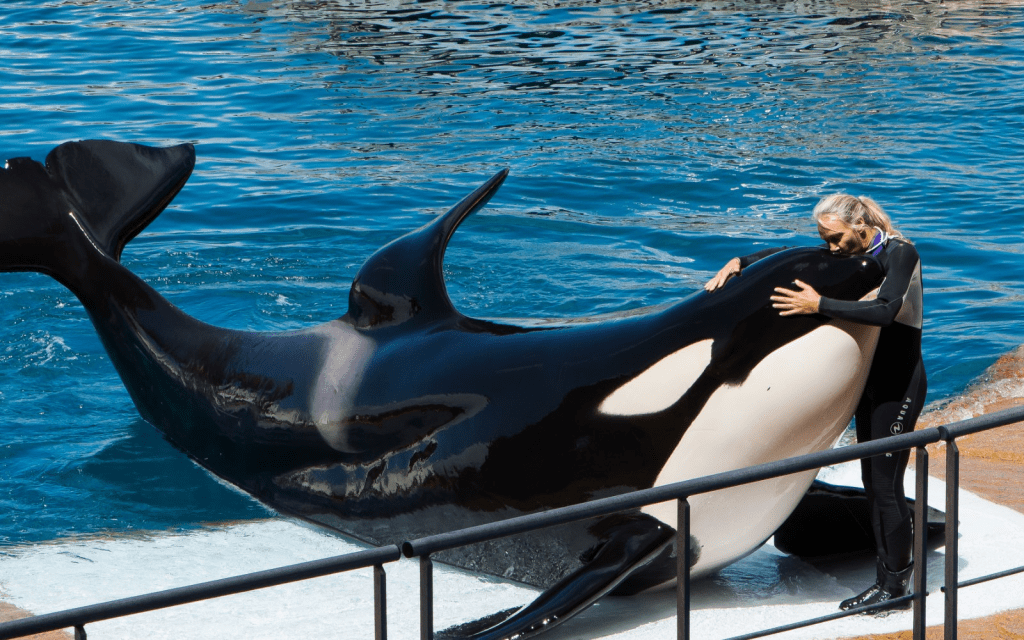
Photo Via France Comfort
Minola Grent
News Editor
In 1961, one of Canada’s most iconic theme parks and zoos opened its doors to the public. With its enchanting musical commercial, Marineland was an instant hit. Over the years, Marineland has grown to house multiple species of marine animals including dolphins, belugas, penguins, sea lions, and seals. The park also kept orca whales until the last one named Kiska passed in 2023. Attractions centering animals, such as zoos and circuses, are nothing new. However, they have been under particular scrutiny during the last two decades. Marineland is no exception.
In February, the death of the 7-year-old beluga, Eos, revived the animal cruelty accusations thrown at Marineland. For instance, Eos is the eighteenth beluga that died at the park in the last five years. These marine mammals generally have a lifespan of up to 60 years. Yet, like Eos, most belugas passing at the park are very young. According to In Defense of Animals USA foundation (IDAUSA), these deaths are due to the living conditions at Marineland, which aren’t ideal.
Belugas have their own distinct personalities and, in the wild, are raised as a part of a large family. In captivity, however, they are placed with other belugas with which they might not get along. This led to the death of Skoot, a 1-year-old beluga, who was attacked by two older males in 2012. With no nowhere to run or hide, the small whale had no choice but to endure the attack. Though Skoot and Eos may look like isolated cases, the In Defense of Animals USA foundation (IDAUSA) says that “Since 2019, 24 animals have died at Marineland; including 18 beluga whales, Canada’s last captive orca, Kiska, a dolphin, a grey seal, a harbor seal, and two California sea lions.” To this day, 31 belugas remain in captivity at Marineland.
Despite its name, Marineland also keeps other land mammals that are generally native to Canada such as black bears, bisons, and deers. IDAUSA reports that the park “was ordered to pay almost $85,000 in fines after being found guilty of animal cruelty charges related to its three black bears.” The three young bears had been living in a cramped space with difficult access to water for months, reports CBC News. They also say that the male bear lived alone in an enclosure measuring 48 square feet while the minimum requirement for black bears is 5000 square feet.
Beyond animal deaths, Marineland has received many warnings about the quality of its water not meeting government standards. Animal Welfare Services investigated the park in 2020. Global News reports that “The following year, [Animal Welfare Services] declared that all marine mammals in the park were in distress due to poor water quality and ordered Marineland to fix the issue. Marineland appealed the order while denying its animals were in distress, but later dropped that appeal.” Though Marineland has since fixed the issue through major investments in new technology, it continuously insists that the animal deaths at the park “are part of the cycle of life,” says CTV News. Furthermore, Melanie Milczynski, chief inspector and director at the Animal Welfare Services, told Global News that she “knows the cause of death of the animals but the province is not at liberty to discuss its findings.” There is a lack of transparency from Marineland and of accountability from the Canadian government, who has yet to shut down the park or enforce significant punishment.
Marineland has strained relationships with the media. In the summer of 2023, a reporter and photographer from the Canadian Press visited the park and spoke with some of the staff members. Later, in October of 2023, Marineland refused to speak with that same reporter. According to CTV News, the park then banned the reporter from its property, claiming bad journalistic practices: ‘“You have consistently displayed an inability to professionally ‘report,’ instead advancing inferences and false allegations in aid of your personal views”’, stated Marineland in an email to the Canadian Press. No further comment concerning this issue was made by either party.
Animal rights in the context of amusement parks and entertainment are not protected. The Canadian government can no longer ignore animal welfare issues when other countries are doingthe most instead of the minimum. For instance, according to Mexico News Daily, Mexico’s senate passed a unanimous bill that enshrines animal welfare protection in its constitution. The legislation protects animals from cruelty, neglect, zoophilia, and more. It also enforces animal protection to be a part of all public school curriculums across the country. Nothing stops Canada from following in Mexico’s footsteps. Until animal rights are not constitutional, they will be in danger.
As of April 2025, Marineland is looking for new ownership, says CTV News. This possible change in management leaves the animals’ future uncertain. Though it is expected for them to be moved, it is unclear as to where and what purpose they will then serve.
No zoo, aquarium, or amusement park using animals as a display can meet the welfare needs of said animals or ensure their wellbeing at all times. It is not ethical. The public’s entertainment should not come before the safety and protection of living creatures.
 The Plant
Leave a comment