

Via The Guardian
Orion Peyrol
Staff Writer
Long have non-human species been viewed as inferior. We don’t even do it consciously; we just see other animals as less intelligent than us, and why wouldn’t we? I mean, they can’t do the same things we can… or can they?
This underestimating of animals goes back a very long time. Ever since we started philosophizing about what it means to be human, we separated ourselves from other animals. Descartes himself, a philosopher often seen as the father of reflections on the self, viewed animals as “material automata”— lacking soul or consciousness.
This idea of other animals being distinctly different from us bled into science. For a long time, when researching animals and their behaviours, we believed that by attributing thoughts and feelings to them based on actions, we were projecting our human experience onto them. Ironic isn’t it?
“By trying to be unbiased, we were unconsciously dismissing the intelligence and experiences of these creatures.”
In the past few years, we’ve learned a lot about what we refer to as animal consciousness or sentience. Sentience, from a scientific standpoint, refers to a creature’s capacity to feel, think, experience, and interact with the world around them, and, sometimes, to have a level of self-awareness.
A lot of research has been done in the past decade analysing the behaviours of various animals and trying to determine their level of sentience. For example, we’ve found that bees, despite having sesame seed sized brains, can count, recognise human faces, and, based on a 2022 study published by the Proceedings of the National Academy of Sciences (PNAS), order objects based on their size.
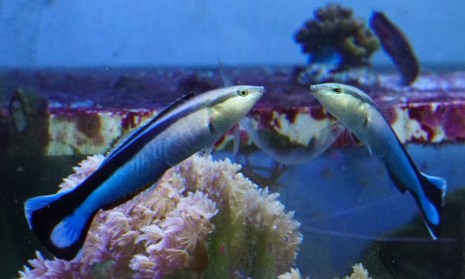
One of the tests done to check a species’ sentience is to see if they can recognise themselves in a mirror. The test was done in 2019 with the cleaner wrasse fish, a small fish with average intelligence. At first, when the mirror was placed in front of them, they viewed their reflection as rival fish and tried to attack it. However with time they seemed to recognise themselves. They started to do things like swimming upside down to see what would happen in the mirror. Then scientists placed a brown mark on the fish and when the fish later saw the mark in the mirror, they recognised it as abnormal and attempted to rub it off.
Only a few species have what scientists call a higher form of consciousness, such as apes, dolphins or octopuses. Similar experiments have been done with octopuses but they seem to be even more complex than we even give them credit for. So don’t be surprised if one day these guys try to take over the world! The Octopus Tetricus, or the gloomy octopus as it’s commonly called, has been seen building underwater ‘cities’ in which groups varying between 2-15 octopuses live in the same area. We’ve found two different cities not far from each other that scientists have aptly named Octlantis and Octopolis.
It seems these ‘cities’ started with a few octopuses living near each other, bringing back food, and expanding their den until it eventually, as more octopuses joined in, formed a ‘city’. These octopuses exhibit complex social behaviours in these cities: social expulsion and eviction of octopuses from the city, mating, and fighting. We’ve found that many species of octopuses use visual signaling through movement and changing colors or patterns to communicate in ways we don’t fully understand yet.
Since this research is so recent, who’s to tell where it will lead to! However, these recent breakthroughs have led experts to question the ethics of our current laws concerning animals. To them, if animals have a consciousness, that consciousness should be taken into consideration when testing on them, keeping them in captivity or farming them. Legally, animals are not seen as conscious or sentient at the US or Canadian federal level. This means that laws regarding their welfare more often deal with their exploitation, their conservation or their treatment in captivity instead of their emotional distress and quality of life.
In 2024 nearly 40 scientists and experts got together to sign the New York Declaration on Animal Consciousness. This is a declaration that states that there is empirical, undeniable evidence that many species might be sentient and should be seen as such under law.
We have spent far too long regarding other species as inferior to us and willfully ignoring the atrocities we make them endure. Animals are so complex and we’ve only begun to scratch the surface of this new area of research, but it is impossible to deny that they are, in some way, sentient and should be treated as such.
 The Plant
Leave a comment