
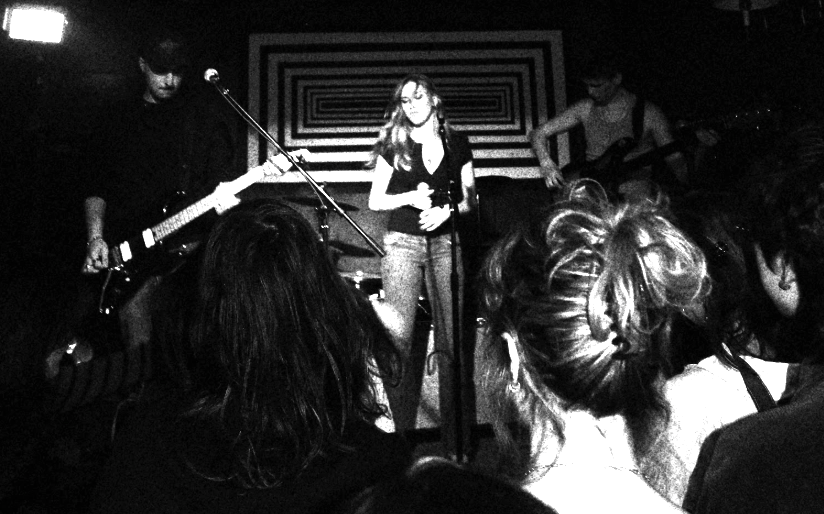
Photo of Dollhouse at Bluedog by Mia Moudilou
Mia Moudilou
Arts & Culture Correspondent
We don’t read and write poetry because it’s cute. We read and write poetry because we are members of the human race. And the human race is filled with passion. And medicine, law, business, and engineering—these are noble pursuits and necessary to sustain life. But poetry, beauty, romance, and love—these are what we stay alive for.
― N.H. Kleinbaum, Dead Poets Society
Whitman from Dead Poets Society said it best. Yet our city seems to have forgotten this. The systematic murder of artistry by the capitalist system we are part of is slowly diluting our humanity and impacting our sense of community. We are conditioned to live to work, and not the other way around; everything is a money-hungry venture above all else. Art in its pure form is being threatened like an endangered species, because the system fails to support what truly feeds the human soul: real-life connection and the support needed to sustain art.
Having spent half of my life living in Europe and the other half in North America, this cliché is a piercing thought in my mind. In the Northern Hemisphere, we are taught to value and sustain the wrong things in life and obstacles are created by a system supported by those who are conditioned just enough… to lose touch with what truly feeds the soul.
I spoke with Sergio Da Silva, a former partner at Bluedog, a 30 year old bar on St. Laurent that hosted countless bands and creatives over the years. It was the first place where I explored my addictive passion with band photography. Sadly, it closed its doors on July 19, 2025, leaving the lively community it built behind.
Bluedog’s death symbolizes the ongoing attempted murder of creative pursuits. Sergio shared some of his insight with me on this topic over coffee at his cafe, Big Trouble. As “Bittersweet Symphony” by the Verve sonically overcast the lyrics, “You’re a slave to money, then you die”, I wished I had the powers to resurrect Richard Ashcroft, so that he could be a part of our conversation.
The cafe is located next to Turbo Haus, his lively 11 year old bar/music venue, which gets its name and ethos from the time his band Trigger Effect spent touring in Europe for 10 years. He aims to bring the European spirit of valuing art to the North, specifically through music.
The first half of the name is “Turbo”, inspired by Turbo Machine, the nonprofit initially created to obtain a “liquor license for weddings”, which then flourished into much more – without the involvement of any wedding bouquets… The second part of the name is “Haus” because every second spot in Europe was named something “Haus”. The band was given a house at each of the music venues they performed at, along with food and genuine care. Sergio described the hospitality his band experienced at music venues in Europe as pure respect for them as artists.
It sounded like the complete paradox of North America, where Wall Street wolves get their 5-star hotels paid for in Miami, while musicians couch-surf or pay more for a hotel than they earned from their gig. Nowadays, Turbo Haus serves as a time travel machine; it’s a space that emulates Sergio’s experience with music venues in Europe. Like those bars in Europe, Turbo Haus has an upstairs apartment that hosts bands and artists coming to perform, who might need a place to stay—free of charge
Turbo Haus began as a DIY space, and Sergio found every loophole in the books (and beyond the books) to make it the safe and vibrant music hub it is. After 3 moves and many obstacles, he still believes “you can find a way to make things that you believe work.”
Sergio being valued as a musician in Europe makes sense, as Europe was the original hub where creative pursuits were taken seriously as professions in all realms of art, music, literature, and film. Whole cities, like Florence, were dedicated to artists, musicians, philosophers, and filmmakers of all kinds. Upon visiting the city under the Tuscan sun this summer, it’s crystal clear that the evidence remains in between its intricate architecture, the musicians taking turns singing under the Santa Maria Novella, and the white marble that Michelangelo turned into an otherworldly, tangible yet uncanny giant named David. Standing at the Uffizi Museum, his detailed veins, fingernails, and crevices come to life. It’s a sight that can still impress a human’s mind 521 years later. The cultural heritage of creative pursuits as valued human activities is undoubtedly a healthy form of baggage for Europeans.
According to Da Silva, Montréal has 3 primary enemies to its nightlife and music hub: property tax, police, and the cost of living. The first enemy is property tax and developers. It’s clear where the values of the current administration stand when a noise complaint from one person—who willingly lives in a nightlife neighborhood—could result in a $10,000 fine for bars like Bluedog, potentially leading to their shutdown and affecting the good spirits of countless people. The ratio should speak for itself, but it doesn’t.
The city should look at the protection and satisfaction of the vast majority, but “this city runs on property taxes from properties in historic nightlife spaces,” Da Silva told me, and there is no true interest in solving issues like this. After years of back and forth, “ultimately nothing changed,” says Da Silva. In truth, the city would clearly rather build homes for the property taxes it can collect from them and so that the banks profit off their mortgage interest.
“Anything that has to do with nightlife is under attack,” are the exact words Da Silva used. In full support of this statement, I would take it even further and say that meaningful parts of life itself are under attack by the capitalist, consumer-driven society we live in. There’s a reason nightlife has always thrived, no matter the circumstances: after-hours is when people truly get to live—beyond the confines of office cubicles and the constant state of busyness. The sun sets and gives us the okay to “waste time”.
It’s a shame to witness spaces like Bluedog shut down, as it is not only detrimental for the lively community expressing and practicing their creative craft of music—which is a proven source of well-being—but also because they remove safe spaces provided by people with resources and the willingness to support meaningful human activities.
It’s important to note that Montréal is still a city filled with a vibrant music and art scene. “The artists will always find a way to make it work, even if it’s under bridges,” said Da Silva. It’s true anywhere, if passion fuels it.
Yet why does the city not make exceptions to support and protect spaces like Bluedog, which foster a safe environment for its people to share happy moments? Instead, enemy number two comes in supposedly to do that: protection, but is it really?
The Police is an umbrella term for the many institutions that are meant to protect people. In Quebec, we have the Provincial Police, the Municipal Police, The Regie de l’alcool, & the Morality police. From Da Silva’s experience, the laws across these institutions are full of nuances that allow them to constantly fight for their own interests. So far, for him, it’s been about ‘finding the loops’ in the system.
It’s important for civilians to understand that legality does not always equate to ethicality. Sometimes laws are put in place to protect the systems that govern people, rather than the people themselves, and that’s why it’s important to question and stand with and for change. Da Silva will be running for office in the November 2nd election with Craig Sauvé’s party, Transition Montreal, aiming to put his ongoing problem-solving efforts to use.
Another sector that Da Silva values is homelessness, which is directly interlinked with the 3rd enemy: the cost of living—courtesy of this pre-recession period. We are all chasing something greater because we are forced to think in terms of survival during this cost-of-living crisis. Sergio made a comment that resonated with this issue: “It is no longer 2005, when I could rent an apartment for 400 dollars; now people live with 4-5 roommates for more.” This creates immense stress for creatives, because it ultimately means working a bunch of random jobs that pay pennies, reducing time to create.
Creating becomes a burden left to the after-hours. This applies not only to young creatives but also to working-class creatives. Overall, it strongly impacts people pursuing the arts, commercializing creative pursuits and reducing them to mere careers while stability remains scattered.
In the past, creatives met at bars, events, gigs, and concerts… After all, we are naturally drawn to reflect our inner worlds. Therefore, the likelihood of attracting a connection that aligns with our mutual hunger for creativity is high—bringing people together on a genuine wavelength where they can flourish and support each other.
After COVID-19, there was a surge in people wanting to go out, have fun, create, and—most of all—be surrounded by others after immense isolation. However, according to Da Silva, many seemed to forget how to be around each other, having lost touch with ‘nightlife etiquette.’ This wave of people who no longer knew how to socialize, combined with those bearing the pressure of building successful creative careers in their 20s, was not a pretty mix.
Real-life connection beats everything; it’s a human necessity, really, to be surrounded and supported by humans who see your vision. During his days in Europe with his band, Da Silva experienced this genuine way of creating. He made countless friendships and played shows around Europe. It was possible because of the small ecosystems; he naturally built a creative community during his time there. For Da Silva, “support is the only way to make any of this work.” Nowadays, everything is becoming more shallow and digitized. Artists are selling their souls on the internet to ‘make it,’ and communities, while strong, are virtual—shaped by the system’s conditioning and control. Although digitalization leads to globalization and immense opportunity, it’s important for artists to balance promoting their work online with staying connected to their passion in real life by performing live for others. Spaces that foster community in this way are slowly going extinct; life is increasingly decentralizing from the very things that allow us to truly be, due to the system we live in. What used to be called friendship and community is at risk of turning into a noble pursuit of networking stripped of its natural beauty. There is a true danger in closing hubs of creative communities. Genuine creativity and community—two aspects of life that are invisible but vital organs to humankind—are being endangered. It’s important to prevent that and intentionally work against it. What if, at the end of the day, we are a species whose purest form of creating—for the sake of expression and connection—is being endangered?
 The Plant
Leave a comment