

Claire Mizuki Rodham
Science and Environment Editor
Extreme weather events in Quebec have increasingly affected herpetology fieldwork and conservation efforts. This year’s extreme heat kept researchers like Dawson’s Tadpole Troopers from monitoring conservation sites. Is this due to the climate’s natural variations or is it global warming? And how can we tell if these weather patterns have caused serious harm to ecosystems?
As explained in Biology Insights, tadpoles are considered an indicator species, meaning they can provide insights into an ecosystem’s overall health. By monitoring them, scientists can track water and air quality, as well as habitat degradation. Amphibians such as tadpoles are especially useful for this because, according to the Museum of Science, they are highly sensitive to environmental changes, including pollutants and rising temperatures.
What Is The Tadpole Research Group?
First introduced at a Dawson Enriched Science Seminar by biologist Dr. Jessica Ford, the Tadpole Research Group quickly became a popular student activity because it offers the opportunity of gaining hands-on experience in field work. Ford has conducted herpetology research since 2015 and, using her experience, she takes groups of Dawson students, called the “Tadpole Troopers,” to sites like Mount Royal or Creek 53. There, they test water quality, monitor larvae, and check developmental stages to see if conditions suit amphibians.
How Have The Recent Hot Weather Conditions Influenced The Tadpole Troopers?
According to data from the Weather Network, this Montreal summer has been unusually hot. On June 24th of this year, a high temperature of 35.1 °C was recorded, breaking the previous June record of 35.0 °C, which was set all the way back in 1964. This scorching climate has prevented the fieldwork divisions of the Tadpole Troopers from conducting research on many occasions since, according to Ford, most fieldwork takes place in swamps. This can be especially challenging as, according to an article published in the University of Washington, swamps can get much hotter than their surroundings. The reason being that because water vapour is the strongest heat trapping gas, this can lead to an increase in the greenhouse effect as humidity rises in a warmer climate. Ford further revealed the extent of these intense conditions, stating that “when there is record high heat, it becomes a health risk for the volunteer. I am not going to risk the health of my team; it was so hot it was unsafe.”
When asked about these unusual weather conditions, Ford believes it may be a mix of both global warming and natural patterns of change, going further to express that while
“it is normal that we have year-to-year changes, the extreme weather events are not normal.”
How Do These Conditions Affect Tadpole Development?
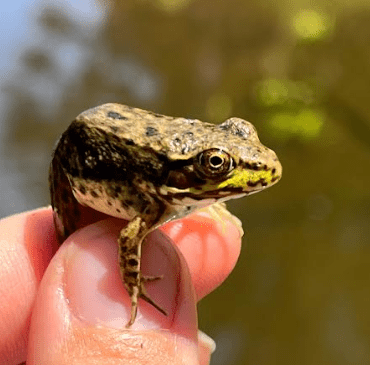
Extreme heat has a significant effect on tadpoles because heat speeds up tadpole development, causing them to metamorphose faster (Ford). As described in the article “Tadpole behavior and metamorphosis”, metamorphosis is “not simply a consequence of unavoidable environmental effects but rather an adaptive response to the risk of mortality in the drying pond”. However, despite it being a natural reaction, Ford explains that this sped-up metamorphosis has many side effects. A notable consequence being that tadpoles complete development at a much smaller size, making them “really tiny!” This is revealed to be detrimental for their chances of survival, as in a study published in BMC Ecology, “the survival rate of large metamorphosing individuals was 95%, compared to 60% for those completing metamorphosis at a small size,” meaning that these extreme heat weather events are correlated with reduced life span for these amphibians.

Why Is It Important That We Protect Tadpoles?
According to research highlighted in What Do Tadpoles Do? by Ford, on top of being an indicator species, tadpoles play a crucial role in ecosystems by reducing algal biomass, increasing the diversity of zooplankton, and regulating phosphorus levels in artificial ponds. Ford reveals that the Tadpole Troopers help protect the tadpoles by sharing the data that they collect with the conservation sites so that they can take steps, such as providing more shade, to ensure their protection. She goes on to empathise: “It is really important that we keep monitoring the sites,to keep an eye on these red flags, and we could hopefully catch it when we can still do something about it. By the time that we realize that something is wrong with them, we need to act.”
 The Plant
Leave a comment