

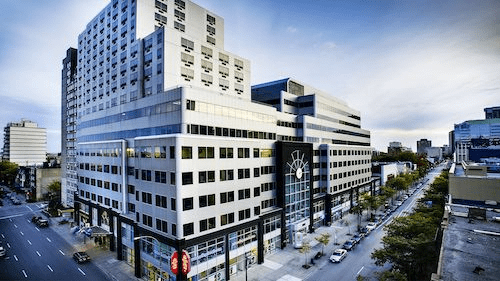
Via LaSalle College Website
Mika Sauvageau
Copy Editor
Law 14, formerly known as Bill 96, is legislation passed in 2022 aimed at strengthening the protection of the French language in Québec. It promotes French proficiency by mandating additional French-language courses at the college level and by increasing opportunities for students to learn and use French. However, the law’s impact has extended far beyond language protection, raising concerns about its effects on access to English-language education in the province.
Since its implementation, English-language institutions have been subject to strict enrollment caps. Under the new regulations, students enrolled in English-language CEGEPs cannot exceed 17.5% of the total CEGEP population across Québec. In addition, only 11.7% of the total CEGEP student body (including both English and French institutions) can enroll in an Attestation of College Studies (ACS) program offered in English.
According to the CBC, these quotas were only publicly disclosed at the end of February 2023. They were based on enrollment data from 2019, a pre-pandemic baseline that does not account for the significant increase in ACS program demand leading up to the law’s enforcement in 2023. As a result, LaSalle College—a major institution offering ACS programs—exceeded its quota and has since been fined nearly $30 million.
This penalty has been widely criticized as disproportionate. According to Claude Marchand, President and CEO of LaSalle College, the over-enrollment was primarily due to international students who had already signed contracts before the law came into effect. Cancelling these admissions would have breached agreements made prior to the 2023–2024 academic year.
Claude Marchand confirmed that he fully disclosed these contractual obligations to the government and formally requested leniency. He explained that the college would not have been able to implement the new caps until the 2025–2026 academic year, after the 2023 cohort had graduated.
Adding to the controversy, LaSalle College does not receive additional funding for ACS students; it receives a fixed annual budget, says the Montreal Gazette, regardless of student numbers. What’s more, international students pay 100% of their tuition, as they are not subsidized by the government.
Despite this, the Ministry of Higher Education denied the college a transition period—even though LaSalle College expressively supports French language protection and is classified as a francophone institution, where all students must pass a French exit exam to graduate.
The result: a $29.9 million fine issued to LaSalle College in June 2025. The college now warns that this penalty threatens its very survival.
Even more troubling, LaSalle claims it has been fined twice for the same students. According to its website, the college had 716 “extra” students enrolled in 2023–2024. In the following academic year, 2024–2025, this number dropped to 350. Despite the reduction, the college was fined for a cumulative total of 1,066 extra students—as if they were new overages rather than part of a continuing cohort.
These rigid measures not only penalize LaSalle but also restrict access to education in high-demand technical fields. LaSalle is known for its leading-edge ACS programs in Early Childhood Education, Information Technology, Business Management, Fashion Marketing and Styling, Graphic Design, and Gaming—fields directly aligned with Opération main-d’œuvre, a provincial initiative launched during the COVID-19 pandemic to address critical labor shortages.
The severity of the penalties raises broader questions about the government’s true motivations behind the enrollment caps.
Hidden within Law 14 is a little-known clause: not only must English-language institutions stay below 17.5% of the total CEGEP enrollment, but they cannot admit more students than they did the previous year.
In other words, the proportion of students in English-language programs can never increase—only decrease.
This built-in decline poses a serious threat to the future of English education in Québec. A small dip in enrollment one year could result in a permanent loss of capacity the next, making long-term recovery nearly impossible.
While much of the focus has been on LaSalle’s ACS program exceeding limits between 2023 and 2025, a bigger question looms: what does this mean for the college’s pre-university DCS (Diploma of Collegial Studies) program, which has already seen a decrease in enrollment since 2019?
If these boom-and-bust cycles continue, they could mark the beginning of the end for English-language education in Québec.
 The Plant
Leave a comment