

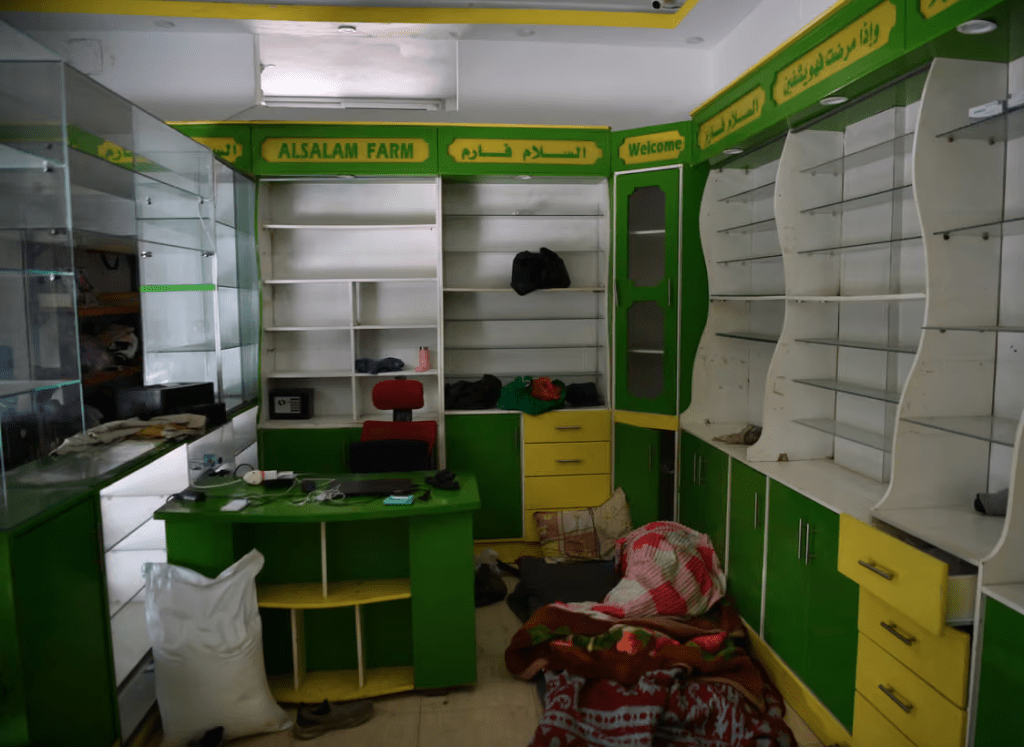
A Pharmacy in GazaVia Anadolu/Getty Images
Chloe Bercovitz
News Editor
“Israeli bombings and displacement have created an immense amount of stress, but experiencing menstruation in these circumstances feels like an entirely different kind of war,” says Mona, 17, after speaking with More to Her Story. She has been displaced alongside 45 others and confined to a stuffed shelter in Rafah. With pharmacy shelves bare, the utter absence of medication leaves Mona throwing up in agony from period cramps. There is no privacy.
After Hamas took over Gaza in 2007, Israeli officials have undertaken extreme efforts in isolating the Gaza Strip from both the rest of Palestine, and the world. By drastically limiting the quantity of goods and peoples that can pass Israeli-controlled crossings, there has been a dramatic downward spiral of negative effects.
According to a factsheet provided by Unicef, in 2022, Israeli authorities have only approved 64% of requests to exit Gaza for entry into the West Bank to receive specialized medical treatment. There has been a clear pattern of patients dying before hearing a response.
However, since March 2,2025, it has been the longest complete closure since the blockade’s start and little to no supplies have entered the territory.
The UNRWA (UN agency for Palestine refugees) claims that every single one of their trucks—containing food and medicine alike—have been denied entry for over 150 days now. While the precise death toll remains indefinite—indefinitely—PBS’ current estimate is now 64,000.
While the world was busy watching Palestine perish from missiles, a silent killer was on the rise—one that has failed to receive adequate attention due to various triggers, such as indignity, pain, and embarrassment. “I do not know [what to say]. No matter how much we talk, we cannot express what happened to us. One is ashamed to talk about these things, but what can we do?” was said anonymously to More to her Story.
Period products are a rarity in Palestine. With food and medicine taking precedence in scenarios where an aid truck manages to surpass state lines, this leaves other essential goods out of the picture. In fact, the communication coordinator of NGO ActionAid International disclosed that 16 trucks of sanitary items have been permanently stalled by the Egyptian border.
Even when pads reach Gaza in the form of hygiene kits, Mona, for example, claimed that they were very itchy and poor quality: so much so that she got an infection from them. Other women and girls that receive these hygiene kits trade them in exchange for food to nourish their starving families. “I go… [to] Facebook marketplace where I see women replacing or bartering pads for food for their kids,” was likewise said in an interview for More to her Story.
Amidst a state of desperation, the only option is to seek alternatives. A girl sheltering in an Unrwa school told The Guardian that she washes and reuses her used pads. An amalgamation of bacteria and soap caused irritation. However, she didn’t feel as if she was given any choice in the matter; she was desperate.
“I wish I was able to properly clean myself,” says Sara, 18, in an interview with Care.
Factors, such as a lack of toilet paper or clean water, contribute viciously to this deprivation of dignity. While filled-trucks remain rooted at state lines, so many needed goods fail to reach Gaza. Especially when compounded by an innumerable demand, essential products such as toilet paper fail to reach the hands of those who rely on them. Such an utter desolation has not only left women and girls in a state of desperation and grief, but also without their dignity. A key pillar of a humanitarian crisis is when cleanliness becomes a luxury. Washing oneself has been reduced to once a month—once a week for those who are “fortunate” enough. Unicef reveals that 97% of piped water in the Gaza strip is contaminated. With Palestinians forced to live a life reduced to the fraught search for food and clean water, their health hangs in the balance.
A spike in stress levels was quick to become an everyday reality in Gaza; stress means heavier, or more frequent periods. Such loss in blood is a common contributor to anemia. UNICEF states that 76% of pregnant women in Gaza are currently suffering from anemia, and 92% have a UTI. Indirect complications from these forced conditions include sepsis, infertility, and death.
Every month, women and girls in Gaza need 10 million disposable pads.
A private space to clean themselves—and clean water to do so.
Clean clothes to change into.
This utopia can only become a reality once the blockade imposed by Israel is lifted. On June 15th of this year, the UN had a “special meeting”; the resolution was to ensure that aid reaches civilians and that border crossings reopen. Albeit 149 votes in favour, Israel has not acted accordingly.
In the meantime, we must watch women and girls endure a war that extends far beyond missiles and manufactured starvation, for they are fighting more than one. The latter is unspoken; a battlefield in oneself.
 The Plant
Leave a comment