

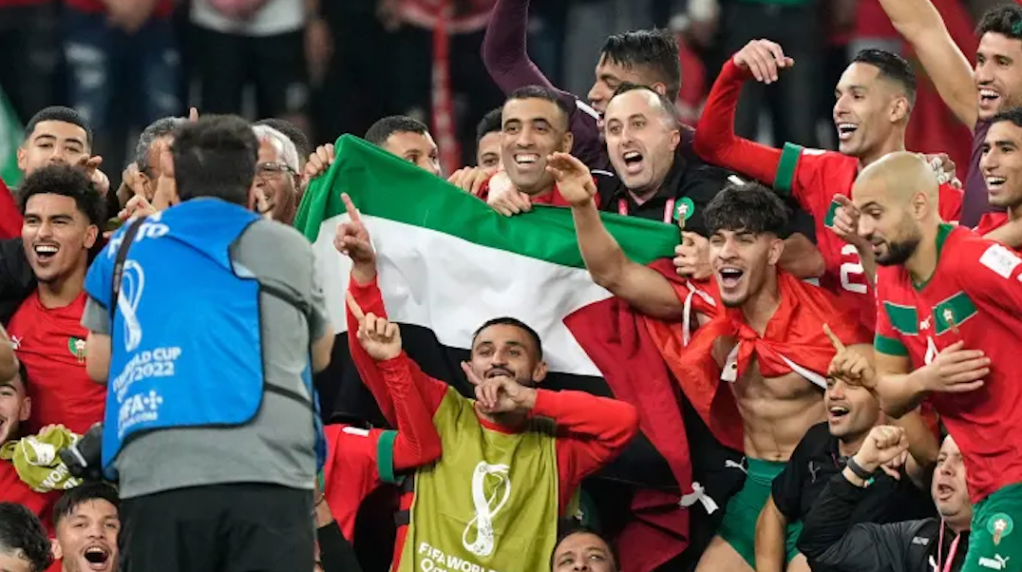
Via DW
Sara El Alami Saidi
Contributor
As we switch gears to welcome the 2026 World Cup into our homes, it is impossible to forget the echoes of the 2022 run and the mark it left on our generation of immigrants of colour, Africans, Arabs, and most importantly, Moroccans. Football is the world’s most beloved sport, one that has shaped entire national identities. In Brazil, political allegiance can be signaled by the colour of a football jersey. In Morocco, the very lyrics of the national anthem — the Cherifian Anthem — were commissioned by King Hassan II ahead of the 1970 World Cup, transforming what had been a purely instrumental piece into a chant meant to be sung in the stadium.
Beyond the joy, drama, and amazing atmosphere sparked by Morocco’s unprecedented underdog run, their path through the brackets often felt as though it were almost scripted. In Group F, Morocco defeated Belgium — the former colonial tyrant in Congo but also the home of a Belgian-Moroccan community of nearly half a million, many with roots in the Rif and Souss.
From there, the Atlas Lions’ journey seemed fated to maximize the empire and colonial legacies narrative. Spain awaited, conjuring memories of the Arab-Amazigh conquest of Al-Andalus, the Reconquista’s sweeping impact on North Africa, the Spanish protectorate in Morocco’s northern and southern regions, and the bitter experiences of the battle of Anwal and the Rif War. Today, the colonial past lingers in the enclaves of Ceuta and Melilla, with some even claiming the Canary Islands as Amazigh. This history hung over the penalty shootout, when Madrid-born Achraf Hakimi coolly slotted a cheeky Panenka straight down the middle of the goal, sending the stadium, living rooms and school cafeterias across the world into a frenzy and Morocco into the quarterfinals.
The next chapter came against Portugal. Fez-born En-Nesyri soared above the defense to score a magnificent header, booking Morocco’s place in the semifinals — an African first — ending in Cristiano Ronaldo leaving the field in tears. Morocco’s encounter with Portugal carried a long shadow: the beginning of Portugal’s empire starting in the 15th-century by the seizure of Morocco’s Atlantic ports, inland forays toward Fez, and King Dom Sebastian’s death at the Battle of the Three Kings near Ksar El Kebir. What some might call a full circle moment.
Finally, the Atlas Lions braced themselves for the semifinal against reigning champions France. With a squad missing some of its key players and half exhausted, half injured, they nonetheless faced their toughest test under the eyes of the world. Most of the team being French nationals, they were fully aware of the symbolism of playing against the colonial power that had annexed Morocco into its African empire in 1912, imposed its modernizing–traditionalizing protectorate logics for four decades, and still shapes Morocco’s economy, culture, and politics today. The game ended in heartbreak but also beauty, with then-PSG teammates Mbappé and Hakimi exchanging jerseys in a gesture of mutual respect.
Yet Morocco’s run cannot be reduced only to these colonial echoes. The politics of its historic journey, and especially the climactic match against France, spoke more profoundly to Morocco’s present and future. The Atlas Lions embodied the paradoxes and dualities at the heart of Moroccan identity today. They carried African and Arab banners, but they were also the Indigenous people of North Africa, Amazigh, representation, with stars like Hakim Ziyech and Sofyan Amrabat hailing from the Rif. Their support for Palestine was proudly visible, as the team waved the Palestinian flag at every opportunity, even as Morocco accelerated its normalization with Israel. And their most human moment, the image of Achraf Hakimi embracing and kissing his mother, or Sofiane Boufal dancing with his mother, brought vicarious joy into every Moroccan household; they showcased Moroccan values on the world stage.
In the end, Morocco’s team remained a people’s team: for the working class, for immigrants, for Africa and the Arab world. Their journey in Qatar blended contradictions, overlaps, and identities into a gutsy and beautiful style of play that lifted spirits worldwide. Whatever the semifinal result, the Atlas Lions opened a new horizon of possibility, and their run will be remembered as nothing short of historic.
Dawson Blues’ Co-Ed Baseball Season
Date — Event — Time — Venue —
September 27, 2025 — D3 BAS – Beauce-Appalaches vs Dawson — 1:00 pm —
Dawson College – Denis-Boucher Stadium in Lachine. (LaSalle Park)
September 27, 2025 — D3 BAS – Dawson @ Beauce-Appalaches — 4:00 pm —
Dawson College – Denis-Boucher Stadium in Lachine. (LaSalle Park)
September 28, 2025 — D3 BAS – Dawson @ Drummondville — 1:00 pm —
Cégep du Drummondville (Stade Jacques-Desautels)
September 28, 2025 — D3 BAS – Drummondville vs Dawson — 4:00 pm —
Cégep du Drummondville (Stade Jacques-Desautels)
October 1, 2025 — D3 BAS – Dawson @ André-Laurendeau — 7:30 pm —
Cégep André-Laurendeau (Stade Eloi-Viau)
October 6, 2025 — D3 BAS – John Abbott vs Dawson — 7:30 pm —
Dawson College – Denis-Boucher Stadium in Lachine. (LaSalle Park)
October 11, 2025 — D3 BAS – Dawson @ Édouard-Montpetit — 1:00 pm —
Cégep Édouard-Montpetit
Hey, my name is Tim. I’m a student athlete on the Dawson Blues baseball team. I’ve been in this team for two years now, and I can definitely say that it’s an experience that I will not forget. Even if the team may not be the best definitely, I can assure you that it is the top welcoming team I’ve been in. It has one of, if not the best, team spirit from the teams I’ve played with! I love my teammates and my coaches! I’m sure if we had a bigger audience coming to watch our games from Dawson it would make us win more! GO BLUES 😉
Timofey Sherstov, Physiotherapy Technology student
 The Plant
Leave a comment