

Via Healthline
Charlotte Renaud
Arts & Culture Editor
Mushrooms have always been a controversial food, from setting off countless arguments around the dinner table between parents and children to prompting debates in government over its legalization. The mushroom is a curious organism that continues to spark interest amongst scientists as well as curiosity in all of us. As we grow older, new questions surround it: how did some of us go from refusing to eat mushrooms as little kids to now having the desire to take them for psychedelic trips?
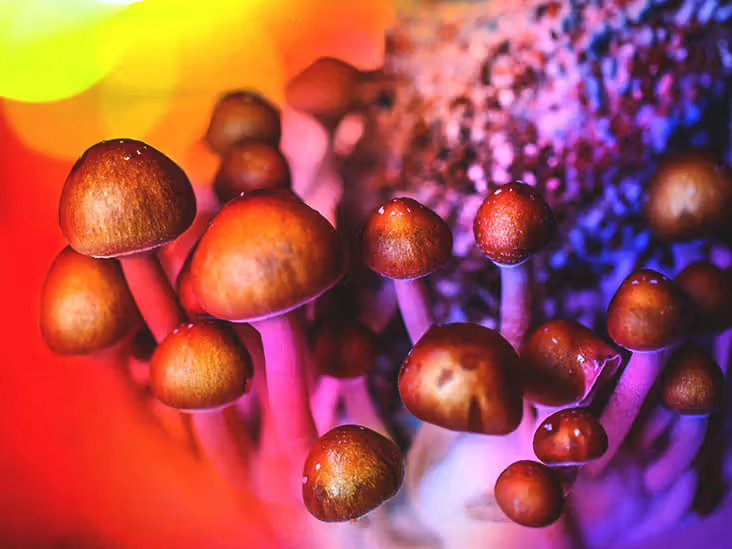
Scientists estimate that there are over 2.2 million species of mushrooms—some we eat, some grow on our feet, and others are even psychedelic treats! The psilocybin mushroom, commonly referred to as the magic mushroom, might not be offering us any true nutritional benefits like its cousins the Shiitake and Maitake, but it has been (and continues to be) consumed for its spiritual benefits.
According to Gastón Guzmán’s article “Hallucinogenic Mushrooms in Mexico: An Overview,” this kind of mushroom can be traced back all the way to Mexico prior to the Spanish Conquest. Hallucinogenic mushrooms have been used by many indigenous peoples such as the Nahuatls, Morelos, Mixes, Zapotecs, and Mazatecs for religious rites throughout the country. There are about 250 species of Psilocybe mushrooms, including 150 of them that are hallucinogenic. However, only specific species of these mushrooms are found in Mexico and are used for the ritual (Guzmán 408).
In his article, Guzmán explains how the ceremony is held at night so that the consumer is free from daily distractions. They will also be guided by a shaman or an older experienced person in their homes in front of a Catholic altar (409). The mushrooms are then typically placed in a gourd named the jicara and incensed with copal resin (409). The prayers are in Spanish or indigenous tongues and the mushrooms are set out in male-female pairs. Generally, the ceremony only uses one species of mushroom, and a local participant receives up to six pairs whereas outsiders may be offered only one or two at first.
The love for hallucinogenic mushrooms is reflected in the Nahuatls’ “Mushroom Church” that was built to honor the Ganoderma lobatum mushroom. When a Nahuatl native found a mushroom with the outline of Christ on its undersurface, the miracle seemed too great not to commemorate it. The reality of the mushroom’s origins is believed to be fabricated by a priest in the 18th century to redirect the Nahuatls’ love for hallucinogenic mushrooms towards a love for Christ. Despite this, the indigenous tribe continues to worship the mushroom that remains in a metal box in the Church’s corner alcove (410).
According to Lapatin V. A’s article “Psychedelic Revolution: Psychedelia in the American Counterculture of the 1960s and its Place in Today’s Culture” psychedelic mushrooms gained popularity in the 1950s and 1960s in the United States when their consumption coincided with “youth protests in Western societies” (Lapatin). Psychedelics have a great effect on the human psyche and consciousness that is incomparable to that of other drugs, rendering them as an interesting candidate for spiritual and even medical use. The magic mushroom, like other psychedelics, demolishes the barrier between a person’s ego and the external world. Lapatin describes that these drugs “[make] it possible to experience bliss and oneness with all things.” The writer also refers to the frequent spiritual growth that people experience afterwards, developing qualities such as compassion, acceptance, and pacification.
Psychedelics became a staple of the American counterculture of the 1960s because many believed it was the cure for injustice, oppression, violence, militarism, racism, and sexual repression that stem from fear, greed, and distrust. Drugs like the magic mushroom could cleanse people’s consciousness from materialistic and consumerist ideals and instead plant unconditional love for oneself and the world. This begs the question: if psychedelics can change a person, what’s stopping them from changing society?
The extent of the mushroom’s magic could reach much further than the individual, it could potentially affect society at large—
a belief shared by many counterculture activists such as Timothy Leary and Allen Ginsberg who saw this as justification for the use of psychedelics.
Authorities, however, did not share this view. In fact, psychedelics have been banned almost everywhere in the world. Recently, few countries have begun to distance themselves from the taboo surrounding the magic mushroom and its legalization. For example, according to Jennifer Chesak’s article in BBC “What psychedelics legalization and decriminalization looks like around the world,” the magic mushroom is allowed in Australia for “prescribed therapeutic use under strict regulation” (Chesak). In 2008, Peru decriminalized personal and spiritual use of the drug, recognizing it as a part of its indigenous heritage. In Canada, magic mushrooms remain illegal, but as pointed out by Eric Stober in his article “Magic Mushrooms are still illegal in Canada: how can stores be opening?” stores like Shroomyz and Fun Guyz have opened in Toronto, Montreal, Ottawa, Winnipeg, and Vancouver.
Overall, the magic mushroom remains controversial. Is it the key to a deeper understanding of ourselves and of the world we live in? Is it just another hard drug that should be banned? The magic of the mushroom is undeniable, but it has yet to be determined as positive or not.
 The Plant
Leave a comment