

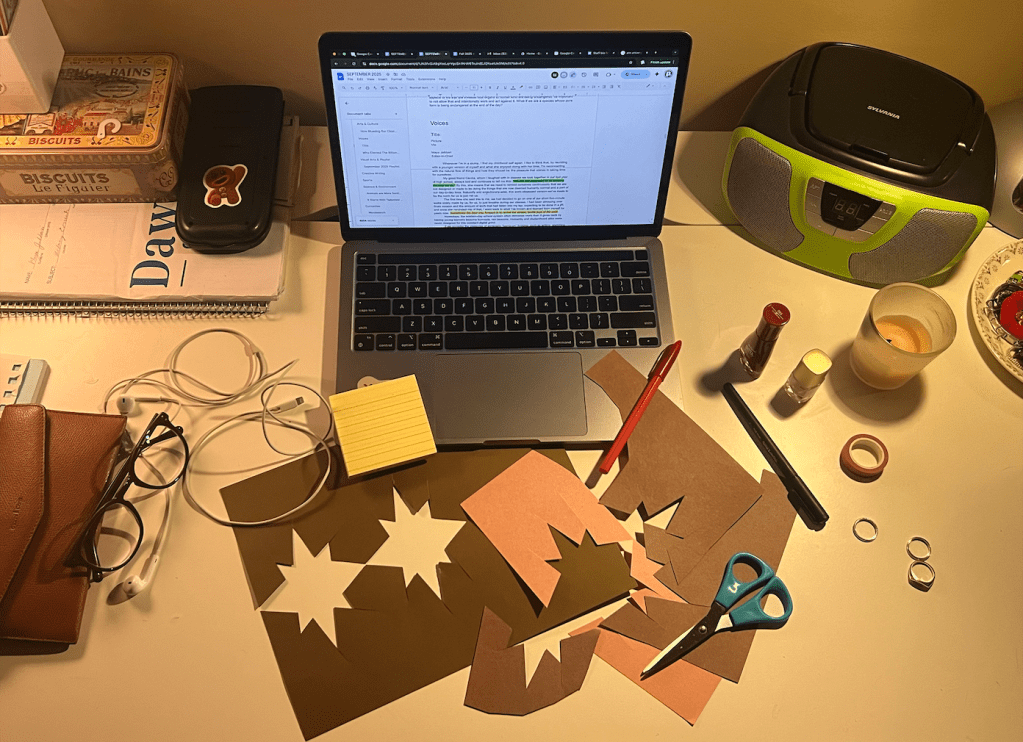
Via Maya Jabbari
Maya Jabbari
Editor-In-Chief
Whenever I’m in a slump, I find my childhood self again. I like to think that—by reuniting with a younger version of myself and what she enjoyed doing with her time—I’m reconnecting with the natural flow of things and how they should be: the pleasure that comes in taking time for ourselves.
My good friend Cecilia, whom I laughed with in classes we took together during our last year of high school, always told me and continues to remind me: “We are not supposed to be working the way we do.” By this, she means that we need to remind ourselves continuously that we are not designed or made to be doing the things that are now deemed humanly normal and a part of our day-to-day lives. Naturally—and from an evolutionary perspective—this work-obsessed version we’ve normalized for ourselves, is just not us.
The first time she said this to me, we had decided to go on one of our short five-minute walks—created by us, for us—just to breathe during our classes. I had been stressing over finals season and the amount of work that had fallen into my lap; all expected to be done in a jiff. Once she reminded me of that, I went back to what I’ve known and learned from myself for years now.
“Sometimes the best way forward is to revisit the simple, tactile joys of the past.“
Nowadays, the modern school system often demands more than it gives back—producing burnouts instead of beacons. Humanity and studenthood alike were never designed for this constant digital grind.
If we consider the pleasures of especially “hands-on” hobbies—like writing, sketching, or scrapbooking—often dubbed “grandma hobbies” in response to stress, we may find them to be deeply grounding and refreshing experiences for many. In an article titled “How Knitting May Be Rewiring Your Brain,” National Geographic dives into how the activity is making a comeback among younger generations, offering a relief from digital burnout. It’s specifically the rhythmic, bilateral motion of knitting that activates brain systems tied to emotional regulation; therefore, the process of knitting itself directly helps de-escalate the knitter’s anxiety.
“Creating with your hands connects you to being human.“
Reconnecting with oneself can also bring people involuntarily back to their childhood comforts—watching a favorite comfort movie, colouring in a colouring book, or even baking something simple can support their well-being when this kind of work-related stress becomes overwhelming. Julianna Bragg, a writer for CNN, discusses how psychologist Dr. Ramani Durvasalu observed that “if an activity once brought you comfort as a child, it may still have the same calming effect in adulthood.” Durvasula believes that traditional childhood hobbies might also drive creativity in your job or company enterprises by tapping into your imaginative side. More directly for students, Frontiers, a scientific research publishing platform, proved that drawing enhances distress tolerance by fostering psychological resilience and encouraging self‑disclosure, helping students articulate and process stress non‑verbally. Even if the hobby chosen is ostensibly childish, this coping mechanism remains valid. While these coping methods are a far stretch from exams, the underlying principle persists: simple, familiar solace is nothing but good for a stressed mind.
Humans (and especially students) are not simply meant to endure. We’re meant to create, connect, and find calm in the doing.
Speaking from personal experience, any time I’ve been struggling with work—feeling overwhelmed and almost immovable—I take a pause and do something creative. Time and time again, my assignments after that break have come out stronger and more insightful, and most importantly, I have taken pleasure in working on them.
In the words of one of my favourite authors, Joan Didion, “To free us from the expectations of others, to give us back to ourselves – there lies the great, singular power of self-respect.”
 The Plant
Leave a comment