
Via Duluth News Tribune
Julia Azzouz
Creative Writing Editor
“Until you make the unconscious conscious, it will direct your life and you will call it fate.”
- Carl Jung, Aion
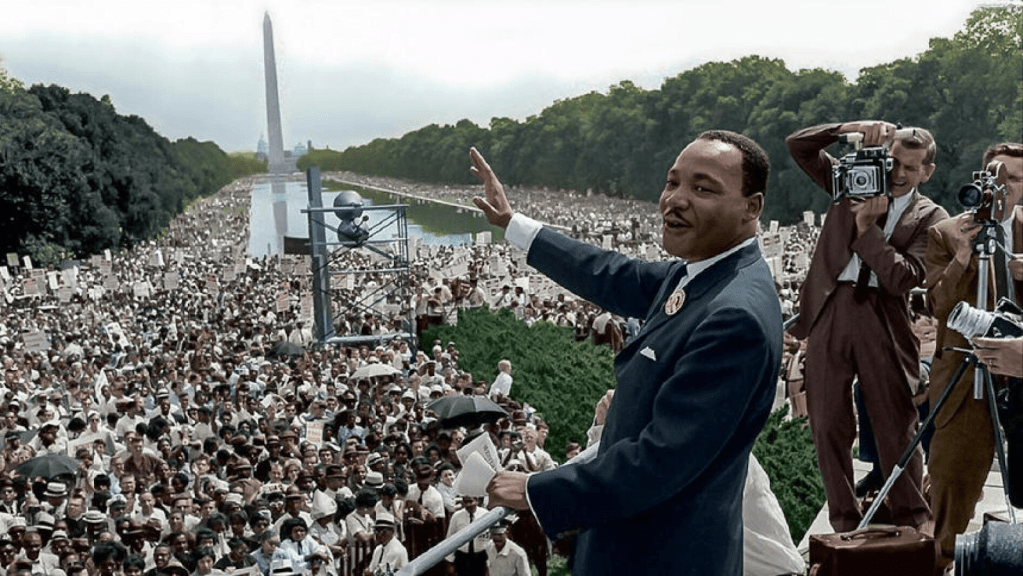
From Plato to Martin Luther King, the utopic ideal has challenged political authority, cultural norms, and the way we relate to one another by expanding the popular conception of what is possible. Today, as society faces mounting existential threats—rising authoritarianism, ecological collapse, and fractured international relations—we are overwhelmed by the heavy facts, paralyzed by what is often framed as the “immutable truth”; but truth on its own is not always enough. At times, our capacity to imagine, feel, and dream can disrupt and redefine what is possible. Imagination is a political force, and it can transform abstract possibility into concrete reality. When it is monopolized by dominant ideologies with the aim of control and profit through fear and suppression, there arises a deterministic rhetoric that insists on the impossibility of change. Reclamation of this imaginative power has historically emerged through the artistic counterculture, where art has served not just as expression, but as lifestyle and resistance. So where is that resistance now? Where is the counterculture?
To understand why counterculture appears to be absent or ineffective today, it’s important to ask what exactly culture is. In his 1961 book The Long Revolution, the cultural theorist Raymond Williams provides a framework for defining culture with three interrelated categories: 1) the ideal, 2) the documentary, and 3) the social. In other words, culture, according to Williams, manifests itself as the symbiotic relationship between our conception of human perfection—our “intellectual and imaginative works”— and our institutional and interpersonal structures. If a shift occurs in any of the three dimensions, the two others will shift with it. A society’s changing ideals can reshape its art and its social organization; a radical work of art can shift collective ideals, and so on. Culture, in this sense, is never fixed. In constant flux, it’s an ongoing struggle between what is and what could be.
American art movements in the 20th century alone exemplify such shifts in the ideal, documentary, and social categories as increasing pressure and hardship delegitimized the dominant idea of utopia. The “American Dream” excluded the intersecting marginalized groups of Black Americans, women, non-Christians, and the working class. In response, artistic communities became spokespeople for the alternative futures that bloomed in the popular imagination. In the 1920s, the Harlem Renaissance gave form and visibility to the dignity and struggle of Black Americans. By celebrating Black identity through music, poetry, and visual art, the movement not only countered racist stereotypes, but also asserted Black cultural autonomy in the face of white supremacy. Similarly—though protesting different conditions—the Beat Generation of the 1950s rejected postwar conformity and capitalist consumerism through their poetry, jazz, and anti-institutional spiritual practices. They offered a different model of fulfillment rooted in presence, community, and transcendence rather than in the accumulation of goods and capital. The folk revival, the hippie counterculture, and punk followed in a similar vein, using music, literature, and collective ritual to reimagine society from the margins.
These movements were effective not only because of their messages, but because of their capacity to create community through collective imagination and emotional engagement. Like religion, these cultural communities operated through ritual, shared symbols, and regular gatherings. They gave people a language for their pain and tools for their hope.
“When people swung to jazz, read poetry aloud, sung in circles, and exchanged writings and criticism, they rehearsed living in a better future.”
Within these microcosmic communities, presence and opinion rippled out and exerted a noticeable influence, elevating personal experience to the status of art and protest. Mutual support, though not unconditional, was tangible. Physical gatherings make solidarity visible as crowds announce collective will through their sheer size, presence, and disruption.
Whereas community was once exclusively confined to physical spaces and media, it is now created and maintained on the Internet. Adapted to a globalized world, digital spaces can be useful for organization and communication over long distances, but they do not have the same impact as a gathering of people in a public space. Online communities demand less commitment, less sacrifice, less presence. Concert venues, art galleries, libraries, parks—these were once gathering places where like-minded people met, exchanged ideas, and built trust through shared rituals and physical proximity. You could often tell what someone stood for by the way they dressed, what music they listened to, what books they carried, or who they spent time with. Countercultural belief was visible, stylized, embodied, and situated in the real-world.
Yet, in our modern landscape, it seems like every emerging idea of utopia is turned into a product that is commodified and sold. The capitalist rhetoric of inclusion seeks to absorb dissent for the sake of commercial profit, absorbing countercultural lifestyles into the mainstream. Aesthetic symbols like tattoos, piercings, and dyed hair, once signifying dissatisfaction with oppressive and conformist capitalist systems, are now rebranded as individualist tools for self-expression and are stripped of their political and cultural context. While punks in the ‘70s and ‘80s adamantly withdrew from the industrial workforce by protesting its norms, capitalism now markets itself as inclusive to gather as many participants as possible— even those who purport to oppose it.
“The corporate claim on diversity seeks not to dismantle systemic inequality, but to neutralize resistance.”
This is the logic of the “postmodern society”, a term theorized by the philosopher Jean-François Lyotard in The Postmodern Condition (1979). In this social and cultural context, grand narratives—religion, revolution, progress, nationalism—have lost relevance, leaving behind a deep skepticism toward universal truths and collective visions. In a world of hyperreality (as Jean Baudrillard puts it), “simulacra”—aka images— seem more real than people, and politics becomes performance. What remains is fragmentation: fractured identities, contradictory ideologies, and a pervasive irony that treats sincerity as cringe. Our visions of justice and transformation are shared online, applauded, and then forgotten. We admire resistance as art, but we no longer believe it can change anything. Legal scholar Cass Sunstein notes that minority groups only succeed in changing majority opinion if they hold their position with clarity and confidence, but in a post-truth world, confidence often reads as delusion, and clarity is drowned in noise.
As we view the world on the large-scale, we lose touch with ourselves. Our desires, needs, and aspirations are cast away. We verify our material conditions through the eyes of an invisible viewer: scientifically, empirically, and with little room for interpretation. While an empirical outlook is necessary and beneficial when dealing with global issues like climate change or international policy, it discourages theoretical or visionary thinking, reducing lived experience to an extraneous variable and dismissing desire, intuition, and creativity as naïve, irrational, and trivial rather than as legitimate forms of knowledge. The abolition of slavery, the fall of colonial empires, and the expansion of civil rights were not born from panoptical self-evaluation, but from an articulated sense of urgency, from a real connection to personal experience and a desire to transcend deplorable living conditions. They began as ideas that defied what was logical and accepted. The impossible becomes real not when it is approved, but when it is believed.
The modern counterculture has lost faith in its ability to mobilize action. Art and imagination are understood like fiction, entertaining and moving but ultimately disconnected from reality. However, fiction speaks to truth more than reality does. The state of a thing, isolated from interpretation, cannot speak for itself. The subjective communication of objectivity is not inconsequential, not pointless, not a lie. Imagination must be taken seriously. The Harlem Renaissance, for instance, was more than an artistic movement; it reshaped Black identity and visibility in American culture, laying the emotional and intellectual groundwork for the Civil Rights Movement decades later. Likewise, the folk revival of the 1960s, grounded in storytelling, galvanized resistance to segregation and the Vietnam War, providing the emotional language for real-world policy critique. Even the punk and hippie movements (while less tied to legislative change) created self-sustaining subcultures that practiced alternatives to capitalist and hierarchical norms. In each case, political imagination did not remain symbolic; it mobilized people, clarified demands, and envisioned futures worth fighting for. These communities believed in the possibility of change, and that belief itself became contagious.
If the counterculture seems reclusive today, it may be because we’re still searching for it in forms that no longer match the world we live in. Maybe the counterculture is scattered, buried under layers of existential fatigue and performativity, or maybe it’s evolving in ways we are not yet attuned to see. To find stable ground to march on, we must anchor ourselves in personal experience, in community, in ritual, in hope, and in creativity. Punk may be dead, but our capacity to envision a better future isn’t, and that in itself can be revolutionary.
 The Plant
Leave a comment