


Via Hulu
Maya Jabbari and Chloe Bercovitz
Editor-In-Chief and News Editor
Obsession, nostalgia, and identity alike all stand beneath that same umbrella that is yearning. And, while social media has personified it in such a way that detracts from its value, I still believe that this nearly inexplicable feeling merits exploration: the well-worn theme of the human condition is the idea that we all have universal experiences that define what it means to be alive.
Lately, I can’t help but notice how Ireland and Irish culture have become everyone’s newest obsession. However, perhaps our latest crush isn’t truly much about Ireland at all; rather, it serves as a reflection of how our hearts haven’t stopped aching.
We’ve always needed something to obsess over, from the myths and faiths that once shaped civilizations to the fandoms and playlists that now define our digital age.
“We attach meaning to something external – something outside ourselves. In an effort to feel transient, we lament our identities onto places and objects that were once the memories that made us who we are.”
But now – why is Ireland, and Ireland specifically, so emotionally charged? Especially for those that have never even set foot there?
Before Ireland, there was (and arguably, for a certain demographic, still is) Japan. Particularly among White men, Japan has almost always been a blueprint for obsession. Japanophilia, the lust for everything Japan (culture, architecture, lifestyle..etc.), has, in recent years, taken over the minds of Western culture. The term “Japanophilia” describes the love of everything “Japanese.” The scholar Jehyun Jenny Lee from the University of Washington argues that Western anime and manga fandoms are driven by “the fantasy of Japan in the Western imagination” — a longing for “something culturally and aesthetically different from the West in the age of globalization.” However, it’s important to note the difference between obsession and fetishization here. Dr. Bitna Kim, a PHD professor at Indiana University of Pennsylvania, interviewed White American men and found that there seems to be far more than obsession with Japanese culture and Asian women as a whole because of grounded stereotypes. Here lies the difference between our nature, as humans, to consume Japanese culture and Irish culture. Those engulfed by the former tend to lead into fetishization (particularly the West) and those interested in the latter, simply put, express a fondness and yearnfulness to live there.
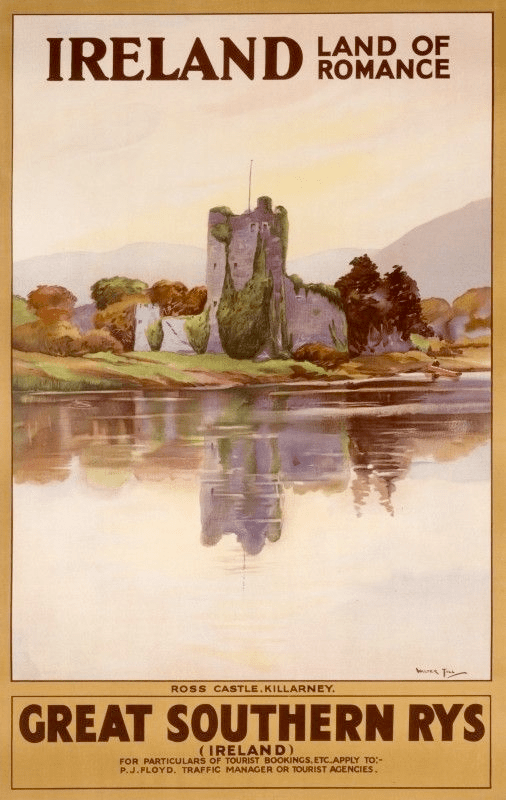
Especially among young people, Ireland has been long revered and regarded as a great place to live and breathe. Its distinctive charm unravels through a tapestry of qualities: a rich literary legacy, a folky atmosphere, sweeping emerald-like landscapes, and temperamental weather. But really, my list was hard to end. There’s something about Dublin’s walkability and affordability that makes the capital so incredibly approachable. With its Georgian architecture and its irreplaceable sense of pub culture, Dublin just evokes an atmosphere that feels almost as if your Pinterest board could give you a hug and a big kiss at the same time.
But Ireland isn’t just about the aesthetic, for it has become both a niche and a muse within pop culture. A few years back, it was often remembered as the filming location of Game of Thrones. Since the pandemic, however, Sally Rooney’s global success of Normal People, Conversations with Friends, and Intermezzo has reintroduced Ireland as a state of mind. Loving too much or not enough. Feeling too hard to love. It’s all just a bit romantic to me how it reflects an intimate piece of ourselves that so many of us secretly share with one another.
And with Sally Rooney came, you know it, Paul Mescal, the actor who played Connell in the Normal People limited series. Another prominent Irish actor that has been gaining recognition since the mid 2010’s is Saorise Ronan, known for her lead roles in both Ladybird and Little Women. According to The Irish Times writer Patrick Freyne, in an article from 2024, “Right now, actors such as [Cillian] Murphy, [Paul] Mescal, Andrew Scott, Barry Keoghan, Eve Hewson and Saoirse Ronan are dominating recently celebrated films such as Oppenheimer, All of Us Strangers, Saltburn, Flora and Son and Foe.” Since the release of this article, the popularity for these Irish actors has certainly spiked with the release of, specifically, Gladiator 2, for Mescal. Even The Bear star Ayo Edibiri has become the internet’s poster-child for Irish fascination (she’s from Boston), and her obsession validates ours (she’s just like us).
In music, the folky, hazy, and natural sounds that Irish artists bring to the table are like no other. The Cranberries’ “Linger” and Sinead O’Connor’s defiance feel eternal. Not to mention Hozier, whose voice feels both urgent and filled with longing. Ache and resistance make this yearning for Ireland both relatable and groundbreaking, because the artists channel these emotions themselves. It feels holy.
Pop culture’s Irish wave works because it feels participatory. What you consume becomes who you are. Part of you migrates to Dublin, to Sligo, to some place green, damp and honest. You begin to crave it, to nourish it.

With that being said, who would’ve thought that Guinness (known to be older men’s beloved beer of choice) would become incredibly popular among our generation. According to the brand-valuation firm Brand Finance, 67% of 18–25-year-olds now think Guinness is a “cool” brand, up from just 22% in 2023. A further 60% of young people now see Guinness as a “modern” brand, up from 33% in 2023, and “consideration” among women has risen from 67% to 77%.
Guinness’s rebrand and popularity is also really part of Ireland’s rebrand. It’s authentic, and authenticity is what we want. It’s also long-lasting; it’s a feeling of belonging to a place that is unapologetically itself and holds that with pride.
Ultimately, in yearning for Ireland, by extension, we long for everything that it has brought us. Be it sad books, sad music, actors in sad roles – maybe we even should be asking ourselves why we actively choose to cultivate our pre-existing feelings of doom? There’s no doubt in feeling despair: inflation and interest rates have skyrocketed, armed-conflicts rage across the world, and political polarization has bred hate speech, violence, and gridlock.
Maybe I’ve only brought this up because I’m on my phone more than ever, and Jaden Smith’s voice keeps begging for me to “talk about the economic and political state of the world.” Undeniably, there are myriad other factors to consider when examining the Irish obsession, yet that doesn’t detract from its striking parallel to the times we’re living in – which is bound by this strange, shared, and almost habitual disconnect.
What makes this so striking is in its familiarity: one’s yearning to “go back” to Ireland eerily feels as if history is looping back into itself. A certain cultural melancholy always follows a collapse of some kind, raising the question of whether this all might be a recession indicator? Take the First and Second World Wars: society’s disillusionment birthed the creation and gravitation towards philosophical explanations, such as existentialism, absurdism, and modernism. In the quest to find meaning and understanding during a period of catastrophe and confusion, culture served as a voice of reason – a reflection of one’s mind, body, and soul. Given that so much of Ireland’s creative identity is rooted in sorrow, the same cycle continues. We gravitate toward it in an attempt to locate meaning amid uncertainty; to find coherence in a moment that feels like nothing but utter chaos. Like many of those who came before us, we turn to art not only to escape, but to better appreciate the sometimes awful human condition – for Ireland itself makes us feel more human.
 The Plant
Leave a comment