

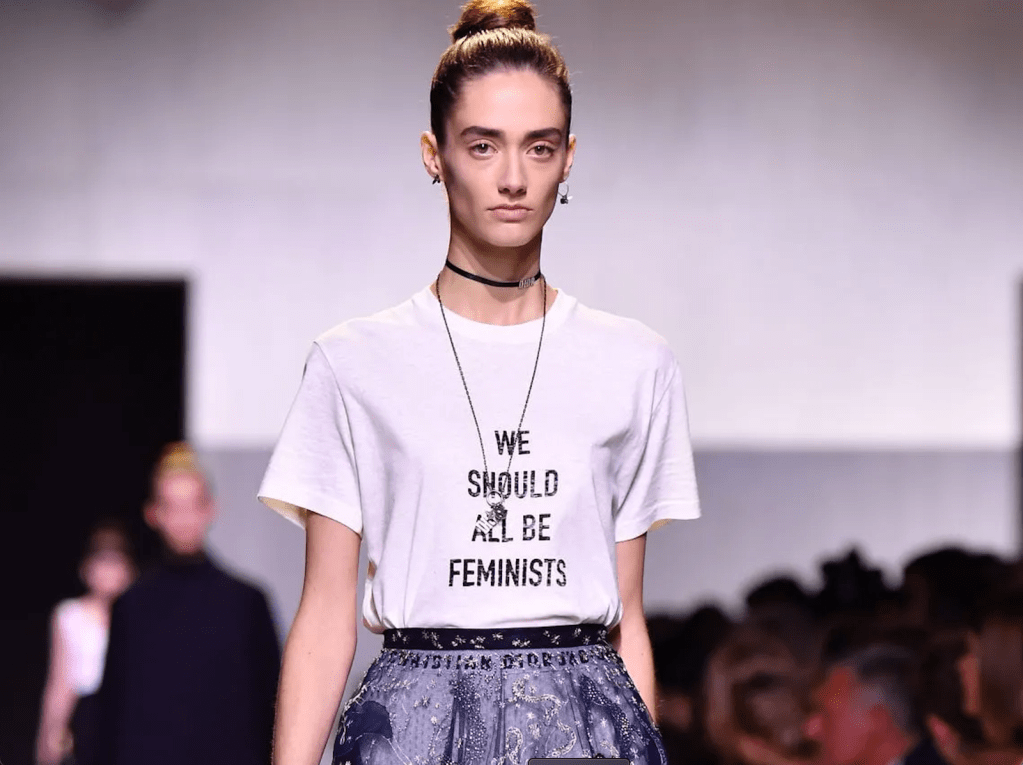
Image via 2017 Dior Spring Fashion Show – Jacopo Raule/Getty Images For Dior
Yasmine Bouanani
Secretary
Our fast-paced world will polish anything until it shines, even emptiness. We are constantly trying to do everything a little quicker. We try to gain money quicker, find love quicker, produce
food and art quicker. This burn-and-repeat rhythm barely leaves us the time to engage with deeper aspects of our existence. We flee depth for the refuge of the material, the visible, the beautiful. But there is a name for beauty when it loses its meaning: aesthetic.
When political, spiritual or cultural symbols are stripped of their histories and context in order to make them more easily digestible, they are fundamentally betrayed. We can’t expect them to retain their full weight and significance. This process, when repeated endlessly across screens and continents, leaves us with a world that looks full but has nothing to say. A traditional embroidery becomes a pattern, a black fist becomes a logo, a movement becomes a mood board. The cultivation of aesthetics divorced from substance is not a harmless trend, it’s a
gateway to ignorance, the quiet loss of identity, and the systemic erosion of cultural and social power.
Imagine a sacred garment, once worn in ritual or resistance, reduced to a decorative motif on a mass-produced t-shirt. Its meaning will not only be buried but also profited from, all while the communities it was taken from are left, more often than not, unseen and uncompensated. Their identity is turned into novelty: something worn instead of lived. Take the case of the French fashion house, Carolina Herrera, which used traditional patterns from Indigenous communities in one of their collections. Their lack of acknowledgment of the origin of those patterns contributed to the economic marginalization of those indigenous communities whose art is being sold for luxury prices. This thirst for rapidly consumable prettiness might not be malicious in itself, but its recklessness can lead to erasure.
Beauty without root, detached from community and purpose, can also increase pre-existent damages. In Thailand, for example, a Nazi iconography has appeared on t-shirts and market trinkets, not as hate speech, but as a design. This terrifying symbol was, through ignorance, mistaken for fashion. It is a sad case of historical amnesia. When history fades, its horror can be invisibilized, hidden in decoration. This is the violence of forgetting. No symbol or words could be inherently “bad,” but existing context can allocate it a tone and significance. Ignoring its context does not strip the object of its label. While it is certainly impossible to be knowledgeable of everything, this reality demands a duty of care towards the collective human memory. Nothing is more human than a mistake. However, symbols we choose to wear and the histories they represent are not weights we can depossess ourselves of for convenience.
This phenomenon affects more than just cultural heritages, it is profoundly political. Activism and social movements are routinely absorbed into capitalist marketing. A $800 Dior “We Should All
Be Feminists” t-shirt or a corporate pride merchandise show the repackaging of tools of justice into slick advertisements. This is disempowering as it strips these symbols of their original
strength and intensity. When activism becomes a brand or trend, illusions of progress replace the essential work of change. This comes from a refusal to engage in the difficult, unglamorous work of politics. This move is not accidental, it’s a calculated performance. Selling neatly packaged bits of activism allows companies to gain social currency without requiring any substantial change to their labor practices, supply chains, or employment methods. The consumer is left with only pretty things to say and wear, mistaking consumption for commitment.
Beautiful things have always fascinated us, but their pleasures should not override principle.
“The tension is not between the beautiful and the meaningful, it is between passive consumption and active engagement.”
We must insist that fashion is a dialogue, not just decoration. Wearing clothes means wearing stories and values, which offers beauty both power and memory. Of course, you can wear an item simply because its color attracts you, but that simplicity is a luxury that could be purchased at the expense of others and even of yourself. The true danger of aestheticism is not that we create a world of surfaces, but that we accept it.
 The Plant
Leave a comment