

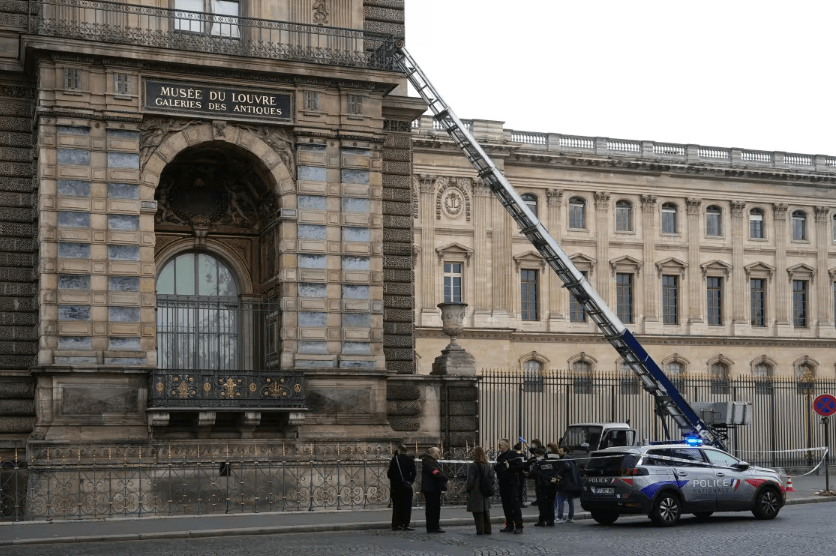
Image via Dimitar Dilkoff/AFP – Getty Images
Nadira Zibirov
Copy Editor
The Louvre, the world’s most visited museum, was recently the target of a brazen jewel heist. According to BBC News, on the morning of October 19th, shortly after the museum’s opening, four suspects arrived on site. Using a vehicle-mounted lift, they accessed the Galerie d’Apollon via the second-floor balcony. After reportedly threatening the guards, who then evacuated the premises, they cut through the glass of two display cases containing the jewels, and four minutes later, escaped using two scooters. No one at the scene was injured, and the entire heist was executed in just seven minutes.
As for the jewels, those stolen came from some of France’s most auspicious royal women: Empress Eugénie, Empress Marie Louise, as well as Queens Marie-Amélie and Hortense. The missing pieces include tiaras, necklaces, earrings, and a very celebrated “reliquary brooch.” The jewels, worth €88 million ($102m), have not yet been recovered, except for the imperial crown – which was found damaged along the escape route after being dropped by the thieves.
Given that these items, said to be of immeasurable heritage value, will be difficult to sell intact – investigators believe they will be broken down into smaller pieces or melted to disguise their provenance and increase marketability. The police is therefore under pressure due to limited time, with sixty investigators currently working on the case. According to ABC News, as of October 25th, several suspects have been arrested, with four formally charged.
The museum has also faced repercussions. To preserve evidence for the investigation, the Louvre temporarily closed and reopened three days after the heist. Meanwhile, the director of the museum, Laurence des Cars, submitted her resignation, calling the heist a “terrible failure.” However, France’s culture minister, Rachida Dati, refused her resignation, even after she admitted security gaps were to blame. According to French media, a preliminary report revealed that one third of the rooms in the raided area had no CCTV cameras. Additionally, Natalie Goulet, a member of the French Senate’s finance committee, said that the gallery’s localized alarm had recently been broken. Investigations are underway to determine whether it was deactivated or originally non-functional. However, France’s culture ministry confirmed that the Louvre’s wider alarm system did sound, alerting staff who immediately followed protocol by contacting security forces and evacuating visitors. Despite this, officials and union representatives have criticized the museum’s security system for being “inadequate” and “aging.”
The public has also expressed their discontentment. While the heist caused political outrage – with President Emmanuel Macron labelling it as an “attack on our history” and other politicians calling it an “intolerable humiliation” and a “wound to the French soul” – public opinion seems to be mixed. Many are upset by the cultural loss, as well as the museum’s security flaws, although others are more fascinated by the audacity and cinematic nature of the heist – seeing it as a “movie-worthy plot” and applauding the fact that no one was physically hurt. Cosmopolitan and NPR News mention that the incident has also become a source of entertainment and romanticization on social media, inspiring memes and Halloween costumes; these actions have received backlash for turning the event into a “pop culture moment.”
The Louvre heist has also sparked deeper reflections on humanity’s values. Many are concerned with the state of the world and have criticized both politicians and media outlets for treating the robbery as a national disaster – while remaining silent on ongoing genocides and persecutions. News outlets, such as Le Monde and TF1, have elicited controversy, given that the heist has had such massive coverage while humanitarian crises in Gaza, Sudan, Congo, China, and elsewhere are treated with little urgency. Some even find themselves sympathizing with the thieves as a form of rebellion against the obscene inequality and misplaced priorities.
The incident has also served as a wake-up call regarding colonialism and cultural ownership, given that the stolen jewels are products of colonial extraction. The sapphires, emeralds, pearls, and other gemstones were originally mined in Asia, Africa, and South America; regions historically exploited for their cultural and natural resources to fuel European wealth and power. Museums displaying such artifacts are now perceived by some as showcases of a history marked by exploitation, colonization, and violence. This has reignited debates on museum ownership and the ethics of cultural display.
“What initially seemed to have been a cinematic heist has reshaped perspectives.”
It has raised ethical questions about whether certain museums serve as testimony to colonial rule, and humanitarian concerns about where society’s true priorities lie. Above all else, the Louvre heist has prompted reflection on whether this event will set a precedent for other museums in Western civilizations.
 The Plant
Leave a comment