

Via Rotten Tomatoes
Minola Grent
Managing Editor
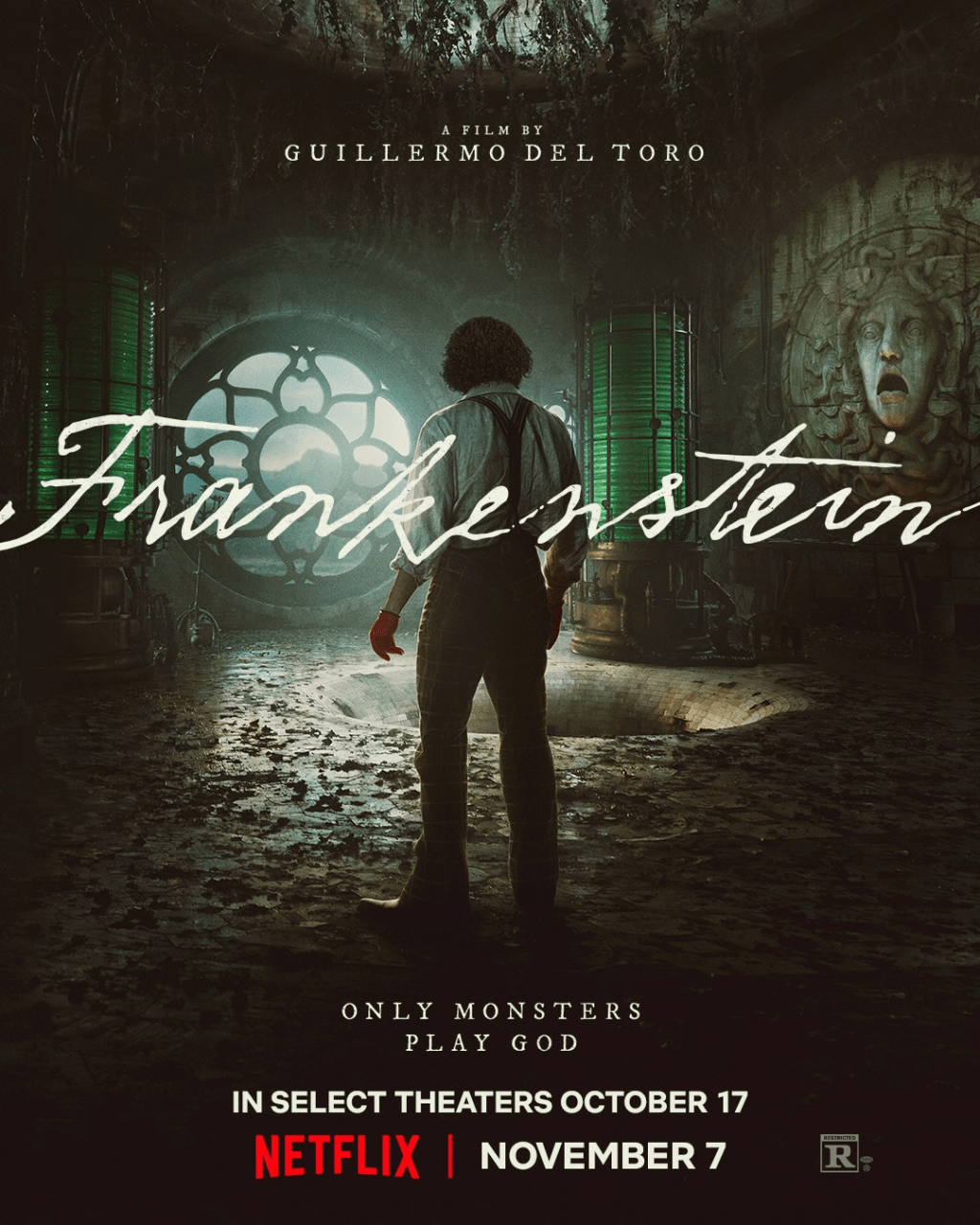
Frankenstein: No, it’s not like the book. Get over it.
Guillermo Del Toro’s Frankenstein was released to the public on October 17th. It played at the AMC Forum, right next to Dawson’s main building. Going in, I was excited because I love Del Toro’s work. However, I couldn’t help being apprehensive given the mixed reactions at its various premieres across multiple film festivals. “The screenplay […] felt [not] like an adaptation of Mary Shelley’s Frankenstein but of [a] paper written by an 8th grader,” remarks a user on Letterboxd. “[M]ary [S]helley found rolling in her grave,” cries another.
Del Toro’s reimagination of Mary Shelley’s 1818 novel is just that: a reinvention. This 2025 rendition of Frankenstein focuses its attention on the dynamic between creator and creation as their bond tethers between that of god and subordinate, and that of father and son. An exploration of both Victor Frankenstein’s mind and the creature’s sets the film apart from its predecessors. The runtime is fairly split between the two characters, effectively placing them equally as developed main characters.
Victor is a delightfully flawed character and a joy to follow. Del Toro beautifully captures his almost childlike whimsy as he excitedly picks apart corpses to build his creature. However, despite his entertaining penchant for the gruesome, Victor is a selfish liar, a maniacally consumed scientist unwilling to renounce his wild endeavour.
The creature, unlike in the source material, isn’t William, Victor’s brother. While this decision causes the loss of the brotherly love and relationship between the two, it opens the door to fleshing out Victor’s relationship with fatherhood. We get a look into the creature’s discovery of the world and its development of intelligence. Just like a child finding its footing in the world, we watch him marvel at his first snow and long for the connection and familial love Victor never intended to offer him.
Ultimately, the movie is engaging, and Del Toro’s direction is a sight for sore eyes (but that is a given). That is why I ask that, going into it, you put aside its deviations from the source material. You can enjoy the original novel while nonetheless appreciating Guillermo Del Toro’s film and his interpretation.

Via Radio-Canada
Maya Jabbari
Editor-In-Chief
On Kent Monkman’s History is Painted By The Victors exhibition
The Kent Monkman: History is Painted By The Victors exhibition ending March 8th, curated by Léuli Eshrāghi, John Lukavic, and Monkman himself, is meticulously organized to reclaim history’s perpetual colonial narratives and its impact on, specifically, Indigenous and Two-Spirit peoples. Located at the MMFA’s Michal and Renata Hornstein Pavilion, the exhibition further takes back the colonial narrative by not only taking place in a Greco-Roman style building, but also by being displayed by an institution that was built by Montreal’s elite, who happened to be White men.
Comprising 41 canvases, History is Painted By The Victors is divided into five rooms, each with a distinct intention to further the artworks’ separate meanings in the collection. Displaying gender fluidity, colonization taking place in numerous forms, the prison system’s impact on minorities, police brutality, and the fight for environmental conservation, this exhibition encompasses all, and does it so beautifully, generating thought-provoking questions within us.
Looking at these paintings and digging deeper to understand them and their placement in their rooms was a challenge, but an exciting one. Monkman’s paintings are the type that you walk away from thinking you’ve caught every detail in them, and you look back for one second, and another one comes to you, and by then you’re consumed by it. I can’t express how much I recommend going to see this exhibition. It opens your eyes and forces you to think about the way in which colonial narratives have impacted – and continue to impact – people’s everyday lives.
 The Plant
Leave a comment