

Via Pinterest
Alaa Ettaouth
Staff Writer
In my early days of preadolescence, I dreamed of finally being a part of “girlhood.” I envisioned myself living life like every effortlessly stylish girl in movies: walking around the city with a cup of coffee in my hand, holding hands with my friends while we laughed about our lives and talked about the next shopping spree we were about to go on. I felt profoundly connected to this sentiment as I was eager to finally be a part of it.
The term “girlhood” defined by the Cambridge Dictionary as “the period when a person is a girl, and not yet a woman, or the state of being a girl”, is widely used nowadays, yet it reflects a personal experience or vision unique to each person. It is so universal and precious that we needed to translate this feeling into art, such as cinema and television. Some were mocked on the playground for liking pink or playing with dolls and, therefore, rejected the fact of ever enjoying an ounce of their femininity. However, when we turned on our television we saw the complete opposite as being a fairy or a pop star was deemed cool. The simple fact of being a girl seemed so cool!
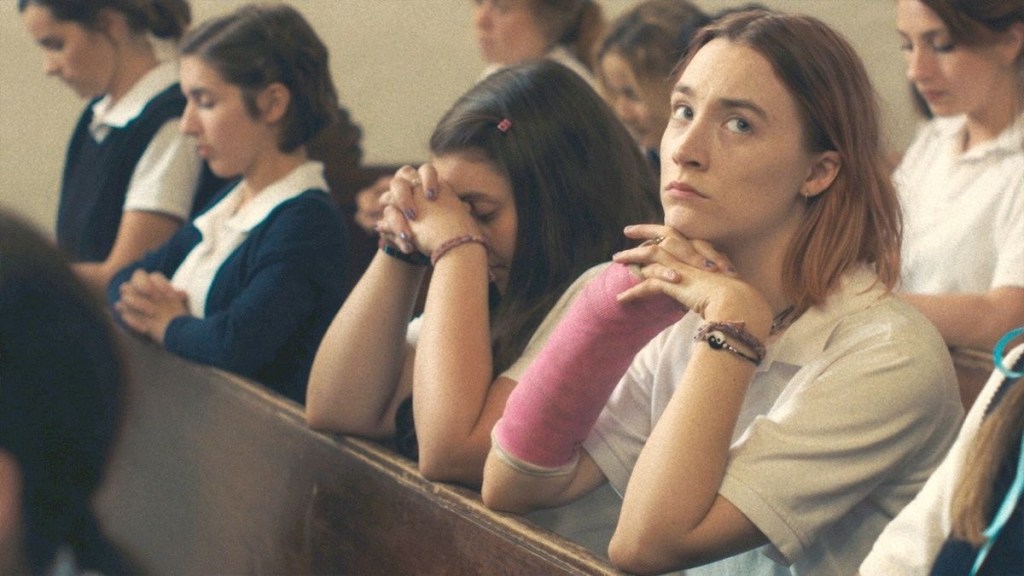
As I grew up, I began to watch a lot of movies, trying to make sense of my evolving experience as a girl. I would attempt to feel seen and put in the shoes of another girl who lived my perfect definition of girlhood (even if it was only for an hour and a half). I watched every rom-com, read every book about a teenage girl rambling about her life I could get my hands on like Le Journal d’Aurélie Laflamme or Dork Diaries. I lived for shows like Lou!; even if my life had almost nothing in common with hers, I would still imagine myself sitting on my bed, eyes on a window surrounded by city life just like how she described her life through her sketches. That is when I eventually came across the movie Lady Bird. In modern internet culture, this movie is the quintessential representation of experiencing girlhood: it tackles themes like anger, strenuous relationships with parents, and the ups and downs of finding yourself while navigating a world you do not seem to fit into. Instead of fully enjoying my watch, I remember feeling so confused after watching it, and I simply could not put my finger on why, because I wholeheartedly thought it had the perfect recipe to become one of my favourites.
My take might seem beside the point, even childish, but it was plainly because she did not look like me. I could not completely relate to her story because I was incapable of putting myself in her shoes, even if it was only for an hour and thirty-five minutes as it did not fit me to begin with. This distinction did not affect me as much as a kid, when teenage girl experiences were still vague and unknown territory to me. But when I watched Lady Bird, I had passed the age where movies or shows were only watched as means to be entertained for a moment– I wanted to see myself on the screen, to catch glimpses of personalities I could embody because I am still searching for my true self.
It was hard because when a non-white girl was introduced in a series or a movie, her experience as a girl was never the subject; she only served as a tool for the white main character or as an example to feed harmful stereotypes. Those girls were stripped of any sense of girlhood, reduced to their ethnicity or cultural problems. They were never pictured as whimsical or desirable, but rather as someone to be pitied and unimportant. In Gilmore Girls, a show extremely dear to my heart, this insensitive trope marked me. While Rory Gilmore was busy juggling boys that were obsessed with her and being her quirky bookworm self, Lane Kim, her best friend, was exempted from any sort of desire or romantic relationship. When Lane was the centre of attention, it was because her controlling and “crazy” Korean mom wanted to send her to a Korean Catholic school or was suspicious of her dating a white boy. Lane Kim’s storyline could never be detached from her ethnic background, for she only served as a sort of comedic relief or as an attentive ear to Rory – the only person in the show who could experience every facet of girlhood.

Via Gilmore Women
Nonetheless, movies and shows may have strong holds on the person that consumes them, but they also shape the common narrative and are the direct reflections of how our world functions. TV can also shift consciences and enhance how certain marginalized communities, thus women, are perceived and treated. How we carry, describe, and present ourselves partly comes from the media we consume. However, when whiteness is the only acceptable form of representation of the female experience, it obviously affects many social spheres of our society. This normalization of the absence of intersectionality in the media directly stains our modern vision of feminism, that is often now described as “white feminism.”
Indeed, movies and various depictions of women’s struggles, such as stories about them climbing the social and economical ladders, contribute to the advancement of the feminist cause, to a certain extent. This representation made feminism more present and accessible to a large public while also “glamourizing” it. In a way, taking part in activism as a white girl by protesting the unjust, sexist dress codes is considered acceptable. However, raising concerns about how this way of denunciation may have worse repercussions for girls in ethnic minorities (as seen in the Netflix movie Moxie) is irrelevant, or worse, mocked and degraded.
“This lack of intersectionality in media is an issue that has set a cage of ‘acceptable requests’ women can make in the name of feminism – requests that often solely benefit white women. “
We can ask for more women in higher positions because it is a tolerable portrait of white women in cinema like in Legally Blonde or The Devil Wears Prada, but we cannot dare to speak up on issues touching marginalized communities for example, the systemic medical discrimination Black women face or how women in minorities are more subject to poverty than white women since they do not fit this vision of docile and unrevolutionary feminism the media feeds us. These concerns are too truthful and, consequently, impossible to be glamourized or turned into stories with a final moral that really resolves the issue. Elle Woods may have succeeded in dismantling the patriarchal prejudice everyone had toward her in an hour and thirty-six minutes, leaving the audience satisfied. However, a non-white woman could never deconstruct an entire system unsuited for her in this short amount of time… While it was never really about Lady Bird, I still wish her story could have spoken to me, and to all the other girls that felt the same way. Being delighted and romanticizing life should not be reserved to one type of audience, but that pleasure should be enjoyed by every single girl turning on her television in the hopes of finding comfort in being seen, for who she is.
 The Plant
Leave a comment