

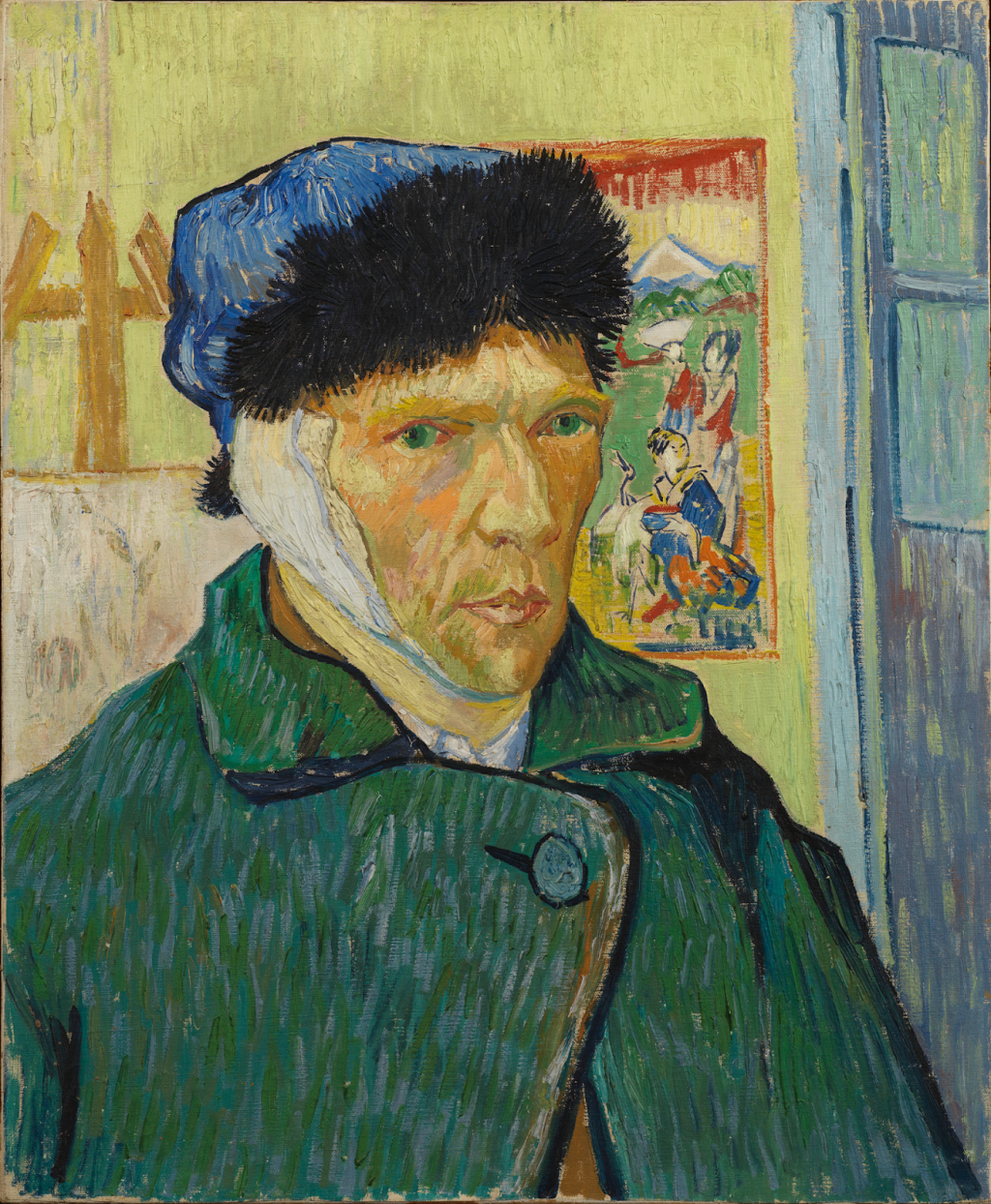
Self-Portrait with Bandaged Ear by Van Gogh
Charlotte Renaud
Arts & Culture Editor
The creation of art is not always pleasant, but it is necessary. It allows us to understand ourselves and the world, but most importantly, it also enables us to live our emotions instead of ignoring them. Art is what allows us to move through life. By materializing our emotions, we let ourselves move on. Art is the opposite of immobility; it reminds us that life continuously changes and that by default we must change with it.
The tortured artist myth has always romanticized torment, pain, and mental illness as a necessary side effect of being an artist. Its dangerous effects are entrenched in artistic industries as well as individual beliefs. A disturbing example of the much too common glorification of pain is seen in a conversation between actor Jim Carey and movie director Michel Gondry. The two met before the filming of the movie Eternal Sunshine of the Spotless Mind to discuss Carey’s role. At the time, the actor was struggling with depression and Gondry told him: “You are so beautiful right now. You are so broken… Please don’t get well.” To Gondry, Carey’s emotional unwellness would transmit into his performance and thus had the potential to be even more “moving.”
By perpetuating the glorification of mental illness, artists dealing with depression are discouraged from seeking treatment. Too many artists – musicians, writers, painters – who struggle with mental illness do not receive the help they need. Kurt Cobain, Sylvia Plath, and Van Gogh are only some of countless other examples.
Everyone knows Van Gogh as the genius who painted The Starry Night. However, everyone also knows him as the man who struggled with severe manic depression, severed his ear and then went as far as committing suicide. According to Ginevra’s article “The Myth of the Tortured Artist,” “Van Gogh was a great artist not because of his mental illness, but in spite of it.” Yes, he used painting to cope with what he was living through, but his illness was not the source of his genius. There is a great difference between embracing sadness and embracing mental illness. To embrace pain is knowing that it will pass; but to embrace mental illness is refusing to seek that change.
The human experience is complex and inexplainable. We feel the way we feel sometimes without understanding why.
“There is beauty in pain because it is a part of being alive; but it is not what makes us alive.”
It is not prettier nor uglier than any other human emotion. Pain should not be romanticized as an emotion one should linger in longer than necessary; to stagnate in it would be depriving oneself from the entire human experience. In Van Gogh’s case, his pain wasn’t simply a part of the human experience, it was his life.
The je-ne-sais-quoi that propels artists to create is not pain and it never will be. However, there are benefits to using emotional turmoil as a tool to create art. According to Will Richards’ article for NME, Billie Eilish explains that she was struggling with depression and “hated every second” of the process in making her first album When We All Fall Asleep, Where Do We Go? In a video where Billie was recording her song “listen before i go”, her mother asks her how she feels about the song implying that she jumps off the roof of a building. Billie replies, “I feel like it’s something I want to have said. This song is the reason I don’t. This way of saying it, instead of doing it, is better.” Art can be a tool to cope with mental illness and Billie knew this. Today, in her music, she continuously spreads awareness about depression and anxiety. Despite still struggling with both, she feels that she is in a much better place and prioritizes her well-being before anything else.
Wielding pain as an artistic tool can be powerful if done correctly. Channelling pain and heartbreak into art is a wonderful way of creating something beautiful out of something that isn’t.
Justin Vernon, known for his work in Bon Iver, spent three months in a family cabin in Wisconsin in solitude. He was retreating to deal with his heartbreak and health challenges. He lived a life away from society in the hopes that he would find himself again. The product of his escape: For Emma, Forever Ago. The album won critical acclaim and contributed immensely to the indie-folk genre. It continues to move people today, and is without a doubt, Bon Iver’s most famous album. Only pain could’ve created the nostalgic masterpiece For Emma, Forever Ago. Perhaps it is works such as these that beg the troubling question: is pain necessary to create such beautiful art?
This year, Bon Iver released a new album: SABLE, fABLE. If For Emma, Forever Ago was born from the ashes of pain, the new album was born out of hope. In an interview, Justin Vernon explains that he’s finally distancing himself from the “guy in a cabin” narrative and embracing a more hopeful chapter in his life. He’s lived the pain and now he’s moved on from it. The human experience is not stagnant; it is ever changing, and we must change with it… that is the je-ne-sais-quoi that artists wield – change.
 The Plant
Leave a comment