

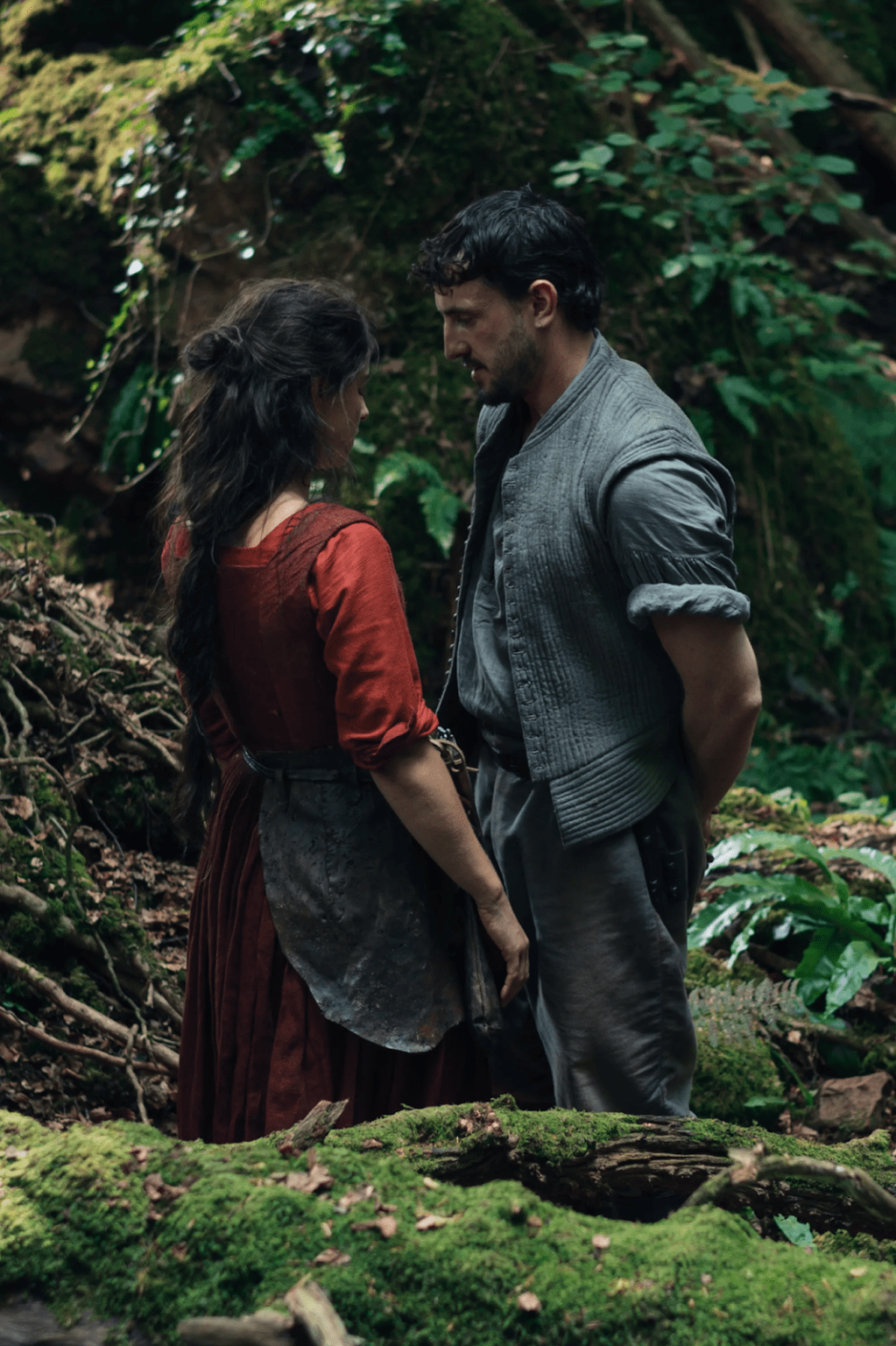
Via British Vogue
Simon MacLaren
Contributor
When I saw the trailer for Chloé Zhao’s adaptation of Hamnet, a 2020 novel by Maggie O’Farrell, I was thrilled. I decided that I had to get ready for the movie by reading the book – in my English class, we were reading Shakespeare’s Hamlet, which inspired O’Farrell’s novel, so the timing was perfect.
While I am still excited to watch Zhao’s film, which was released in theatres on November 27th and includes critically acclaimed performances from Jessie Buckley and Paul Mescal, I was disappointed by Hamnet the novel.
My hopes were high for Hamnet, because its premise is fantastic. O’Farrell draws on the story behind William Shakespeare’s 1603 tragedy Hamlet, the finest and most influential work in the English literary canon. Shakespeare’s eleven-year-old son, Hamnet, died in 1596, shortly before Shakespeare began writing his famous tragedy; Hamlet’s powerful consideration of what it means to be mortal, which still rings true to twenty-first-century readers, channels the monumental emotion of a grieving father. The complex feelings portrayed in Shakespeare’s play are already interesting; O’Farrell deepens the story by adding the perspective of Hamnet’s mother, Anne Hathaway (called Agnes in the novel). Agnes lived in Stratford with her children, while Shakespeare lived in London; exploring the relationship between her and her brilliant but distant husband could even be its own complete novel.
O’Farrell has so much to work with, and I was entertained and moved by her novel. But reading Hamnet is like watching a chess genius take hours to win a single match. Yes, it succeeds, but one feels it doesn’t live up to the expectations that are set by its rich premise.
”My dissatisfaction made me wonder: what makes a good adaptation? O’Farrell’s novel certainly doesn’t hold a candle to Hamlet; but why?”
I found the answer in Tom Stoppard’s Rosencrantz and Guildenstern Are Dead. This play, first performed in 1967, retells Hamlet through the perspective of Rosencrantz and Guildenstern, the hapless attendant courtiers. In Shakespeare’s play, they spy on Hamlet and report his behaviour to Hamlet’s uncle, King Claudius. Hamlet sees right through these witless noblemen, however, and they serve only as incompetent foils to Hamlet’s verbal gymnastics. Stoppard reimagines Shakespeare’s work by exploring these featherbrained stock characters; he reflects the desperate existential uncertainty of the tragedy in Rosencrantz and Guildenstern, who are trapped in Hamlet’s plot, acting out roles that imprison them in futility. Just below their foolish calm, they are panicked animals caught in cages. Rosencrantz and Guildenstern know just as well as the audience that they will die, and they approach their fate like people in a canoe with no paddles slowly drifting towards a waterfall. In the instant before his end, Guildenstern reflects that “there must have been a moment, at the beginning, where we could have said – no.” Stoppard’s play is a masterful metatheatrical reflection, and it has become a contemporary classic.
Rosencrantz and Guildenstern Are Dead is so great because it knows its source material inside and out. Stoppard makes few changes, but his editorial thrift lends them power. Hamlet’s lines in Shakespeare’s play and Stoppard’s adaptation are identical, for example. Yet through Rosencrantz and Guildenstern’s reactions to Hamlet, Stoppard creates a new version of the tragic hero. Stoppard’s play is not completely original, but it doesn’t have to be: the source is rich enough to share its wealth and support a thoughtful adaptation. In short, Stoppard’s play is great because Hamlet is great.
For Maggie O’Farrell, Hamlet is incidental. She is interested in the human drama of Shakespeare and Agnes. Bits and pieces of Hamlet come out in her book, but only in the most obvious ways. Hamnet dies, and the epigraph to the next part of the novel is “I am dead / thou liv’st … draw thy breath in pain / to tell my story.” O’Farrell takes two different lines and mashes them together; the relevance of these words to the plot of her novel is as subtle as a brick to the head. The final scene of O’Farrell’s novel is a performance of Hamlet, with Shakespeare onstage and Agnes in the crowd. O’Farrell’s dismissive attitude to the play is apparent: Agnes is bored and uncomfortable watching the performance, and the book ends in the middle of Act 1, Scene 5. We are left with one last Hamlet quote: “Remember me.” It’s a good line, for sure, but Shakespeare has so many others, especially in this play, that are uniquely his and dig deeper into the theme of remembrance. Adaptation is not easy. It requires checking the imagination and working with what has already been created. Hamnet’s connection to Shakespeare could have lent it such wealth, but O’Farrell’s novel is instead left impoverished. Here’s hoping that Zhao and company read both Hamlet and Hamnet with care.
 The Plant
Leave a comment