

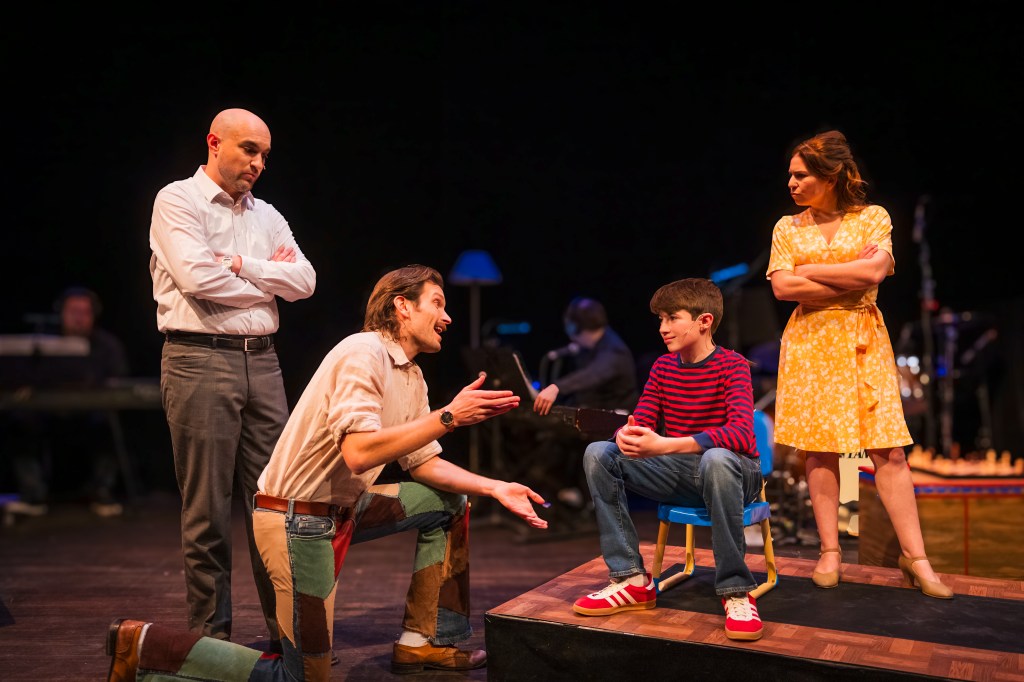
Via Contact Theatre, Matthew Sandoval
From Left to Right: Daniel Wilkenfeld as Marvin, Jonathan Vanderzon as Whizzer, Lucas Crelinsten as Jason, Amanda Caron as Trina
Joséphine Savard
Arts & Culture Correspondent
“This is where we take a stand
Welcome to Falsettoland” – Falsettos
March 7th, 2026, opening night of Falsettos at the Segal Centre for Performing Arts in Montreal. Falsettos is presented by Contact Theatre, an independent company founded in 2019 by producer Ally Brumer and director/choreographer Debora Friedmann. The company reimagines classics in contemporary ways, as seen in past productions of Cabaret in 2025 and Spring Awakening in 2024, both highly acclaimed by media.
An exceptionally marvelous queer and Jewish musical, Falsettos explores relationships in all their forms: from the fragmented dynamic between a wife and her ex-husband, to the passionate love between an ex-husband and his male lover and to the touching bonds between a male lover, an ex-husband’s chess-crazed son, and a wife’s new husband–the ex-husband’s psychiatrist. And, lest we forget, the lesbians from next door.
The experience begins upon entering, while the speakers play music from the 70s as if the audience was listening to WNBC radio in New York City. Minutes before the opening number, the wife, Trina (Amanda Caron), walks in and plays chess with her son Jason (Lucas Crelinsten) as the ex-husband Marvin (Daniel Wilkenfeld) travels the audience asking spectators to solve his Rubik’s cube. The pre-show taking place sets the tone for the immersive experience that is Contact Theatre’s Falsettos.
Set in New York City at the end of the 1970s, the play presents an unconventional Jewish family as it invites the audience into their lives. Actors take their seats before the show begins. Many people are holding bouquets of flowers. Families and friends gather here. Almost everyone in the room knows someone in the show. A community has already formed around this piece of art.
Lights dim, live musicians play and the opening number, “Four Jews in a Room Bitching” begins. This song marks the moment an uninterrupted 2h30 of musical theatre commences. Comprised of 41 musical numbers, hardly a single line goes unsung.
The set designs utilize toy playsets, plastic dolls and childlike costumes to make the show feel more comedic, and less like a heavy lesson in grief and growing up. The playfulness of the sets also rings in the absurdity that is this family: after all, how many Jewish wives divorced their gay husbands in the ‘70s without scrutiny? Probably none.
Falsettos unearths many taboo issues of the later 20th century. In an anti-semitic New York society, it was important for stories like this to exist. With its Broadway debut in 1992, Falsettos shone a light on a Jewish family just like any other, without casting them as outsiders to the shared human experience. They go through divorce, loss, reconnection, and more, just as any other family did.
This performance also does a brilliant job at revealing the queer experience of the ‘80s, a decade marked by the beginning of the AIDS crisis in 1981. “Falsettoland/About Time” opens the second act by introducing the audience to two new characters: Dr. Charlotte (Lily Lachapelle) and Cordelia (Emma Yee). They portray a lesbian couple who joins Wilkenfeld’s character in taking the audience through the queer community’s need to support eachother in the wake of AIDS.
During this act, Marvin and Whizzer (Jonathan Vanderzon) rekindle their relationship, dazzling the audience in vibrato-filled songs of love and lust such as “What More Can I Say?” and “More Racquetball.” However, in intentionally dissonant harmonies, the audience discovers that Vanderzon’s lively character is ill with AIDS. It is only then that Falsettos becomes a play about grief and about a family coming together despite hardships.
At the end, the audience files out of the room, discussing how they loved the intimacy of the small cast, or how they appreciated the discreet commentary on how the queer community came together during the 1980s. Everyone stays and waits before leaving. For some, it is because they need a moment to digest the weight of this story. For others, it is because they need more time to revel in the beauty of this musical. For most, they are waiting for the actors to come out from backstage, so they can shower them with congratulations.
The lyric “Learning love is not a crime” from “Falsettoland/About Time” beautifully encapsulates the message this play conveys. No matter the shape it takes. No matter the things it must endure. Through the wonderful texts of James Lapine and William Finn,
“This show teaches the audience that love can be the most beautiful thing in the world, but only when acceptance meets community.”
Falsettos runs at the Segal Centre for Performing Arts from March 7th to March 15th of 2026 and is a must-see for theatre lovers of Montreal. It will be followed by Detroit: Music of the Motor City from April 12th until May 3rd, and then Grow, beginning on May 24th.
 The Plant
Leave a comment