

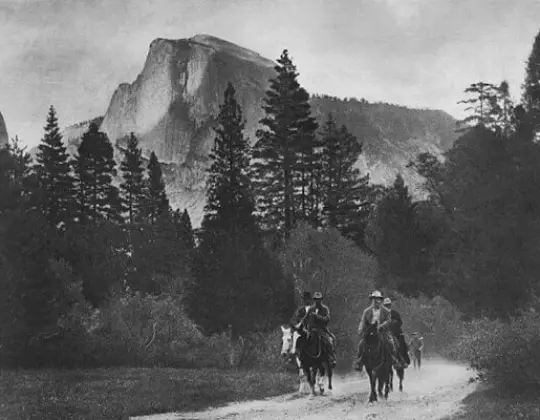
Via Theodore Roosevelt Presidential Library
Nicole Motta
Arts and Culture Editor
Do the splendour of mountain ranges beckon you? Do you, like many others, find yourself being
cradled by nature’s whispers telling you to leave everything behind, promising a life of true freedom, naked souls, and worldly beauty? The prospect of days like these – along with deleting the Omnivox app – appeals to many. While few find the courage to follow through with these “extreme” desires, many turn to nature amidst their busy lives to quench the thirst for solace.
Nature’s vastness is haunting, transcendental; it seems nothing puts banal life into perspective quite like being grazed by soft, tepid sunlight trickling through the needles of a great pine. For centuries, this glory has been a great inspiration: traces of human adoration of the living world are found in countless pockets of culture. In particular, the Romantic period led to the creation of novels such as Frankenstein, which portay nature as sublime, flawless, and almighty. Made in a society influenced by abrahamic religions, it is no coincidence this depiction parallels the way we conceptualize God himself: a presence above humanity which begs our surrender. Western civilizations don’t just romanticize nature, they deify it. The very language we use — take popularized terms like “uninhabited wilderness” and “preservation of nature” – both reveals and perpetuates the idea that nature is something we must venerate in “protecting” it from ourselves. To quote Agent Smith from The Matrix, we assume some truth in the notion that “human beings are a disease, a cancer of this planet.”
However, this presumption has inadvertantly concealed insidious power mechanisms of our nation’s past, which operated on this idea. In fact, a closer look into Canada’s history reveals
“that the western conceptualization of nature is, not only socially constructed, but a tool deeply embedded in the roots of North American colonization.”
With this worldview as the tool, the creation of national parks was the framework.
The Canadian National Park system originated in Western Canada, tied to the expansion of the Canadian Pacific Railway. The railway played a pivotal role in the economic ambitions of Canada’s National Policy, which sought to position the nation as a prominent international force. According to Natural Resource Lawyer Nicholas R. Goldstein, it all began with the unexpected discovery of natural hot springs bubbling by Sulphur Mountain, near what is now the town of Banff, by railroad workers laying tracks in the area. The “pristine oasis” opened a window of opportunity for the Canadian government who had been confronted with competing land claims to the area with Indigenous peoples. Prime minister John A. McDonald decided to protect the site by designating 26 km² of land around the spring as a national treasure under federal ownership in 1883. This protected land meant that Indigenous peoples were legally dispossessed of their territory which constituted traditional hunting grounds.
During the first wave of park development, trespassing, squatting, and poaching regulations were mechanisms used to legally expel Indigenous nations out of Canada’s parks. If they did not conform to regulations, they were forcibly removed by officials. Yet, the protection of these lands proved to be a deceptive motive because, until the Canadian National Parks Act in the 1930s, parks often allowed resource exploitation such as mining and logging (cough cough: capitalism). Overall, these policies clearly worked in the government’s favour: over the course of the last century, Canada has created 37 national parks and 11 national park reserves, according to Parks Canada.
Indigenous nations did not passively accept the expulsion from their homes. In the mid 20th century, Indigenous resistance gained momentum in public consciousness and Canadian governments began to grant special rights to access parks and obtain decision-making authority on management decisions. However, clashes over land stewardship remain far from settled due to differing cultural perceptions of humans’ relationship to nature. In contrast to the western human-nature divide, aboriginal spiritual relationships with natural lands stem from the belief that all living things live in interconnection and cyclical harmony. One is nature.
With this worldview and the recognition of colonialism rooted in the idea of nature preservation, aboriginals invite western civilizations to consider that nature can be both glorious and inseparable from humanity. Though our intentions regarding national parks may be more benevolent than they once were, the ingrained idea that humans are corrupt and contaminating creatures lacks key nuance. While capitalism has perpetrated devastating damage, humans should not be defined by the (reformable) systems currently in power. By keeping the language to understand that we have capacity for change out of arms’ reach, western societies have been relieving themselves of accountability and sustaining a self-fulfilling prophecy. In the words of Oglala Lakota poet Black Elk, “when they realize that at the center of the universe dwells the Great Spirit, and that this center is really everywhere, it is within each of us.”
 The Plant
Leave a comment