

Atika Ume Fazal
News Editor
Via Associated Press
Since 2024, the world has witnessed a myriad of youth-initiated protests and riots against corruption and economic instability. These uprisings, qualified as Gen Z protests, continue to demand changes in different parts of the world,uprooting the inequalities that are being endured.
All of these initiatives were led in huge part by students, often started and encouraged on different social media applications, such as Discord and TikTok.
In Nepal, the large-scale protests turned to riots, managing to successfully oust the corrupt Prime Minister, K. P. Sharma Oli. In Kenya, the decentralized mass rioting movement managed to counter an attempt at a controversial tax hike by the president. In Italy, a general strike in opposition to the country’s involvement in the Gaza Genocide also forced the government to utilize their forces in support of the Global Sumud Flotilla.
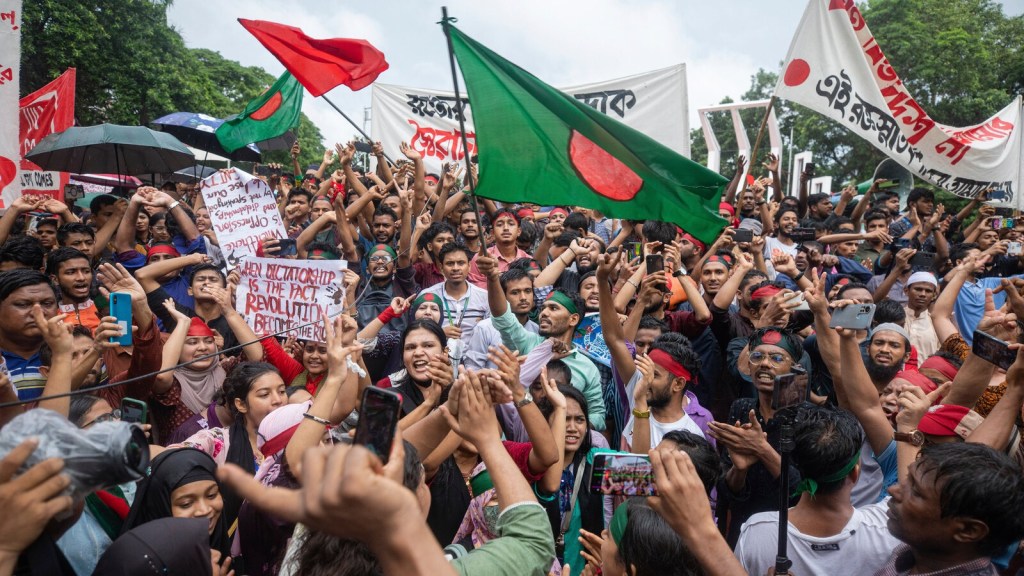
However, the first successful youth-led revolution took place in Bangladesh. Thanks to common efforts, the citizens managed to overthrow the autocratic government of Sheikh Hasina Wazed.
In July 2024, a series of protests opposed the quota-system established in the country that reserved 30% of government jobs for descendents of the veterans that fought Bangladesh’s independence war. The Awami League, which was in power at that time, cracked down violently on these protesters. The OHCHR estimates that as many as 1,400 people were murdered by the country’s security forces. Over 60% of the deaths accounted for were that of Gen Z, constituting what is now known as the July Massacre.
Nevertheless, the uproar in Bangladesh continued, further agitated by the systematic suppression citizens were victims of. According to Al Jazeera, schools and universities were closed down, internet blackouts widespread, and curfews on students installed. The protesters now also demanded the resignation and prosecution of Sheikh Hasina and the banning of her party from any further elections.
In fact, Hasina was known to have constantly rigged elections in her favour over the years. Coming from a family of politicians and born to the first ever president of the country, Sheikh Mujibur Rahman in 1971, she was elected Prime Minister for the first time in 1996. After a tumultuous break from 2001 to 2008, she came back to power and stayed there until her exile in 2024.
Her fourth term, lasting from 2019 to 2024, was her most controversial yet. The elections leading up to it were widely considered some of the most unfair in the country. Organizations like Human Rights Watch accused the government of using intimidation tactics, such as kidnappings and murders, against the opposition.
Her ousting was hence a huge step towards democratic values re-entering the country and its political systems. The protesters demanded she be held accountable in court for her numerous crimes against the Bangladeshi people. Sheikh Hasina still has these charges against her in the country, but managed to avoid them by fleeing to India.
After Hasina’s fleeing and a very bloody revolution, Bangladesh needed a new leader. The interim government of Mohammed Yunus was sworn in until the next elections with the mandate of assuring fairness and freedom in voting, and organizing the constitutional reforms to be implemented.
In February 2026, the elections took place. The Bangladesh Nationalist Party (BNP), led by Tarique Rahman, won a landslide victory. Out of the 300 seats in the government, BNP managed to get 212. Jamaat-e-Islami became the main opposition, gathering 77 seats. Eligible citizens also voted in favour of constitutional reforms under the July Charter, which the BNP has claimed it will endorse, as reported by The Guardian.
“These elections received great praise by local and international communities for having been one of the least violent and most credible voting operations in Bangladesh in a long time.”
According to the election commission, the voter turnout had also been considerably higher from the last “elections,” reaching up to 59.4%. The youth-led revolution was successful, as they tend to be. In fact, researchers at Harvard claim that protests that involve young people tend to be 2 times more triumphant than those that do not.
The elections were not without controversy though. The Jamaat-e-Islam party has a reputation for being against the rights of women in the public space. Their leader, Shafiqur Rahman claimed, in an interview with Al Jazeera, that women should not come into leadership. Tarique Rahman, on his side, has allegations of money laundering and political interference through his mother, who was also the leader of BNP.
Nonetheless, these elections still marked an amelioration of the conditions that electors faced. There were oppositions that felt safe enough to campaign, and people’s well being was not determined based on their political affiliation. Bangladeshi Gen Z’s revolution not only ended up creating a preferable environment for themselves, they also inspired other youth around the globe to act.
 The Plant
Leave a comment