

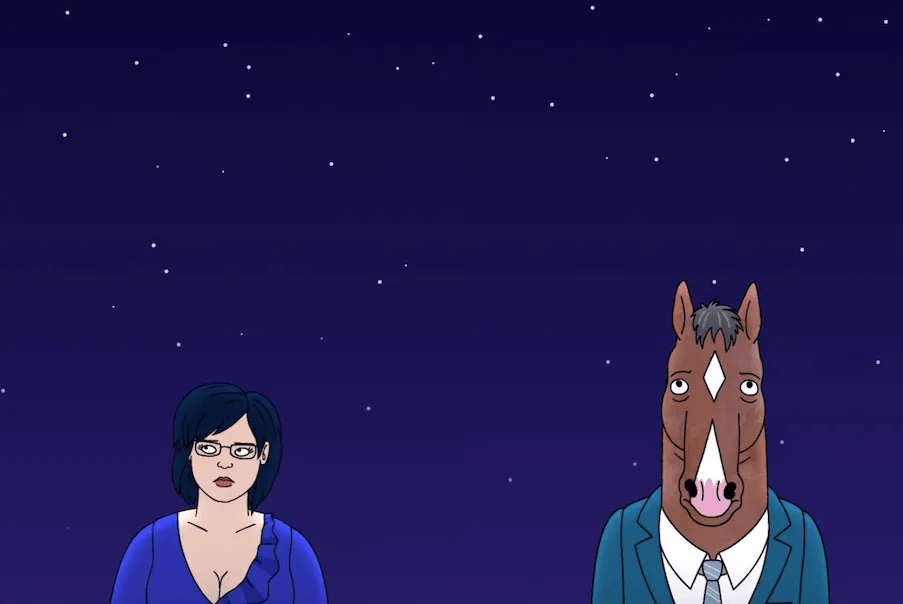
Via The Verge
Maya Jabbari
Voices Editor
When people talk about television that explores mental health, the conversation almost always centers on serious dramas. These shows often pride themselves on their authenticity, complex characters, and emotional intensity. But, arguably, that’s not always what I’ve seen. To me, there is one show that stands out in that genre: BoJack Horseman.
Despite being animated and often absurd, BoJack Horseman has one of the most honest portrayals of depression, addiction, trauma, and self-destructive behaviour in modern television. It handles mental health with more openness and nuance than many live-action series that claim to be grounded portrayals of reality.
Part of what makes the show stand out is that it refuses to romanticize suffering. In many television dramas, like, for instance, 13 Reasons Why, the troubled protagonist’s struggles become a kind of aesthetic – it’s something that makes them mysterious, complex, or even admirable. The audience is, thankfully, encouraged to sympathize with their pain, but sometimes overlooks the harm they cause. BoJack Horseman rejects this entirely. BoJack’s depression does not make him intriguing or something to be studied; it makes him destructive, selfish, and frequently makes others distance themselves from him. The show can’t stress something enough: being in pain does not excuse hurting others.
With that being said, because BoJack’s struggles ripple outward, characters like Diane, Princess Carolyn, and Todd are not just supporting players in BoJack’s life and the show itself; we get an insight into their lives and how they are shaped by BoJack’s actions. For instance, Diane’s storyline is, in my opinion, one of the most thoughtful depictions of depression on television. Her experience manifests into persistent dissatisfaction, burnout, and a sense that she is failing to live up to her own ideals. When Diane eventually begins taking antidepressants, the show treats the decision with refreshing realism. It isn’t a miracle cure, and it isn’t a weakness.
With BoJack himself, specifically in the episode “Stupid Piece of Sh*t,” we hear his constant inner monologue, which relentlessly insults him, calling him worthless and incompetent in mundane moments of daily life. The show understands that mental illness is sometimes this exhausting presence of a voice in your head that never stops tearing you down. This is so incredibly refreshing to see.
Another strength of the series is how honestly it depicts long-term mental illness. Many shows treat emotional struggles as arcs that can be neatly resolved. A character spirals for a few episodes, confronts their trauma, and emerges changed, and that trauma never returns. But, of course, mental illness isn’t just something that disappears at the click of a button, and BoJack Horseman, time and time again, reminds us of that. He often (and God, I really do mean often) promises to improve, and sometimes even appears to make progress, only to fall back into the same patterns of addiction and self-sabotage. The show treats it as a psychological reality where recovery, as we see in our day-to-day lives, is rarely clean or linear.
Ironically, the fact that BoJack Horseman is animated may be one of the reasons it works so well. I think people turn away from it and maybe don’t even take it seriously because of this factor. At first glance, it appears as something you can play in the background and indulge in unseriously. But, out of nowhere, it hooks you in, makes you cry and makes you laugh. It truly makes you feel. This surreal world where celebrities can be dogs, cats, or horses, creates a layer of distance that allows it to tackle extremely heavy themes without feeling overwhelming.
Humour ties into this as well because the series is loaded with visual gags, wordplay, and absurd situations that often appear moments before or after emotionally devastating scenes. Rather than weakening the drama or the comedy’s impact, this balance reflects how people may actually experience difficult situations. Humour and pain frequently exist side by side, and BoJack Horseman captures that contradiction better than most. In the end, honesty is the name of the game and it’s what makes BoJack Horseman so effective. It doesn’t promise that its characters will be fixed or redeemed in clean or satisfying ways.
“Instead, it suggests that improvement is something people must choose repeatedly, often after failing many, many times. That message may not be comforting, but it feels real.”
In doing so, Bojack Horseman proves that sometimes the most insightful commentary on real life can come from the most wildy unexpected places.
 The Plant
Leave a comment