

Yasmine Bouanani
Secretary
Via the Canadian Press
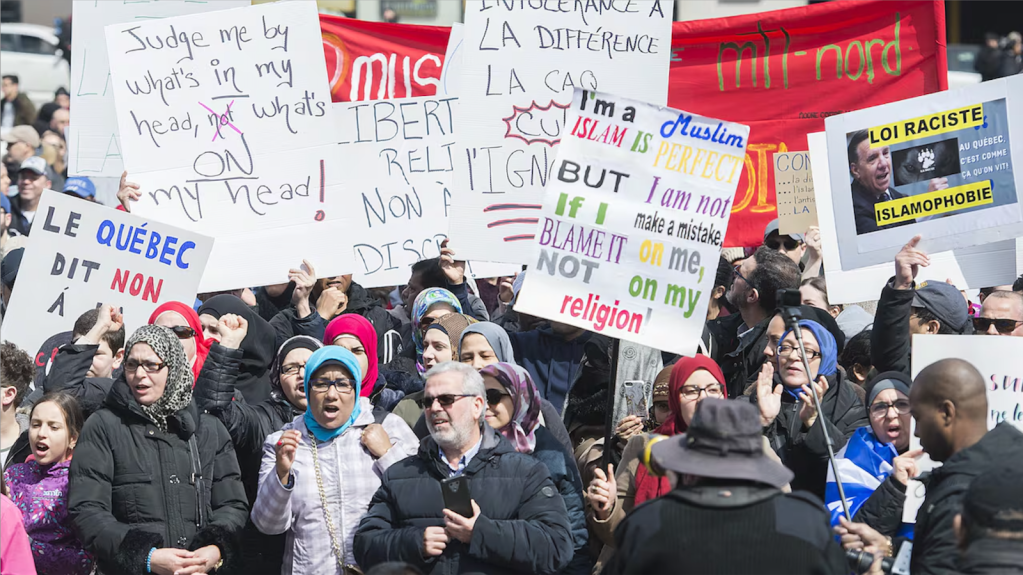
Laws are not abstract; they shape the livelihoods of thousands. Seven years ago, the Quebec government adopted its Act Respecting the Laicity of the State, more commonly known as Bill 21. The law prohibits certain public employees, such as public school teachers, police officers or judges, from wearing religious symbols while performing their duties. Since its introduction in 2019, the bill has generated many debates around religious freedoms and the very meaning of secularism. This strong controversy has in no way deterred our leadership from entering discussions on possible extensions.
Last November, Secularism Minister Jean-François Roberge presented the proposed Bill 9 to strengthen the application of state religious neutrality offered by Bill 21. Its details vary by drafts, but it is reported to suggest a set definition of “religious symbols,” and a broader coverage of what or who is affected across public institutions. The ban on religious symbols could be extended to more school staff such as daycare workers, secretaries, librarians, or other school employees.
The original ban has already been limiting the employment opportunities for Quebec citizens from religious minorities, and this proposed addition would multiply its effect across public employees. While existing employees were initially protected by a “grandfather clause”, they couldn’t get promoted or transfer school boards. Anyone hired after the law’s adoption had to comply or risk losing their positions. But the impact also touched on future employees. Research has found that over half of surveyed education and law students concerned by the bill in Quebec were now planning to leave the province because of the legislation. Critics warn that Bill 9 would only expand the damages. It would intensify staffing shortages and families, students, and colleagues would feel the ripple effects, as more people lose their jobs or leave Quebec.
Another restriction proposed by the new bill would be a ban on religious spaces in public institutions. This could mean that Dawson’s very own campus would lose its prayer rooms. These spaces have until now been provided to accommodate religious students and as a recognition of the diverse demographic of the college. “My schedule is super packed so being able to pray on campus between classes helps me a lot,” said a member of the student body. “Without it, I’m not sure how I would keep up with everything.” The student also added that debates around laicity initiatives can sometimes feel like they send signals about who is welcome in public institutions. They shared concerns on the future prospects of religious citizens in the province.
“It just feels like we are shown the door.”
These concerns are shared by a significant portion of Quebec’s student population. According to a 2021 survey, 34% of students reported increased everyday discrimination against religious minorities since Bill 21 was passsed.
Bill 9 may also adjust administrative processes for granting exemptions or handling workplace accommodation requests related to faith, and introduce an update on enforcement mechanisms. These changes signal a stronger regulatory approach to managing religious expression in schools and workplaces, hindering people’s access to an education and a stable employment. “Stripping people of their right to learn or to work because of their faith has no place in a democracy,” affirms Harini Sivalingam, Director of the Equality program at the Canadian Civil Liberties Association.
To understand these secularism laws, it is crucial to know about the tool that enables their passage. Section 33 of our Canadian Charter of Rights and Freedoms, also known as the Notwithstanding Clause, allows Parliament or Provincial legislatures to enact laws that bypass certain provisions of the Charter: fundamental freedoms and legal and equality rights. In 2019, the Quebec government invoked the clause pre-emptively to enact Bill 21 “notwithstanding” the rights to freedom of religion, freedom of expression, and equality rights before courts had even ruled on its constitutionality.
The clause was originally created as a compromise to preserve the democratic control of elected representatives and ensure courts don’t hold the final say on all controversial laws.
As a form of safeguard, it was intended for there to be public backlash anytime the clause is used, discouraging governments from abusing it. However, critics affirm that logic fails in cases infringing on the rights of minority groups, like with the laicity laws, because they lack the political influence to generate sufficient resistance to influence governmental decisions. Their small numbers mean that their votes don’t directly sway elections, that fewer of their members hold elected office to represent their voice, and that their lack of visibility limits the impact of their protests. In short, the clause can allow minority rights to be trampled if the majority agrees to it.
From March 23rd to the 27th, 2026, a hearing is being held at 301 Wellington Street, Ottawa. Bill 21 has faced extensive legal challenges, progressing from the Quebec Superior Court to the Quebec Court of Appeal, and has now reached the Supreme Court of Canada. Challengers to the bill, which include the Canadian Civil Liberties Association, the National Council of Canadian Muslims, individual plaintiffs, and the English Montreal School Board, argue that the law violates several parts of the Canadian Charter of Rights and Freedoms, such as freedom of religion, equality rights, gender equality, and minority language education rights. They request the Court to find Bill 21 to be unconstitutional or to force its application to be limited. They affirm that Section 33 should not allow governments to completely override discrimination protections. Over the course of the hearing, lawyers will present legal arguments before the 9 justices of the Court, who will test the legal reasoning and implications of Quebec’s secularism laws, as well as the constitutional issues surrounding the topic.
Hearings being granted five full days is highly unusual. Usually, court appeals last one or two days,depending on the severity of the case. The length of this present hearing is a testament to the constitutional importance of the case. After all, it raises multiple questions regarding Charter and the use of Section 33. No fewer than 38 interveners are set to speak, representing a wide range of legal, civil rights, and community perspectives.
The Supreme Court’s ruling could reshape Canadian constitutional principles, setting precedents that affect not only religious freedom, but also how governments across the country can go about suspending rights through the Notwithstanding Clause. The question of the relationship between democracy and minority protection is at the heart of the discussion. The Supreme Court could either fully uphold Bill 21, clarify limits on Section 33, or, in a very unlikely outcome, strike down parts or all of the law. Most experts expect the Court to uphold the bill, but clarify how far provinces can use the Notwithstanding Clause in the future.
The decision could possibly bring about a domino effect. If the Court clarifies limits on Section 33 or partially strikes down the law, it could reshape how future provincial laws are written, affect other existing laws, and shift the balance of power between courts and elected governments. The stakes are also very high because of the Federal-Provincial tension prevailing as the hearing touches on Quebec’s claim to a distinct model of secularism. The outcome could either strengthen the province’s authority to set its own policies or place new limits on provincial power under the Charter. The final decision, however, can only be expected six to twelve months after the conclusion of the hearing, so either in late 2026 or early 2027.
Beyond the courts and the legal jargon, it is important to not lose sight of the concrete life impacts these debates have.
“While legal arguments focus on charters, clauses, and constitutional principles – the human impact is very tangible.”
Real people are affected by the restrictions and social implications of the Act Respecting the Laicity of the State. Students juggling prayer and study, teachers facing career uncertainty or stagnation, and entire communities questioning whether their identities are respected. All Canadians have now front- row seats to the shaping of legal precedents that will influence which citizens feel welcome in classrooms, workplaces, and public institutions for years to come.
 The Plant
Leave a comment