
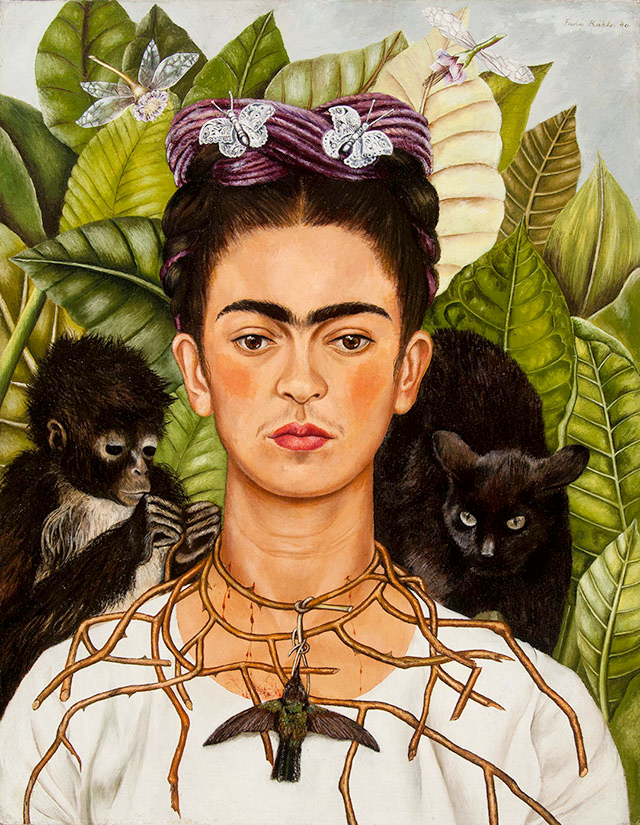
Self Portrait with Thorn Necklace and Hummingbird, via Harry Ransom Center
Chloe Bercovitz
Managing Editor
“A very effective way to control women is to convince women to control themselves,” said Glennon Doyle.
I find it hard to believe that female beauty standards have ever been about looking good. Looking beautiful, even.
We can all agree that insecurities are irrational. Our pores, our cellulite, our acne, skin tone, our body hair.
Who cares?
But I’m ashamed to say:
I do.
And so do you.
Why is that?
Beauty standards are a bit cultural. Very political. They are, in essence, the ever-evolving norms that measure beauty. They ought to be met in order to merit successes, both personally and professionally.
The human race has always been enamoured and consumed by appearances. In ancient Greece, it was believed that the more attractive you were, the better you were emulating the Gods.
Then came the Middle Ages; beauty became intertwined with morality. From a theocentric Western scope, girls were, indeed, expected to be chaste. And, to look virginial, you ought to look young and pale. Forever. With white as the historical emblem for innocence comes a good six hundred years and counting of oppressive, systemic expectation.
Sounding at all like white supremacy yet?
Colonialism took such preferences and transformed them into a caste system, in which physical traits became a means of deciding one’s humanity and worth. So, when we talk about beauty standards in today’s world, we are often just treating and acknowledging both scars and histories.
I do believe, though, that this worldview persists: “it’s reflected on the faces in the pages of fashion magazines, which, up until recently, were almost exclusively white,” says Vogue reporter Jessica DeFino.
And once you begin convincing people that they are less than, they become a captive market. Big corporations were quick to profit from these deep-seated, systemic insecurities. And when that doesn’t work, then you can always just create new insecurities altogether!
When you make someone believe that they don’t smell good, that their hair looks disgusting, or that their skin looks strange, chances are that they’ll become insecure. Chances are that they’ll want to do something about it. That’s the beauty marketing standard, which, likewise, upholds the patriarchy.
DeFino likewise explains that, for face creams to sell, women had to become demonized as having skin that is either dry or oily. That blemishes and wrinkles are wrong. Buying creams would fix that.
Even when the sales of Gillette began to stagnate, of course, a new, female market was born. Body hair became refashioned as unhygienic. With a new problem, came its solution, and it just so happened to be conveniently packaged in a razor box.
But I can’t help but notice that beauty culture today has done more than selling insecurity, for it too, is stealing. Slick hair, gold hoops, skin prep – they are all rooted, historically, in the efforts of women of colour. The clean girl aesthetic has been rebranded. This new label, more palatable to sell, posits a very striking irony. These practices were not born from luxury, but rather, survivalism. Developed by women navigating societies that scrutinized and forced them to appear “clean,” in order to be taken seriously – in a cruel reversal, the very aesthetics that once invited discrimination are now praised when detached from the women who created them. Only now have they become marketable.
Modern beauty standards have likewise been weaponized as a backlash against feminism. During second wave feminism, came with even more rules and regulations with regard to the female appearance. Throughout the ‘60s and ‘70s, it was the politically protected right of an employer to enforce the appearance of a female employee. This was also the same time that diet culture began; diet-related articles in magazines rose 70% from ‘68 to ‘72, according to American author Timothy Ferriss.
And then the feminists who rebelled against this were suddenly wearing a new label:
“the ugly feminist.” It was a cheap way to undermine the movement, attacking the desirability of the messenger rather than the message itself. But when a woman is dismissed as bitter and unattractive, it gets remarkably harder to be taken seriously. This characterization then served as a warning to others of what a rebellion ought to cost.
Today, we often perceive beauty routines as a means of self-care. And definitely, sometimes, this is true. But I’d like to suggest, here, that real self-care is intrinsically political – and begins when we stop funding a culture that torments us into thinking that our very existence is inadequate.
“I believe that self-care is subversion. Self-care equality. It is liberation.”
It is when girlhood can, finally, just live and breathe amid the comfortable existence of bodies that were never even a problem to begin with.
 The Plant
Leave a comment