

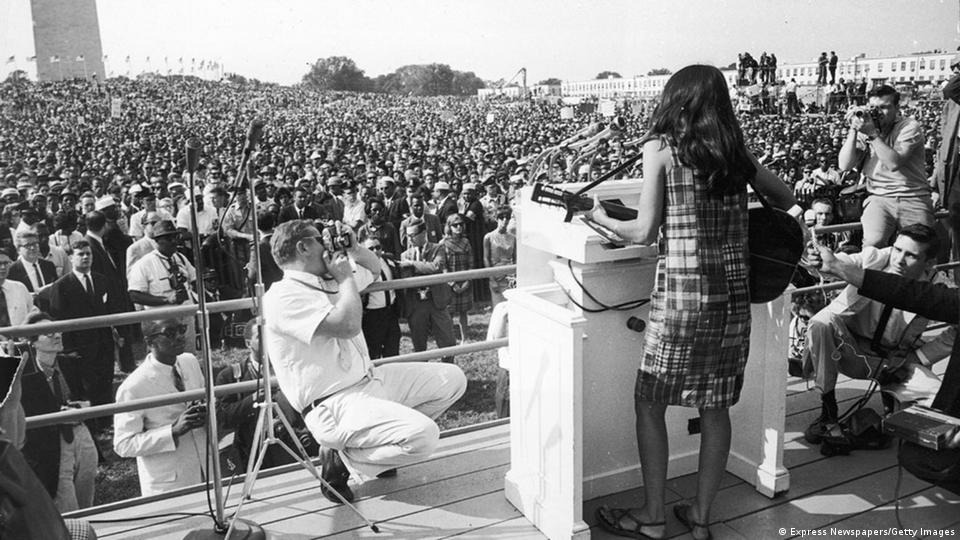
Joan Baez performing at the Civil Rights March on Washington in 1963
via Getty Images
Orla Jeanes
Staff Writer
Activism has always been closely linked to music, so much so that protesting itself holds a musical quality. Whether they are heard through shouts, cries, chants, or the clanging of pots and pans, the sounds of protest rely on creating noise; in this way, they are musical.
Historically, social justice movements have depended on musicians to supply the rallying masses with their anthems, and time and time again, artists have responded by either overtly or subtly suffusing political ideas into their song. Think of Nina Simone’s “Mississippi Goddamn,” Marvin Gaye’s “What’s Going On,” or Bob Dylan’s “Blowin’ in the Wind,” all of which are tracks that denounced racial oppression during the Civil Rights Movement in the U.S.
During the counterculture movement of the 1960s, mainstream music was made up of an unprecedented number of songs that outspokenly contested the status quo. Participating in legendary music festivals like Woodstock and the Newport Folk Festival, hundreds of cultural icons would come together to decry injustice.
“It seemed as though, in that era, an integral part of the artist’s identity rested in their ability to transcend boundaries, not only creatively, but politically.”
These days, much of that sociopolitical consciousness seems to have disappeared from popular music. The way in which singers now express themselves politically—that is, if they do at all—feels calculated and superficial. When it comes to recent contributions to musical activism, I find that there is an overall absence of the genuineness, raw emotion, and unabashed demand for change that once characterized protest songs. If wars, poverty, and suffering remain just as widespread and unresolved, why is it that musical activism is no longer equally prevalent?
Ironically enough, the rise of democracy is somewhat to blame. As it neared the end of the twentieth century, the world began to see a major shift in international politics: the Soviet Union collapsed, the Berlin wall fell, both the Vietnam and the Cold War reached their ends, and at least thirty countries transitioned from authoritarian to democratic forms of government. In his 1989 article titled The End of History, the American political scientist Francis Fukuyama presented the idea that, with the dawn of this new age of liberal democracies, civilization had reached “the end point of mankind’s ideological evolution.” Essentially, the world had become ‘okay’ enough to alleviate the West of the sense of political urgency that had been fueling counterculture music for several decades.
That being said, global politics are not the only culprit. Over the course of the past two decades, digitalization has completely revolutionized the music industry, and not necessarily for the better. If you feel as though the overall quality of newly released music has gone down while the number of album releases has gone up, you are not alone. The demands of our modern-day, dopamine-addicted digital market have largely resulted in an influx of songs catered to sensationalism. Pressured by the expectations of the profit-driven music industry, many musicians have strayed from the creative and expressive aspects of music making. Instead, they’ve turned their attention to studying consumer habits and forming business strategies, such as carefully designing a trending audio that can maximize the number of streams to their song.
In the same vein, preoccupied with becoming mainstream and avoiding public reproval, singers will sanitize and, consequently, banalize their music. Unsurprisingly, the succinct and daring lyrics of protest songs, often marked by curse words or explicit critiques of those in power, do not have a reputation for being uncontroversial. However, to protect an artist’s image in popular culture—and with it, their number of streams—a certain neutrality when it comes to their political views is required.
There is a reason for which music has been dubbed the universal language. Arguably more so than any other art form, it has the ability to convey emotion in a way that is deeply resonating and visceral; cheesy as it is, you can feel it in your soul. Fused with activism, it harnesses a unique ability to mobilize the masses and build a sense of solidarity amongst them.
So far, the 21st century has not shown itself to be much better than its antecedent: hatred, violence, and tyranny still run rampant, proving to us that the march to justice is far from over. Personally, I think it’s about time we had ourselves a new rallying chant, one that will get us back in the streets, continuing the fight of past generations.
 The Plant
Leave a comment