

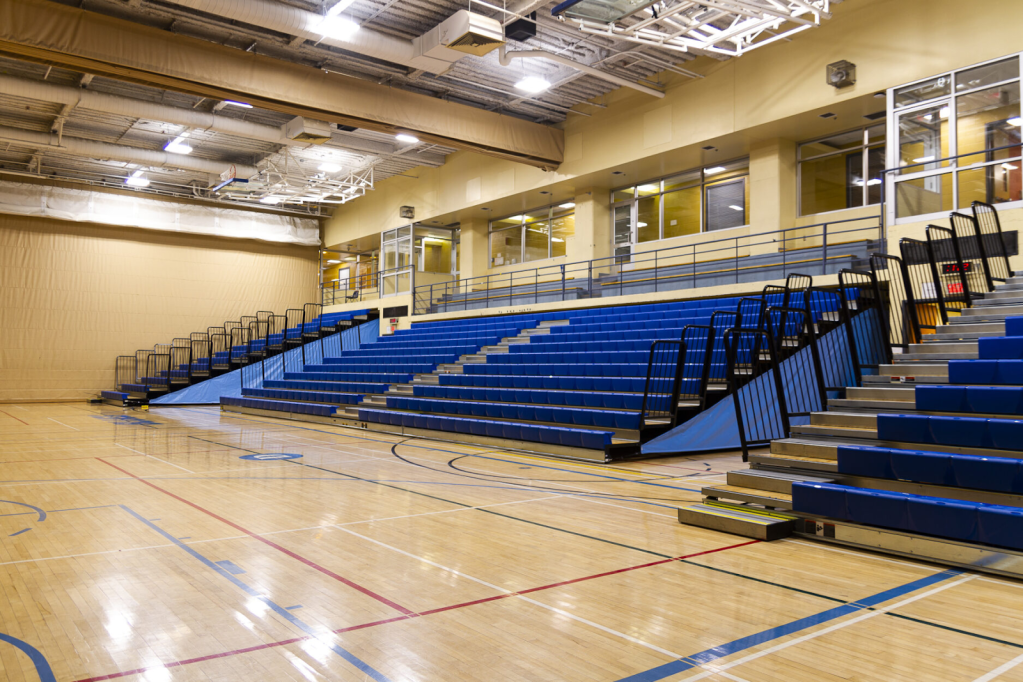
Via Dawson Athletics
Minola Grent
Editor-in-Chief
A few years back, CEGEP students were required to take 4 Physical Education (PE) classes to graduate, which, in a standard 2-year pre-university program, amounted to one every semester. Though it is unclear when the shift took place, the Ministry of Education decided to remove one, leaving the PE Department with only three classes to teach every student how to lead a healthy and balanced life. In fact, Dawson, in particular, insists on making sure all students have access to this part of their education through a comprehensive accommodation system. The one thing that cannot be granted, however, is an exemption. I interviewed Layal Nakhlé, a beloved PE teacher and the department’s accessibility representative, to understand the inner workings of Dawson’s Physical Education courses and accommodations.
PE classes are rarely popular, especially when most CEGEP students’ lifestyles look more like that of overworked adults than that of teenagers. Yet, they are there for a reason. Layal explained that
“the goal is to expose students to different ways of maintaining a healthy life so that, once in adulthood, they are equipped with the tools to take care of their bodies and minds.”
The requirements for the three classes follow a growing structure: the 101 teaches students about general fitness and nutrition, while the 102 brings in the acquisition of skills and goal setting. Finally, the 103 combines the previous two into a plan the student makes to achieve a muscular and cardiovascular goal. Students are pushed to choose activities that they enjoy and can envision themselves continuing to perform in the future.
The variety of PE classes ensures most students can find something that fits their fitness level and physical limitations. Students who are registered with the Student AccessAbility Center (SAAC) are eligible for accommodations for PE classes. However, it is important to note that Dawson College only offers exemption in extremely specific and dire situations. Outside of exceptional circumstances, the SAAC and Layal, the PE accessibility representative, pride themselves on the wide array of accommodations that can be offered to students.
Critiques have been made towards the school using clause K.3 in the fourth section of the Institutional Student Evaluation Policy (ISEP) which states: “An exemption is the action by which the College exempts a student from registering for a course normally required in their program of studies.” However, the clause explicitly mentions that the exemption policy applies to courses required in a student’s program of studies. This refers to concentration courses, not general education ones, such as English, Humanities, and PE. These classes are tightly monitored by the government, prohibiting the college from offering exemptions.
When asked about what exactly these accommodations entail, Layal explained that almost anything is possible. Layal works in collaboration with the student and their SAAC counsellor to find the best course of action. For example, if a student is recovering from an injury and has a physiotherapy plan to follow, that can be integrated into their PE class in the stead of other physical activities they may not be able to perform. If a student has reduced mobility in their lower body, and the chosen PE class relies on exercises targeting that region, adjustments can be made to instead focus on the student’s upper body. In short, class requirements can be changed to entirely fit the student’s needs and limitations.
On top of physical disabilities, students can also receive accommodations for their mental health concerns. For instance, accommodated students may have a support person of their choice present during classes. They may also be allowed to step out when difficult or triggering topics such as nutrition and eating disorders are addressed.
Furthermore, if a student were to miss multiple classes due to a health condition, opportunities will be given to retake the missed classes throughout the semester.
In short, exemptions are not granted because it would deprive students of a part of their education that attempts to show them different ways to be healthy. Health looks different on everybody, and Layal understands and wants to continue showing this to her students.
 The Plant
Leave a comment