

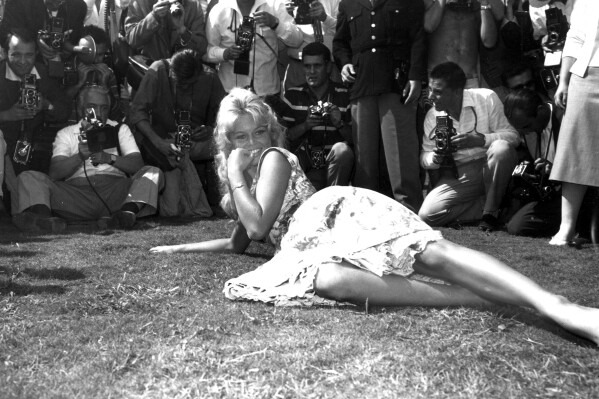
Via AP News
Orla Jeanes
Staff Writer
On December 28th of this past year, one of the most celebrated female icons of the 50s and 60s resurfaced in newspaper headlines. As was announced by her foundation, the French actress and international movie star Brigitte Bardot had passed away, aged 91. Despite having retired from the world of cinema in 1973 to pursue a career in animal rights activism, she never entirely disappeared from the public eye and retained much of her original fandom. While successful actors tend to slowly lose prominence as time passes and new, younger faces take both their roles and their celebrity, the name and image of Brigitte Bardot remains extremely well known, even amongst today’s youth.
Immortalized through the works of key filmmakers of the French Nouvelle Vague period, namely Louis Malle’s Viva Maria and Jean-Luc Godard’s Le Mépris, Bardot is best remembered as the compelling young woman with pouty lips, blonde hair, and bold, winged eyeliner. For the most part, she portrayed characters who, in spite of their somewhat demeaning naivety and coquettish tendencies, resented the men in their lives and, consequently, patriarchal society. These fictional women are often destructive or manipulative, questioning and upsetting their romantic relationships, or using their sex appeal to their own advantage. For instance, in the 1958 crime film En Cas de Malheur, Bardot plays a criminal who, having made her attorney fall in love with her, corrupts him into paying a fake witness to attest to her innocence.
After her big breakthrough in the French director Roger Vadim’s Et Dieu Créa la Femme, the philosopher and feminist activist Simone de Beauvoir praised her defiant nature and stated that she “challenges certain taboos” that “denied women sexual autonomy.” In the same text, a 1959 essay titled “Brigitte Bardot and the Lolita Syndrome,” de Beauvoir commented on how Bardot’s character Juliette, an orphan whose seduction of two men results in a dramatic duel in the movie’s final scene, establishes a more egalitarian, if still problematic, dynamic between herself and her paramours, writing that “the male is an object to her, just as she is to him.”
Without wanting to disregard her contributions to the film industry, it is worth asking why Bardot is still relevant to many young women in the twenty-first century. Meanwhile there areother Nouvelle Vague greats, like Jeanne Moreau or Catherine Deneuve, who have faded to the peripheries of pop culture.
If taken as a whole, it is possible to observe certain trends in the idolatry of teenage girls, specifically when it comes to the cult followings that have emerged around women who aren’t necessarily mainstream. Names that come to mind are Sylvia Plath, Joan Didion, Jane Birkin, Patti Smith, or even fictional characters, such as Lux Lisbon from Jeffrey Eugenides’ novel The Virgin Suicides, all of whom are examples of figures that teenagers seem to gravitate towards that are, relatively speaking, more “obscure.” The question that we are then left with is: why do these women hold such strong appeal for young female audiences?
As we navigate adolescence, we slowly learn that there is comfort to be found in things that remind us of ourselves; in the face of all the hormone-induced emotional hurdles, identifying parts of ourselves in other people makes us feel less disoriented and alone.
” Concurrent to this need for connection, there is a continual search for identity and, with it, individuality.”
For inspiration, we look at those known for their unique and seemingly effortless styles, as brought to us by Birkin and Bardot’s timeless “French chic,” Didion’s simple yet elegant writer’s uniform, and Smith’s artful combination of shaggy hair, collared shirts, and loose neckties. This, of course, is in addition to their notable accomplishments and influence in literature, journalism, cinema, music, and activism.
To have an awareness of popular culture inevitably leads to having favourite celebrities. That being said, there are certain questions to be raised as to what factors are influencing our choices. For example, many Sylvia Plath fans have fallen prey to romanticizing mental health disorders, oftentimes revering The Bell Jar as an almost sacred text. Also questionable is the selection of the American writer Joan Didion as a muse, in lieu of numerous other pioneering female authors, despite her having been accused of being an anti-feminist.
As for Brigitte Bardot, much of the fame accorded to her in recent years is owing to her public endorsement of far-right political candidates and her hostility towards immigrants. She repeatedly targeted different groups with bigoted comments, calling gay people “fairground freaks,” referring to #MeToo victims as “ridiculous,” and describing Muslims as “cruel and barbaric.” However, in spite of her hateful language, she somehow managed to escape the censure of many Bardot idolizers. For a society where cancel culture is all the rage, why is it that certain people are given carte blanche to test—and often exceed—the boundaries of what is deemed politically correct? In Bardot’s case, maybe it’s that they refuse to associate the old her with the woman who once emblemized sexual rebellion or that their real admiration lies in the visual aesthetic she embodied rather than the person she was. Nevertheless, it seems almost as though teenage girls can be tolerant of controversiality on the condition that it helps them in their quest to set themselves apart.


Leave a Reply