

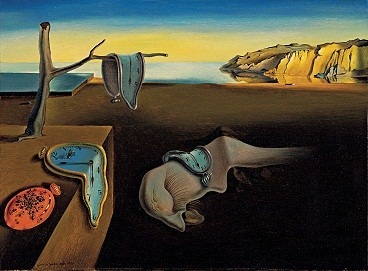
Salvador Dalí’s “The Persistence of Memory”
Via Wikipedia
Martin Kaloshi
Science and Environment Editor
Eleven minutes to Dawson now, and my quads are pumping ice, literally. Naked hands gripping the handlebars of my Bixi, I swerve through slush, traffic, ice, frostbite, frostbite, frostbite. -25 °C wind chill pounds a straight-i-hat vector onto my face, and it’s Newton’s third sprung into action as I blow a cloud of vapour back. I’m deep inside my Mechanics nightmares. These are the kinds of struggles boomers had to endure to get to school “when I was your age.”
Just a few moments ago, a green line metro train 20 meters below me—ordinarily destined for Atwater, ordinarily my ride to school—broke down, rendering me rideless. So I, determined to make a decent first impression in my first French class of the semester, resorted to Bixi. Bike ride through hell (the cold Canadian kind) it was.
But unlike my ordinary trips down the green line, this one successfully extinguished my commuter autopilot. With hypothermia creeping in and the clock working against me, I felt every minute of those eleven. For once, I was feeling time as I was in it, instead of catatonia in a packed subway car reeking of collective existential dread. And with the frostbite vector arrowhead piercing deep into my skin, I realise one thing: all of this is awfully weird. That I was BIKING as it was -25, that my eleven minutes to get to class actually felt like ELEVEN WHOLE MINUTES, and that my bummy ride might have momentarily cured my bummy temporal dissonance.
There is a name for weird and new experiences feeling longer. The “Oddball Effect” is the psychological phenomenon where the brain, taken aback by the unexpected “oddball” stimulus, actually perceives it to last more.
The human brain functions on prediction, assuming the next event based on the expectation built up from similar previously recurring experiences. These identical routine stimuli are processed so efficiently by the brain that, over time, response from neurons is repressed, making these moments feel expected and short. When an “oddball” flings by, it challenges the brain’s expectations, causing a moment of “surprise” during which the brain suddenly feels the need to devote more attention to the novel situation. The moment the oddball hits, your brain will even produce a distinct P3a wave, the component denoting the switch-on of attention at the unconscious level. When it’s time for the brain to build memories, it once again overestimates the duration of the weird event.
Basically, your brain savours boring routines kind of like how you “savour” an overpriced, baby-portioned Michelin meal. Compare that to the obscure panful of eggs, tomatoes, and everything else you could find in your fridge you insisted on calling an avant-garde shakshuka.
“Orderly routines, like orderly cooking, are out. Weirdness and novelty? Welcome in.”
A study conducted by psychologist Melissa E. Meade during COVID-19 set out to explore the consequences of letting the novel in among eighteen older adults. Given a mobile “HippoCamera” app, participants were asked to snapshot both routine and unique moments over eight weeks, which included brief audiovisual cues to prompt memory. The study quantified the uniqueness of events based on location and event frequency, as well as a “typicality of day” measure that each participant filled out according to the day’s experiences. The HippoCamera and participants’ recounts captured uniqueness more qualitatively: trying a new skill or recipe or planting flowers. Memory recall was measured via an Autobiographical Interview scale, with details recalled being tagged as either internal (event-specific recollections) or external (recognition of more general information, like whereabouts and names).
The study found that more unique events significantly increased memory of internal details and, though slightly less so, of external details as well. Essentially, participants were more able to remember what they were doing and what was happening around them as they were in oddball.
They also recalled how they felt. Participants, who were asked to respond to short daily questions about their mood, mindfulness, boredom, and passage of time, correlated oddballs to increased positive affect and mindfulness, decreased boredom, and a feeling that isolation was passing faster (with individual moments within each day being longer).
Subpar shakshuka, then, is powerful.
And so are slushy Bixi rides, and accepting the odd song thrown into your playlist on your still-subscriptionless Spotify, and blurting out weird stuff because someone on TikTok said it helps you study better. So this Groundhog Day month, catch me outside my burrow, on a Bixi, playing my oddball composite of a playlist, yowling, because at least I’m able to remember the day it was, and the day it is, and that days are still a thing at all.


Leave a comment