

Via National Geographic, Senscritique, and Cherry Magazine, edited by Asmaa Abouamr
Ayat Basma Abouamr
Contributor
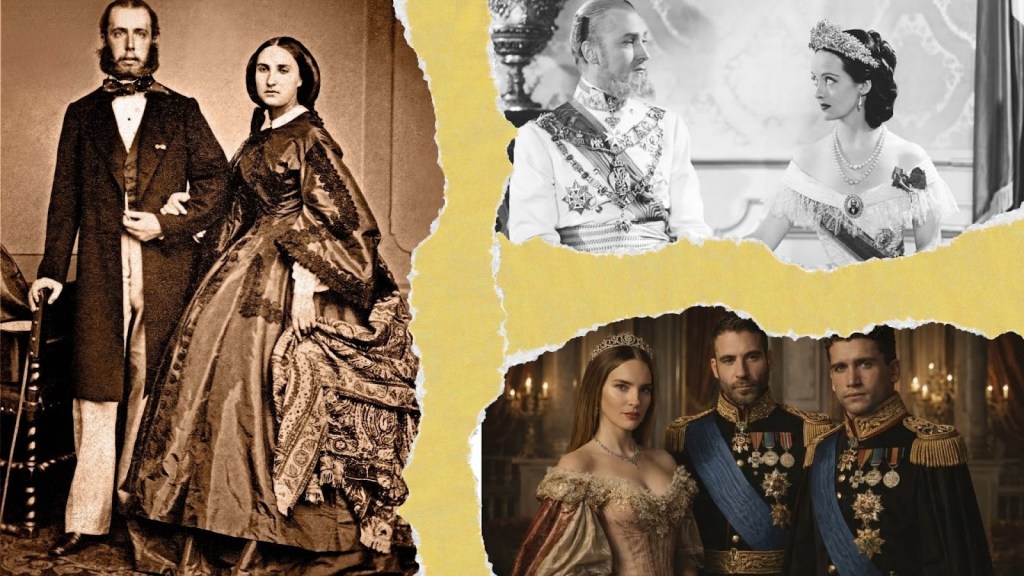
Eighty-seven years ago, two major motion pictures came out dramatizing the events of the Second Mexican Empire told through the point of view of the imperial couple: Maximilien and Charlotte (later Carlota), “Juarez” and “The Mad Empress.”They depicted the implementation of this european imperial couple as the head of states of Mexico, before being defeated by the Mexican forces lead by the president Benito Juarez in about three years. Since then, no other high budget dramatization of the second Mexican empire has hit the mainstream – but it’s looking like it might happen again in 2027.
Sony Pictures Entertainment has announced their most ambitious latin american series “Carlota,” which will cover the events of the empire from Charlotte’s point of view. It is set to release in 2027. Meanwhile, Big Love’s showrunners, Mark V. Olsen and Will Scheffer, are at the helm of an American production of an adaptation of the Fernando del Paso novel: Noticias del Imperio. This adaptation started development in 2021 and covers that part of Mexican history through Maximilian and Carlota’s letter. Finally, the second season of the German Netflix show The Empress, covering the reign of Maximilian’s sister-in-law, Sisi, has hinted at the Mexican debacle in its second season, with Maximilian having been told the need for European control of the Americas and multiple close-ups on Mexico specifically. The third season is set to release in 2027 and might cover the couple’s Mexican debacle.
With three TV dramas in three different languages covering the events of their short reigns, 2027 could be a year of attention for the doomed imperial couple. At first glance, it seems odd there would be such an unexpected boom in adaptations, but the story of the second Mexican empire is a compelling tragedy.
The second Mexican empire lasted from 1864 to 1867. The conservative Mexican elite and the French authority conspired to install Archiduke Maximilien of Austria and his wife Princess Charlotte of Belgium as emperor and empress of Mexico. After being told they had been elected by the Mexican people, they made their way to the country, unaware that the democratically elected president of Mexico, Benito Juarez, was already preparing to overthrow them. The empire ended with the execution of Maximilien and the start of Charlotte’s sixty-year-long madness.
There is an interesting story there: the imperial couple fits into stereotypical archetypes. The quiet but intelligent and ambitious princess and the sensitive second born prince who always had to grow in his brother’s shadow. They are dismissed from their post as rulers of Lombardy–Venetia, because of the liberal reforms they were enacting., and then an empire is served to them on a silver platter: a place away from the rigidness of the Austrian court where they can finally make a positive difference, a place where they’re in charge and they can put in place their education and healthcare reform. A promising future awaits them, only for everything to crumble as soon as they arrive. They make enemies and lose their allies, but their ideals will not let them abandon the project. The empire falls and Charlotte is left alone; a mix of grief and stress makes her lose herself. the kind of broken fantasy that can make for a compelling show.
However, underneath the fantasy was a colonialist project that doesn’t get examined by other retellings of the events. Older retellings of this historical event tend to get sucked into the romantic tragedy of a fallen empire. “Juarez” And “The Mad Empress” definitely exude an air of solace for the fallen empire. The books retelling the events are called Maximilian and Carlotta: A Tale of Romance and Tragedy as well as The Crown of Mexico: Maximilian & His Empress Carlota. The characters in the latter were described by one Goodreads user as a “star-crossed couple from Europe’s best families.” We cannot forget colonialism cannot be separated from royalty.
From a historic point of view, Maximilian was in the wrong. He was a foreign ruler placed by a foreign entity to eradicate the republic that was fought for by the Mexican people. Benito Juarez was the rightfully elected ruler and he was native to the land. An Austrian duke had no right to rule Mexico. His execution was just and the fall of the empire was actually a good thing — not a tragedy and nor a fairytale. If you wanted to defend Maximilian and Charlotte you could easily do it. They were deceived and were explicitly told that they were wanted. They desired to rightfully rule the land.The initial deceit could paint them as victims of the situation. They were used by France and the conservative Mexican elite: they were pawns in a game and they suffered the consequences. Despite this, the spectre of colonialism still rules their legacy.
After going mad, Charlotte was entirely unable to deal with her inheritance. So, her wealth was given to her brother, King Leopold the second, the ruler of a relatively weak and poor European kingdom made Belgium’s wealth through the colonial conquest of Congo. One of the earliest uses of the term “crime against humanity” was used to describe the atrocities of his policies in Congo. The king would not have been able to colonize it without Charlotte’s money. The individual character of a royal cannot prevent their fundamental perpetuance of a harmful system.
If 2027 is to be Maximilian’s and Charlotte’s year in fiction, I hope the inherently violent nature of the empire’s colonial project will take center stage instead of relying on the glamour of a fallen empire.
 The Plant
Leave a comment