

Via The Guardian
Alaa Ettaouth
Staff Writer
“Si on regarde dans l’histoire, les meilleurs c’étaient les Noirs et les Arabes.”
Extracted from a 2011 interview, young Kylian Mbappé spoke those words, a reflection of his innocent vision of the global sensation that is football. This sentiment is often echoed by fans, especially children of the African and Arab diaspora in Western countries. It is not a secret that these communities occupy a significant place in the various leagues and clubs of this sport. Players like Ivorian Dider Drogba, fourth all-time African men’s top goalscorer in international football, and more recently Achraf Hakimi, named the best right-back of Paris Saint-Germain, and the recipient of the African Footballer of the Year title, are worldwide known icons and celebrated for their achievements.
But under this veil lies a deep misunderstanding of the struggles African players faced, and still face, in their quest for ascension. Today, sports critics are so comfortable mocking the national French team and choosing whether they’re “real French people” or Africans, depending on the final outcome of the match. It is undeniable that Western sports institutions hold immense prejudice against African players, deeply rooted in racism and past colonial relationships, which creates the perfect recipe for Eurocentric dynamics to continue thriving in the beautiful game.
According to EBSCO, “Eurocentrism” is a term used to describe an excessive focus on the cultural contributions and achievements of European societies, often at the expense of recognizing the richness of other cultures, as well as their involvement in advancing society. In football, it refers to the historical, economic, and cultural dominance of European football. It often starts with a superiority narrative from Western countries, which is legitimized by the application of controlling politics and restrictions, stemming from the core of the establishment of the Football International Federation Association (FIFA).
FIFA was created in 1904 in Zurich, Switzerland, to administer football competitions between eight founding countries: Belgium, Denmark, France, Germany, the Netherlands, Spain, Sweden, and Switzerland, which are also historically colonial powers (except for Switzerland). Those countries had a monopoly on organized competitions for years, all while establishing a damaging narrative. This injust system flourishes at the expense of the growing need for space allocated to African, Asian, and South American countries to play: it was only in 1970 that African countries were allocated its first World Cup spots.
Today, this is still a persistent problem: in the upcoming 2026 World Cup, 10 spots were alloted among the 53 eligible African countries, while Europe had 16 for 54 countries. It might not seem like a significant difference, but it’s a different story when one party comes with a historical advantage!
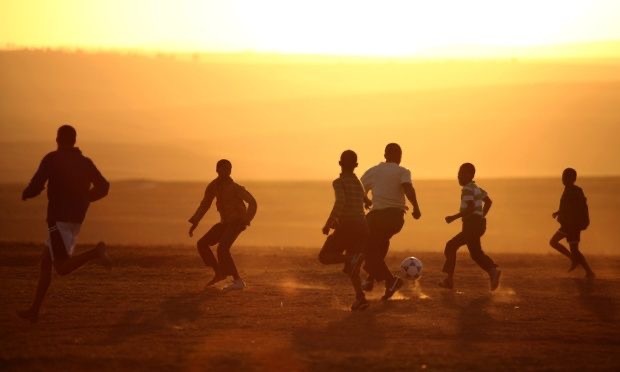
Surpisingly, football was initially a colonial tool to keep Indigenous populations distracted while their colonizers extracted all their resources and attempted to “civilize” them. Football was brought to Africa in the late 19th century, with the first recorded game played in 1862 in South Africa. In 1882, one of the first African clubs, the Savages FC, was founded in the same country, quickly followed by Egypt with Gezira SC. The sport rapidly spread throughout the continent via missionaries, railways, and the military.
” What was meant to control those communities was quickly reclaimed by Africans from across the continent, both as a means of resistance and to fight for their independence.”
North African countries like Algeria and Morocco, which was under French and Spanish protectorate until independence in 1956, began to orchestrate gatherings during matches, the only way for them to express their vocal opposition to the French occupation through chants and slogans.
Unfortunately, marginalized communities so violently internalized these dynamics that a reconstruction of these past colonial relationships can be observed even between African countries. When a political entity decides which countries are more deserving of attention than others, it stains the social order of the continent. One of the most blatant instances of this phenomenon occured less than a month ago, in the 2026 African Cup of Nations held in Morocco. All over the internet, anti-Blackness discourse was targeting countries deemed as “inferior,” in terms of infrastructure or economical power, reiterating colonialist views that for centuries have portrayed Africans as a subservient population.
The chaotic finale between Morocco and Senegal – resulting in Senegalese players receiving racist comments and Moroccan players being accused of cheating, put the spotlight on these tensions, emphasizing the profound conflict between North Africa and the rest of the continent. It parallels the past colonizer-colonized relations that gave value to each group: Western countries can’t fathom that each country has its strengths. A group inevitably has to dominate, just as colonial powers violently stripped the continent from their freedom. As a continent, we can choose to reject these harmful narratives and instead celebrate how rich and diverse Africa really is.


Leave a comment